You Don't Know What Your Record Says Until You Pull It Yourself
A conditional job offer gets rescinded. A lease application comes back denied. A licensing board flags a charge you thought was dismissed ten years ago. In every case, someone else found something on your record before you did — and by the time you heard about it, the decision was already made.
The problem isn't what happened. The problem is that you've never seen your own record the way decision-makers see it. An arrest that was dismissed in county court can still show as "pending" on a state rap sheet because the clerk never transmitted the final disposition. A case sealed under your state's Clean Slate law can still appear on a commercial background screener's database because the screener scraped the docket before the sealing order took effect. A sibling's arrest — same last name, similar date of birth — can end up attributed to you in a name-based tenant screening report.
None of this is visible until you pull the records yourself.
The Record Self-Audit System
This toolkit gives you a complete system for requesting, reading, and auditing every layer of your criminal history — so you know exactly what employers, landlords, and licensing boards will see before you hand them permission to look.
It covers all three record tiers: your FBI Identity History Summary (the nationwide fingerprint-based record), your state criminal history repository (the rap sheet maintained by your state's law enforcement agency), and your county court dispositions (the ground-truth case files). Most people don't realize these are separate systems run by separate branches of government, each with its own errors, its own update cycles, and its own correction process.
The toolkit sequences every step — which records to request first, which forms to use, where to get fingerprinted, how to read the abbreviation codes on a rap sheet, and how to file corrections when something is wrong. It also draws a clear line between the work you can do yourself and the moments where a licensed attorney must take over.
What's Inside
- FBI Identity History Summary walkthrough — the complete submission process for Form 1-783, fingerprint cards (FD-258), and credit card authorization (Form 1-786), including how to choose between direct mail to Clarksburg and FBI-approved channelers that return results in 24–48 hours
- State repository request maps — how to request your own rap sheet from major state criminal history databases (California DOJ, Texas DPS, New York DCJS, Illinois ISP, Florida FDLE, and more), with current fee schedules, fingerprinting requirements, and turnaround estimates
- Court disposition retrieval — how to obtain certified Certificates of Disposition from county clerk offices, including procedures for archived cases, sealed dockets, and courts that have migrated to electronic filing
- Rap sheet abbreviation decoder — a plain-language translation guide for the codes that make official records unreadable to most people: nolle prosequi, ACD, SID, NYSID, PCN, and dozens of jurisdiction-specific abbreviations
- FCRA dispute checklists — step-by-step templates for challenging inaccurate entries on commercial screening reports under Section 611, including the 30-to-45-day investigation timeline and what to do if the agency refuses to correct proven errors
- Clean Slate verification procedures — how to confirm whether your record was actually sealed under your state's automatic record-clearing law, since database update delays and implementation backlogs mean "eligible" and "sealed" are not the same thing
- Escalation thresholds — the specific scenarios where self-advocacy must stop: active warrants, non-citizen immigration exposure, open prosecutions, unresolved commercial disputes past 45 days, and professional licensing board denials with statutory appeal deadlines
- Five printable planning tools — a Jurisdiction Mapping Worksheet, Record Request Tracking Log, Record Comparison Worksheet, Error Dispute Tracker, and Agency Communication Log, designed to be printed and filled in as you work through the process
Who This Is For
- Job seekers preparing for a background check — you want to see what an employer's screening company will find before you authorize the search, so a stale or misattributed entry doesn't cost you the offer
- Renters facing tenant screening — you're tired of paying non-refundable application fees and getting denied based on records you've never seen, with no explanation of what triggered the rejection
- Licensing candidates — you're applying for a state-regulated credential (nursing, real estate, contracting, insurance, elder care) that requires a fingerprint-based background clearance, and you need to know what the board will see
- Expatriates and visa applicants — you need an FBI background check with apostille for a foreign immigration filing, retirement visa, or international adoption, and you need to understand the authentication chain
- Clean Slate verification seekers — your state passed an automatic record-sealing law and you need to confirm that your eligible cases actually disappeared from the databases, not just the statute books
Why the Free Government Forms Aren't Enough
State and federal agencies publish the raw request forms online. You can download an FD-258 fingerprint card from the FBI's website right now. So why does anyone need a toolkit?
Because the forms don't come with instructions that actually work. The FBI's own guidance assumes you already know where to get fingerprinted, which fields on the card you fill in and which the operator fills in, and what to do when the response letter arrives with abbreviation codes you can't decipher. A single smudged print or mismatched middle initial means a rejected submission — and you forfeit your processing fees and restart a multi-week wait from scratch.
State repositories are worse. Every state has its own request process, its own forms, its own fee structure, and its own rules about who can see what. Some states let you request records online. Others require a notarized identity verification mailed to a specific division. Some return results in days; others take six to eight weeks. None of them explain how to read the document they send back, how to identify a missing disposition that makes a dismissed case look open, or how to file a correction when the record is wrong.
Commercial background screeners — the companies that employers and landlords actually hire — add another layer of confusion. These agencies are regulated under the Fair Credit Reporting Act, which gives you specific dispute rights, but the dispute process has strict timelines and procedural requirements that most people don't know exist until the window has already closed.
This toolkit puts the entire process in order: what to request, from which agency, in which sequence, and exactly what to do when something comes back wrong.
Your Records, On Your Terms
Every background check is built on records you have the legal right to see. The question is whether you see them first — on your schedule, with time to identify errors and file corrections — or whether you find out what they say from a rejection letter.
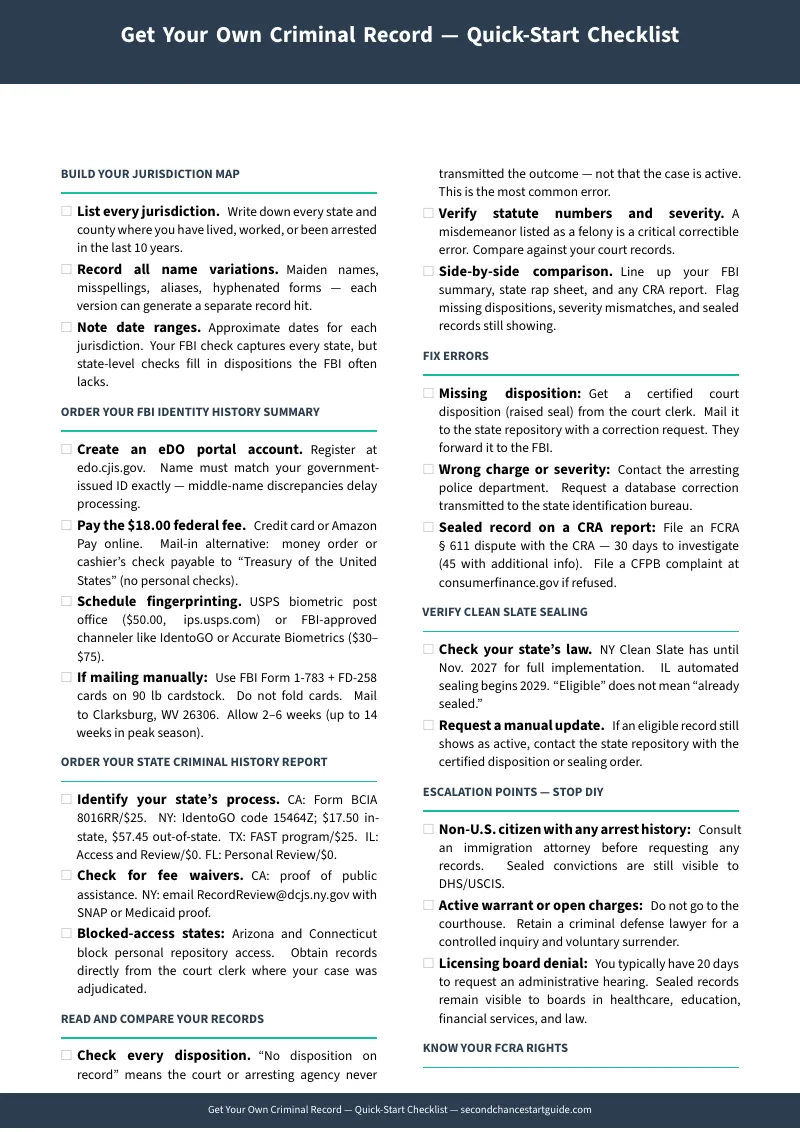
The free checklist gives you the starting sequence: which agencies to contact, in what order, and what to have ready. The full toolkit adds the detailed walkthroughs, the rap sheet decoder, the FCRA dispute templates, the state-by-state repository maps, and the escalation framework for knowing when to bring in a professional.
Get the Record Self-Audit Toolkit →
For , you get the complete system for pulling, reading, and correcting your criminal history records — across every database that matters.