The forms are free. The strategy isn't.
Every state governor's office and the Department of Justice will hand you a blank clemency application at no charge. What they won't give you is a framework for filling it out — how to write a rehabilitation narrative that pardon boards actually find persuasive, which character references strengthen your case versus which ones undermine it, or how to avoid the procedural mistakes that get applications rejected before anyone reads them.
That's the gap this guide fills. We call it the Clemency Application Framework — a structured, plain-language system that walks you from eligibility confirmation through final submission, whether you're petitioning a state governor, a state pardon board, or the federal Office of the Pardon Attorney.
Why this exists
The clemency process in the United States is fragmented across 50 different state systems and a separate federal track, each with its own eligibility rules, waiting periods, application forms, and procedural requirements. The information exists online — scattered across dense government portals, law firm blogs locked behind intake forms, and advocacy sites that run hundreds of pages without a clear action plan.
People end up spending weeks pulling together fragments from a dozen sources, only to discover they missed a waiting-period rule, submitted the wrong supporting documents, or wrote a rehabilitation narrative that focused on the wrong things.
This guide compresses that scattered landscape into a single, organized framework. Every chapter maps directly to a step in the application process, in the order you need to complete it.
What's inside
- Eligibility self-assessment — a structured diagnostic that walks you through waiting periods, sentence-completion requirements, and categorical exclusions before you invest months preparing an application that can't succeed yet
- Record retrieval roadmap — step-by-step instructions for pulling your official criminal history from state repositories, the FBI, and court dockets, including what to do when records across agencies don't match
- Rehabilitation narrative framework — the specific structure, evidence types, and rhetorical approach that pardon boards and the Office of the Pardon Attorney look for, with clear guidance on what to emphasize and what to leave out
- Character reference letter guide — who to ask, what each letter must cover, the structural outline that keeps writers focused on rehabilitation rather than relitigating the original case, and the common mistakes that weaken otherwise strong letters
- Federal clemency deep dive — a dedicated chapter on the presidential pardon process through the DOJ, covering the five-year post-sentence waiting period, the extensive application requirements, realistic timelines, and the investigation process
- State process maps — the three structural models (sole gubernatorial authority, board recommendation, board authority), how each one works procedurally, and what it means for your application strategy
- Rights restoration breakdown — which civil rights return automatically upon sentence completion, which require a pardon, and how firearm rights, voting, professional licensing, and international travel work differently across jurisdictions
- Post-decision action plan — what to do after a pardon is granted (notifying licensing boards, disputing background check records, understanding restored rights) and after a denial (re-application timelines, supplemental evidence, alternative paths)
Printable worksheets and tools included
- Personal timeline builder — fillable worksheet to construct the chronological backbone of your rehabilitation narrative
- Character reference tracker — track who you've asked for letters, what you've received, and what's still pending
- Character reference letter outline — a one-page handout for your letter writers so they know exactly what to include and what to avoid
- Application cost calculator — estimate your total out-of-pocket costs before you file
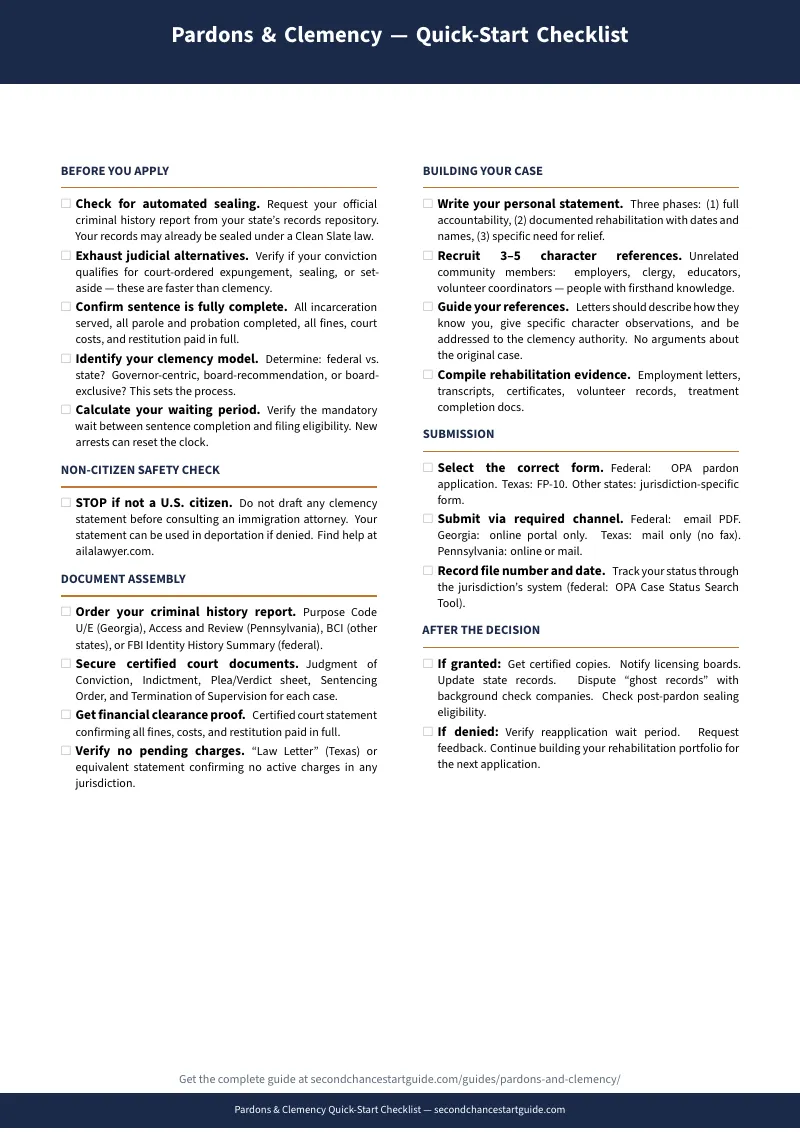
- Document assembly checklist — a printable checklist of every document your application package may require
- Communication scripts — word-for-word scripts for calling court clerks, licensing boards, and clemency offices
- State pardon directory — quick-reference table of waiting periods, authority models, and filing contacts
Who this is for
- People applying for executive clemency who have completed their sentence and want a structured framework to assemble a credible application without paying thousands in attorney retainer fees
- People excluded from Clean Slate automation whose offense grade, conviction date, or supervision history falls outside their state's automatic sealing system — and who need to understand the manual petition or clemency route
- People seeking to restore specific rights — professional licensing eligibility, firearm rights, or the ability to serve on a jury — where executive clemency is the required pathway
- People preparing a federal petition through the DOJ Office of the Pardon Attorney, who need a system for organizing ten years of residences, complete employment histories, financial disclosures, and notarized character affidavits
Why not just use the free government forms?
You should use the free government forms — they're the official documents you'll submit. The problem isn't the forms themselves. It's what the forms don't tell you.
Government portals provide instructions written in dense legal language, without explaining the practical strategy behind each section. They don't tell you that a rehabilitation narrative structured around community impact is more persuasive than one focused on personal hardship. They don't warn you that character letters from family members carry less weight than letters from employers, clergy, or community leaders who've observed your rehabilitation firsthand. They don't explain which filing mistakes get applications returned without review.
Law firms will explain all of this — for retainer fees that typically start between and several thousand dollars. This guide gives you the same procedural framework and application strategy at a fraction of that cost, so you can decide for yourself whether your situation requires legal representation or whether you can prepare a strong application independently.
What this guide does not do
This is process navigation, not legal advice. A pardon is a discretionary act by an elected official or appointed board — no guide, lawyer, or service can guarantee an outcome. What this guide does is help you understand the process, meet the procedural requirements, and present the strongest possible case within the established framework.
It does not promise to "erase your record" or "clean your slate." In most jurisdictions, a pardon leaves the conviction visible on background checks with a pardoned notation. The guide explains exactly what a pardon does and doesn't do — so you go in with realistic expectations and a clear plan.
Satisfaction guarantee
Read the guide. Work through the eligibility assessment. If the framework doesn't give you a clear, actionable path through the clemency process, reach out and we'll refund your purchase — no justification needed.
Start with the free checklist to see whether clemency is the right path for your situation, or get the full guide to work through the complete application framework.