Your license is suspended. The DMV won't tell you which agencies put the holds there — or what order to clear them in.
You pulled your driving record and it says "suspended." You assumed paying the ticket would fix it. It didn't. Or you finished the DUI program and expected your license to come back automatically. It didn't. Or you just received a letter from the LCSA about child support, and now the license you need to get to the job that makes the payments is about to be taken away.
California's license suspension system is not one system. It is at least three — the DMV, the county superior courts, and the Local Child Support Agencies — and none of them tell you what the others require. File your SR-22 before the court has transmitted an FTA clearance, and you start paying tripled insurance premiums on a license the DMV still cannot release. Pay the DMV's reissue fee before the LCSA has lifted a child support hold, and your money processes but your status does not change. Install an IID before confirming you don't qualify for an exemption, and you lease hardware you may not need.
Meanwhile, knowingly driving with a suspended license can lead to criminal charges under CVC §§ 14601–14601.5. A first conviction under § 14601.1 carries up to six months in county jail and a $300–$1,000 fine.
The Agency Clearing Sequence — a step-by-step reinstatement map built around the order that actually matters
The California Driver's License Reinstatement Guide is not a summary of what the DMV website already says. It is a process navigator built around one insight that free resources consistently miss: the order you complete the steps determines whether you waste money. Every hold type is mapped to its clearing agency, every clearing agency's requirements are laid out with exact forms and fees, and the five-step reinstatement sequence is organized so you never pay for something before the prerequisite step is done.
What's inside the guide
Hold Diagnosis and Record Audit — because "suspended" tells you nothing about why. The guide walks you through pulling your official driver record, decoding every suspension notation on it (CVC 40508 for court-level FTA holds, Family Code 17520 for child support, APS for administrative DUI actions, FR for financial responsibility), and mapping each active hold to the specific agency that can clear it. You build a complete hold inventory before spending a dollar.
Court Hold Clearance — FTA and Outstanding Citations — because the DMV cannot lift a hold the court put there. If your record shows a Failure to Appear under CVC § 40508, you must resolve it with the specific county court — not at a DMV field office. The guide covers the MyCitations portal, the Judicial Council Form TR-320 for ability-to-pay reductions (available even after a case goes to collections), and the AB 2746 transition: starting January 1, 2023, courts could no longer report FTAs to DMV under CVC §§ 40509 and 40509.5, but still report § 40508 violations; starting January 1, 2027, the DMV must terminate any remaining suspensions it issued under the repealed provisions.
DUI Dual-Track Navigation — because the criminal case and the administrative suspension are handled by different agencies, and winning one does not resolve the other. The guide separates the Admin Per Se (APS) track from the court conviction track, explains the 10-day hearing request deadline, lays out both restricted driving options (IID-restricted license versus work-and-program restriction for eligible first offenders), and maps the DUI program enrollment, SR-22 filing, and reissue fee requirements for each track.
IID Requirements and Cost Reduction — because commercial vendors bury the fees that actually matter. Intoxalock, Smart Start, and BACtrack Drive advertise low daily lease rates while obscuring monthly calibration charges, lockout fees, and vehicle transfer costs that add hundreds over a standard restriction term. The guide provides the state-mandated low-income sliding scale — from a 90% discount for households at or below the Federal Poverty Level to a 10% discount at 301–400% FPL — and walks you through confirming your installer applies the discount. It also covers the IID exemption process for drivers who meet all three vehicle-access conditions on Form DL 4062.
Child Support Hold Resolution — because the DMV cannot lift this hold until the LCSA sends an electronic release. The guide explains how to contact your caseworker, negotiate an installment agreement, verify whether your household income qualifies for the SB 1055 low-income exemption (at or below 70% of your county's Area Median Income), and pay the separate $15 DMV release fee after the LCSA transmits the clearance. Over 149,000 suspended licenses were proactively released when SB 1055 took effect — but if your income exceeds the threshold, you need this process.
The FAST Program — because if you were cited for driving over 100 mph, the DMV can suspend your license before your court date. The Forwarded Actions for Speeding Tickets pilot program triggers an administrative review by the DMV's Driver Safety Branch independently of the court case. The guide explains what a FAST order means, the hearing request process, and how the administrative and criminal timelines interact.
Negligent Operator Hearings — because paying your ticket does not clear a NOTS suspension. If you have accumulated 4 points in 12 months, 6 in 24, or 8 in 36, you face a one-year probation including a six-month suspension. The guide covers the hearing request deadline (10 days from service or 14 days from mail date), how to present mitigating circumstances, and how to petition for an employment-restricted license.
SR-22 Filing and SB 1107's New Minimums — because filing too early wastes money, and filing with the wrong limits gets rejected. Under SB 1107, any SR-22 policy issued or renewed on or after January 1, 2025 must meet the doubled minimum liability limits of 30/60/15 ($30,000/$60,000/$15,000). The guide explains when to file (not before all other holds are cleared), the three-year maintenance requirement, and what happens if your policy lapses.
The Complete Reinstatement Fee Schedule — because every cause has a different fee. The guide lists every DMV fee by suspension type: $55 standard reissue, $125 Admin Per Se (age 21+), $100 Zero Tolerance APS (under 21), $15 child support release, $55 plus $250 penalty for financial responsibility. Plus a fee calculator worksheet so you know the total before contacting the DMV.
The Safe Order of Operations — the core of the guide. Five steps, in sequence: record pull, source-agency clearing, verification check, financial responsibility and hardware, DMV final fees. Skip a step or do them out of order, and you pay for insurance, hardware, or reissue fees attached to a license the DMV cannot yet release.
Plus: Worksheets and Planning Tools — a hold inventory worksheet, reinstatement progress tracker, fee calculator, agency communication log, and DUI restriction comparison worksheet.
Who this is for
- Commuters whose job depends on driving — your license was suspended and ride-sharing costs are destroying your budget. You need the fastest legal path back to driving, and the guide maps which restricted driving options apply to your specific suspension type.
- Drivers who paid the ticket but are still suspended — you cleared the fine with the court, but the DMV still shows "suspended." The guide explains why these are separate systems and what to do about the gap between court clearance and DMV release.
- Parents facing a child support license hold — you cannot afford to lose the license that gets you to the job that makes the payments. The guide walks through the LCSA negotiation, the SB 1055 income verification, and the release timeline.
- DUI offenders navigating two parallel systems — the criminal case and the administrative suspension are separate processes with separate deadlines. The guide separates both tracks and identifies where the IID cost reductions apply.
- Drivers with holds from multiple agencies or another state — one court hold, one LCSA hold, one insurance lapse, and maybe an out-of-state block. The guide maps every hold to its clearing path and gives you the sequence that prevents wasted fees.
Why not just use free resources?
The rules exist in public. The sequence does not.
- The DMV website lists reinstatement fees and links to forms. It does not explain how to coordinate a court-level FTA clearance with an administrative APS suspension, does not warn you that paying a reissue fee before all source-agency holds are cleared wastes money, and does not cover the LCSA child support negotiation process.
- DUI law firm websites are built to convert you into a client at $300–$500 per hour. They cover the criminal defense side because that is what they bill for, but rarely explain the separate administrative steps you must complete with the DMV. And they will not mention the state-mandated IID sliding scale.
- IID vendor sites push immediate installation while burying calibration, lockout, and transfer fees. They do not mention the IID exemption or the income-based cost reductions they are legally required to apply.
- SR-22 brokers position the SR-22 as the one step to restore your license. It is not — and filing before the other requirements are met can mean paying high-risk premiums while the DMV cannot yet reinstate your license.
The guide costs a fraction of one wrong step in the reinstatement process. One premature SR-22 filing costs more in wasted premiums than the entire guide.
Satisfaction guarantee
If the guide does not deliver what it promises, email [email protected] for a full refund, no time limit.
Start clearing your holds today
The guide costs — one payment, instant download, no subscription. It covers every hold type, every clearing agency, every fee, and the exact sequence that prevents you from paying for something before the prerequisite step is done.
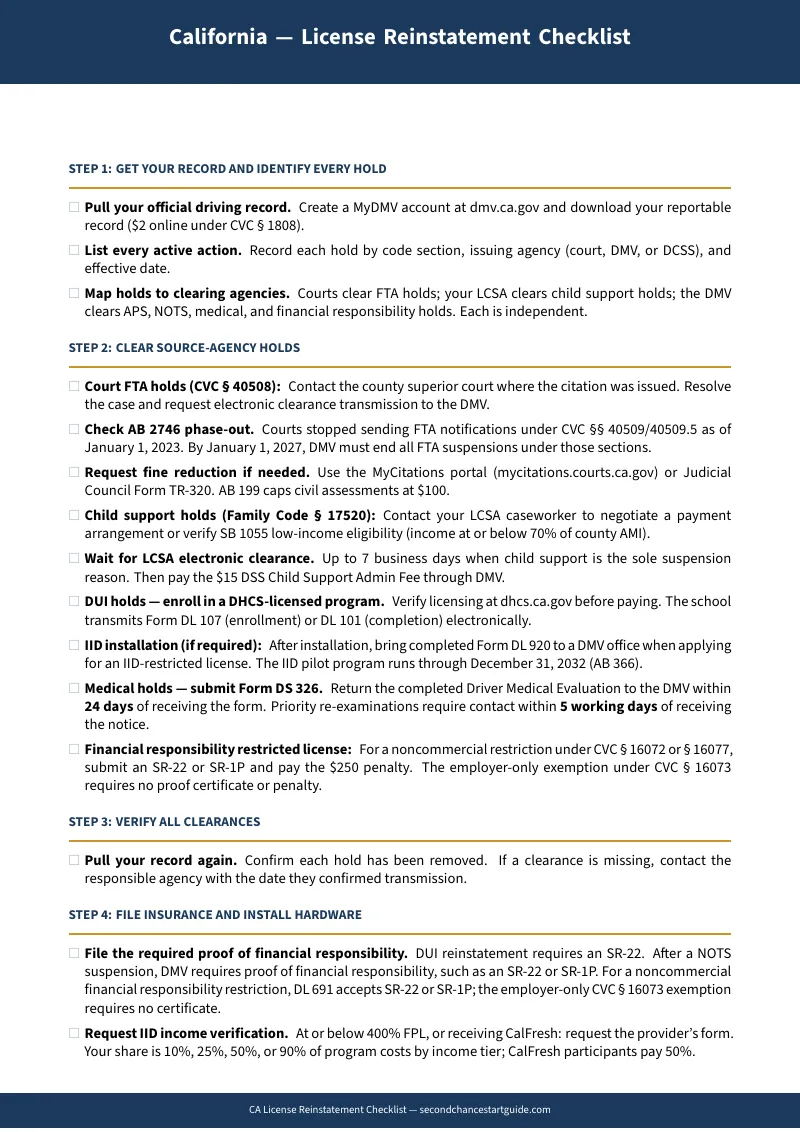
Not ready for the full guide? Download the free California License Reinstatement Checklist — a two-page diagnostic covering hold identification, suspension code decoding, and the clearing sequence. Enough to start organizing your record tonight.
Frequently Asked Questions
What if the rules change after I buy?
We update the guide when the rules change. Email us any time, even years later, and we'll send you the current edition free.