Your Record Should Be Cleared. The State's Automation Doesn't Finish the Job.
Connecticut's Clean Slate Act automated record erasure for hundreds of thousands of people. The state cleared its backlog in mid-2026, and rolling erasures now run continuously. If your offense qualifies, the state may have already erased it from Judicial Branch and State Police databases — without you filing anything.
But here is the problem nobody talks about: the state's automated system only touches state databases. The commercial background screening companies that employers and landlords actually use — HireRight, Checkr, Sterling, TransUnion — maintain their own records. A misdemeanor conviction erased by the state two months ago can still appear on the screening report that determines whether you get the apartment or the job offer. And the state has no mechanism to force those private companies to update.
That gap between what the state has done and what the rest of the world sees is where people lose job offers, housing applications, and professional licenses — not because they are ineligible for relief, but because they do not know the erasure only went halfway.
The Record Relief Roadmap: Every Connecticut Pathway in One Place
The Connecticut Expungement & Record Sealing Guide is not a summary of the Clean Slate law. It is a diagnostic framework — the Record Relief Roadmap — that maps every charge on your record to the specific pathway that clears it, then walks you through the forms, courts, waiting periods, and dispute process for each one. Clean Slate handles the eligible offenses automatically. The Roadmap handles everything Clean Slate cannot reach: pre-2000 records, excluded offense categories, pardon applications, Certificates of Employability, commercial database disputes, and the employment protections that apply once erasure is confirmed.
Most people searching for "Connecticut expungement" do not realize that the state calls it "erasure," that Clean Slate covers only a subset of offenses, or that automated erasure does not extend to commercial databases. The Roadmap resolves each of these confusion points in the first chapter and then builds a personalized action plan based on what is actually on your record.
What's Inside
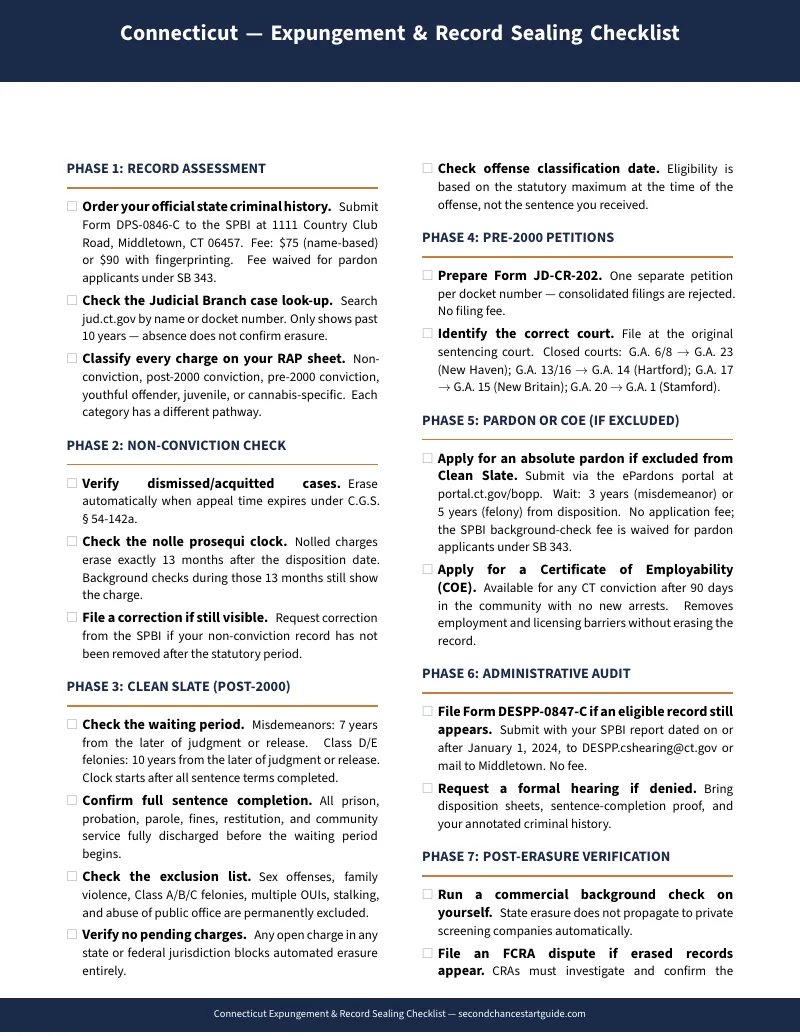
- Clean Slate Eligibility Diagnostic — a structured walkthrough that maps each charge on your record against the automated erasure criteria: offense date (pre-2000 vs. post-2000), offense class, exclusion categories (sex offenses, family violence, certain firearms charges, multiple DUIs), waiting period calculations, and the continuous crime-free rule. You know exactly which charges are covered and which are not before you do anything else.
- Petition-Based Erasure for Pre-2000 Records — step-by-step instructions for filing Form JD-CR-202 with the correct court, including how to document sentence-completion dates for older records where paperwork may be difficult to locate.
- Non-Conviction Erasure Guide — the separate pathway for dismissed charges, nolles, and acquittals, including the 13-month nolle trigger, the immediate-erasure right for acquittals, and what to do when non-conviction records persist in commercial databases.
- Board of Pardons and Paroles Application Walkthrough — covering the absolute pardon process (which leads to erasure) versus the certificate of rehabilitation (which does not), the personal statement, the hearing, and realistic timelines for the full cycle.
- Certificate of Employability Strategy — when a COE provides stronger practical protection than waiting for full erasure, how to apply, which licensing boards must consider it, and how to use it as a bridge while pursuing other relief pathways.
- Cannabis-Specific Erasure — the retroactive provisions under Connecticut's cannabis legalization, which offenses qualify, and the differences between the cannabis pathway and standard Clean Slate erasure.
- Background Check Dispute Templates — ready-to-send dispute letters for commercial screening companies, with instructions on the FCRA 30-day investigation window, escalation to the Consumer Financial Protection Bureau, and Connecticut-specific employment protections that apply when a company reports erased records.
- DESPP Administrative Hearing Guide — the process for challenging the state when its own automation has failed to erase a qualifying record from state databases, including what evidence to bring and the remedies available.
- Employment, Housing, and Licensing Protections Reference — the legal scope of the right to deny, fair-chance hiring provisions, anti-discrimination protections for erased records, and the narrow exceptions where certain employers or licensing boards retain access.
Who This Guide Was Built For
You just signed a background check consent form, and you are not sure what will show up. A conditional job offer is on the line. You think your record should have been erased under Clean Slate, but you have no way to confirm it — and you know the screening company's database might not match the state's. You need to verify your erasure status and, if needed, dispute the screening report before the offer deadline.
You were denied an apartment and the rejection letter does not explain why. Automated tenant-screening algorithms pull from commercial databases. A dismissed case from years ago — one that should have been erased — can trigger an automatic denial without the property manager ever reviewing the details. You need to get the screening report, identify the offending record, and force the screening company to update.
You have a licensing board review coming up and an old conviction on your record. Healthcare, education, insurance, real estate, commercial driving — Connecticut licensing boards run their own checks. You need to know whether your conviction can be erased before the review, whether a Certificate of Employability would help, and whether the board can even access erased records. The guide covers each of these questions with the specific legal framework that applies.
Your record is complicated and you do not know which pathway applies to which charge. Some charges are dismissed, some are convicted. Some are from 2018, some from 1997. Clean Slate might have automatically erased some while leaving others untouched. You need a diagnostic that maps each entry on your record to the right pathway — automated erasure, petition, pardon, or COE — so you are not guessing.
Why Not Just Use Free Resources?
The statutes are public. The forms are downloadable. What does not exist in any free resource is a single document that tells you which pathway applies to each charge on your record, in what order to pursue them, and what to do when state erasure does not reach the databases that actually matter.
The CT Clean Slate Portal confirms that automated erasure is operational and lists eligibility criteria — but it does not provide a diagnostic for determining whether your specific charges qualify, does not address commercial background check databases, and offers no guidance for records that fall outside the automation's scope.
Legal aid organizations provide reliable legal analysis and direct assistance — but services are income-restricted, and the guides are conceptual rather than step-by-step. If you earn too much for legal aid but cannot afford a private attorney, there is no coverage.
Private defense attorneys charge $1,500 to $5,000 for representation. Their blog posts are designed to capture leads, not to walk you through the administrative steps you can handle yourself. Many posts still reference Clean Slate as upcoming rather than operational.
Document preparation services charge $300 to $900 and typically focus on pardon applications — they do not cover the full range of relief pathways, and they do not address background check disputes.
The guide costs a fraction of any of these — and covers every pathway, every form, every dispute template, and the background check gap that none of them address.
Trust Signals
Current as of 2026. This guide reflects the operational status of Clean Slate following the state's mid-2026 backlog clearance, not the 2023 or 2024 "coming soon" language that still dominates most online resources.
Process navigation, not legal advice. This guide maps the administrative steps, forms, and dispute procedures you can handle independently. It also identifies the specific situations — contested hearings, immigration consequences, complex multi-jurisdiction records — where professional counsel is genuinely necessary rather than just conventionally recommended.
Instant download. No subscription. No recurring charges. One purchase, eight PDFs — the full guide, the eligibility checklist, fillable planning worksheets, dispute letter templates, and tracking logs — and lifetime access to the version you purchase.
The Cost of Getting It Wrong
Assume your record was erased when it was not, and the screening company reports a conviction you said did not exist — now the employer is questioning your honesty, not your record. File a petition in the wrong court and you are starting over. Apply for a pardon without understanding that only an absolute pardon leads to erasure, and you spend months pursuing a certificate of rehabilitation that leaves the conviction on your record. Fail to dispute a commercial screening report within the FCRA's 30-day window and the inaccurate data stays in circulation.
Private attorneys charge $1,500 to $5,000. Document preparation services charge $300 to $900 for pardon applications alone. One wrong assumption can cost you a job offer, a housing application, or a professional license — and the timeline to correct the mistake is measured in months, not days.
The guide costs — once. It covers every pathway, every form, every waiting period, and the background check dispute process that closes the gap between state erasure and what the rest of the world sees.
Not ready for the full guide? Download the free Connecticut Expungement Eligibility Checklist — a two-page diagnostic covering Clean Slate eligibility criteria, petition requirements, and waiting period calculations. It is enough to determine which pathway applies to your situation.
Your record is either already cleared or it qualifies for relief. The guide tells you which, maps the next step, and shows you how to make sure the clearance actually reaches every database that matters.