
Your D.C. Record Is Still Visible — and Waiting for the "Automatic Clean Slate" Could Cost You Years
You heard the District passed a clean slate law. You may have assumed your old case is already shielded. It is not. The Second Chance Amendment Act of 2022 mandated automatic sealing for qualifying records, but the D.C. Council clarified that the automated system is not yet operational — D.C. Superior Court has until October 1, 2027, to build it. Meanwhile, a federal bill to repeal the entire Act has advanced in committee. Every month you wait is another month your dismissed charge, completed misdemeanor, or old arrest appears on every commercial background check a landlord, employer, or licensing board runs.
The by-motion pathway — the part of the law that is active right now, since March 1, 2025 — lets you file a petition in D.C. Superior Court asking a judge to seal or expunge eligible records today. There is no filing fee. But the process is not intuitive. You need a specific Criminal Arrest History report from MPD that costs $7 and is different from a standard police clearance. You need to list every unsealed arrest on your motion — miss one, and the court dismisses the entire petition. You need to draft an "interests of justice" statement persuasive enough to survive a potential objection from the U.S. Attorney's Office. And after the judge signs the order, you still need to chase private background check databases yourself or your sealed record keeps surfacing for months.
No single official resource explains this full sequence. The D.C. Courts website provides blank motion forms with no explanatory guidance. The Public Defender Service's Reentry Navigator is a 900-page manual designed for attorneys. Legal Aid DC maintains strict income eligibility limits and substantial waitlists. Attorney websites describe just enough of the process to justify a $1,500 to $3,000 retainer for the same court-issued forms you can file yourself.
The D.C. Record-Clearing Filing System
This guide is a complete filing system built for people handling the D.C. expungement and sealing process on their own. It follows the exact sequence you will execute — from determining eligibility under the current March 2025 rules through clearing private background check databases after the court enters your order. Instead of stitching together fragments from MPD, the courts, legal aid waitlists, and attorney blogs, it consolidates every step, form, deadline, and agency interaction into a single reference that follows your case from records request to database cleanup.
What's Inside
- The eligibility decision framework — maps your specific case outcome (dismissal, no-paper, acquittal, diversion completion, misdemeanor conviction, felony conviction, decriminalized conduct) to the exact D.C. Code pathway, waiting period, and filing requirements under the March 2025 rules, including the 17 categories of offenses excluded from standard sealing
- The two-step record retrieval protocol — exactly how to obtain the Criminal Arrest History for Determining Record Sealing Eligibility from MPD Room 1075 (300 Indiana Ave NW, $7 fee) and pull your complete court docket from the public terminals in D.C. Superior Court Room 4001 — and why the standard PD70 police clearance is not sufficient
- The complete by-motion filing framework — how to prepare and file a motion to seal under D.C. Code § 16-806 or a motion for expungement under § 16-802/§ 16-803, including the mandatory full-record disclosure requirement, the Certificate of Service for the U.S. Attorney's Office, and the difference between in-person and attorney e-filing at D.C. Superior Court
- The "interests of justice" statement structure — how to draft the supporting narrative that judges evaluate when deciding your motion, covering employment history, community involvement, rehabilitation evidence, and the factors courts weigh against prosecution objections
- The 180-day decision timeline — what happens after you file, how the U.S. Attorney's Office or Office of the Attorney General responds, what triggers a hearing, and how to prepare if one is scheduled
- The 90-day compliance window — once the judge signs the order, relevant agencies (MPD, corrections, and others) have 90 days to seal their records. This section covers how to monitor compliance and what to do if an agency fails to act
- Post-order database enforcement plan — how to submit your sealing order to the Expungement Clearinghouse, file FCRA disputes against commercial background check companies that continue reporting sealed data, and verify that your record no longer appears on public court docket searches
- Security clearance, immigration, and licensing warnings — clear guidance on when a D.C. sealing order does and does not protect you: SF-86 disclosure requirements for federal background investigations, why non-citizens must obtain certified docket copies before filing, and which professional licensing boards retain independent authority to review sealed records
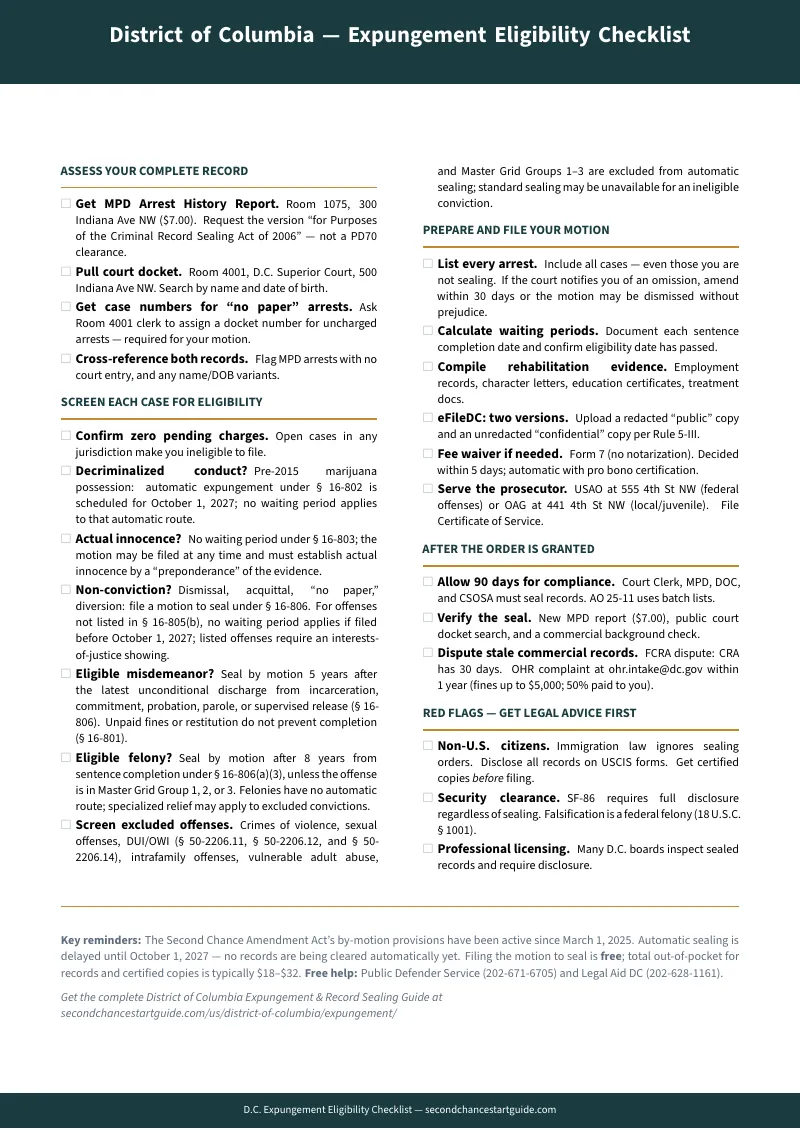
- 23-item filing checklist — included free as a standalone PDF, covering eligibility verification through post-order database enforcement in a printable, track-as-you-go format
Who This Is For
- Anyone in D.C. whose job offer, apartment application, or professional license is being held up by a background check — whether the case was dismissed, no-papered, or resolved through probation or diversion years ago
- Self-represented filers who want to handle the motion process without paying an attorney $1,500 to $3,000 to fill out the same court-issued forms
- People who completed diversion but discovered the arrest still shows on their record and need to understand the separate sealing motion required
- Anyone who assumed automatic sealing was already active and learned — from a failed background check — that it is not
- Family members helping a loved one navigate the process after sentence completion
Why the Free Resources Fall Short
The D.C. Superior Court website provides downloadable motion forms but no explanatory guidance — no eligibility assessment, no filing instructions, no explanation of the "interests of justice" standard the judge applies. The Public Defender Service's Reentry Navigator is the most thorough official resource in the District, but at over 900 pages it is designed for legal professionals, not for someone who needs to file a motion before a hiring deadline passes.
Legal Aid DC and Christian Legal Aid provide excellent representation, but they enforce income eligibility limits and maintain waitlists that can stretch for weeks. If you are facing a conditional job offer that requires an immediate background check, you cannot afford the intake timeline. National form-document websites charge $199 to $600 and use generic templates that completely ignore D.C.'s unique federal-local court structure, the March 2025 by-motion rules, and the difference between MPD and court records.
This guide fills the gap between free forms that assume you already understand the process and the attorney retainer that most people cannot justify for what is — in the vast majority of uncontested cases — a manageable self-representation filing.
Satisfaction Guarantee
If this guide does not give you a clear, actionable path to filing your motion to seal or expunge, email us and we will refund your purchase — no forms to fill out, no hoops.
Start Clearing Your Record
Download the free 23-item checklist to verify your eligibility and map out your filing steps. When you are ready for the full process — motion preparation, the "interests of justice" statement framework, post-order enforcement, and the security clearance and immigration warnings — get the full guide.