You Restricted Your State Record. The Court Files Are Still Wide Open.
Georgia's record restriction system limits access to qualifying records in the GBI's state criminal history database for non-criminal-justice purposes; it does not delete the record. For arrests on or after July 1, 2013, there is no application process; contact the prosecutor to have an eligible record restricted. If you completed First Offender probation, you were told your record was cleared. If you have an older arrest, you may have already submitted the paperwork and received confirmation that your state record is restricted.
None of that matters to the company running your background check. HireRight, Checkr, Sterling, and other commercial screening companies pull data from county clerk websites — the public court dockets that restriction does not touch. A restricted record in the GBI database can appear on the screening report your employer reads before making a hiring decision. This is not a glitch. Where a separate sealing step applies, restriction handles the state database and court sealing limits public access to the clerk's files. Private screeners may retain copies they already collected.
That gap between state restriction and actual background check invisibility is where people lose job offers, apartment applications, and professional licenses — for people whose pathway requires a separate sealing step they did not know about.
The Two-Step Record Clearing System: Restriction Plus Sealing in One Framework
The Georgia Expungement & Record Sealing Guide is not a summary of one pathway. It is a complete diagnostic framework — the Two-Step Record Clearing System — that maps every arrest and conviction on your record to its specific statutory route, explains when restriction, sealing, or both apply, and then covers the background check dispute work that addresses the gap between what the state has restricted and what private databases still report.
Most people searching for "Georgia expungement" do not realize that the state stopped using that term in 2013, that restriction alone leaves court records exposed where a separate sealing step applies, that pre-2013 and post-2013 arrests follow different processes, or that First Offender discharge did not automatically seal court files before HB 162 took effect on July 1, 2026. For sentences imposed on or after July 1, 2026, the court must order restriction and sealing at sentencing, and the clerk seals case documents within 60 days after exoneration and discharge. People sentenced before that date whose sentence has not been revoked with an adjudication of guilt may petition; the court must order the records sealed and unavailable to the public within 90 days of filing. The framework resolves these confusion points and builds an action plan based on what is actually on your record.
What's Inside
- Eligibility Diagnostic by Pathway — a structured walkthrough that maps each arrest or conviction against the statutory route it qualifies for: non-conviction restriction (pre-2013 arresting-agency application or post-2013 prosecutor contact), court sealing for clerk records, misdemeanor conviction restriction under SB 288, First Offender sealing under HB 162, trafficking-victim vacatur, juvenile sealing, or pardon. You know which pathway applies to each entry on your record before you file anything.
- Pre-2013 Non-Conviction Restriction — the full manual process for arrests before July 1, 2013: obtaining the Request to Restrict Arrest Record form, completing Section One, submitting it to the arresting agency with the correct fee, tracking it through the prosecutor's review, and following up with the GBI. Because each of Georgia's 159 counties handles filing differently, the guide covers what to do when local procedures deviate from the state form.
- Post-2013 Restriction and Court Sealing — for arrests on or after July 1, 2013, there is no application process; contact the prosecutor to have an eligible record restricted. The guide explains when a separate court-sealing petition applies and how sealing limits public access to clerk records; private screening companies may retain copies they already collected.
- SB 288 Misdemeanor Conviction Restriction — step-by-step instructions for filing a civil petition to restrict a misdemeanor or a series of misdemeanors arising from a single incident: confirming eligibility against the excluded offense categories, meeting the four-year pre-filing requirement and other conditions, preparing the petition for the original sentencing court, and understanding the statutory balancing test the judge applies.
- First Offender Act Sealing Under HB 162 — for sentences imposed on or after July 1, 2026, the court must order restriction and sealing at sentencing; the clerk seals case documents within 60 days after exoneration and discharge. People sentenced before that date whose sentence has not been revoked with an adjudication of guilt may petition; the court must order the records sealed and unavailable to the public within 90 days of filing. The guide explains how to verify whether your court records were sealed and how to petition if needed.
- Trafficking-Victim Vacatur Process — the petition pathway for people whose conviction or First Offender sentence resulted directly from being a victim of trafficking, including the standard of proof, the prosecutor's potential objection process, and the no-fee provision for record restriction that applies to this route.
- Background Check Dispute Guidance — what to do when a commercial screening company reports inaccurate, incomplete, or unverifiable information. The guide covers how to compile the evidence, submit a formal dispute under the FCRA, request reinvestigation and correction or deletion, and pursue escalation options.
- Juvenile Record Sealing — the process for sealing adjudicated juvenile records after two years from final discharge if statutory conditions are met, the separate procedure for dismissed or nonadjudicatory cases, and the categories of agencies that retain access to sealed juvenile records.
- Pardon Pathway Through the Board of Pardons and Paroles — when a conviction does not qualify for SB 288 restriction or any other direct pathway, the guide covers the pardon eligibility waiting periods, the application process, and the relationship between a granted pardon and subsequent record restriction.
Who This Guide Was Built For
You completed First Offender probation and just found out your record is not sealed. You were told the conviction would be cleared. Your discharge certificate says "exonerated." But the background screening company your employer hired is reporting the original charge — because First Offender discharge before HB 162 did not automatically seal the county clerk's files. You need to know whether the retroactive provisions apply to your case and how to petition for sealing.
You restricted your state record and the screening company still flagged you. You went through the restriction process for a dismissed charge. The GBI confirmed the restriction. Then a background check for a job or apartment reported the case anyway — because the clerk's court docket was never sealed. You need the court sealing petition and the FCRA dispute process, not another restriction application.
You have a misdemeanor conviction from years ago and you did not know restriction was possible. SB 288 took effect in 2021, opening a pathway for restricting eligible misdemeanor convictions, but most people with old minor convictions have no idea it exists. The guide explains the eligibility criteria, the excluded offense categories, and the petition process — so you can determine whether your conviction qualifies before spending a civil court filing fee.
You have arrests in multiple Georgia counties and each one has different requirements. Fulton County, DeKalb County, Gwinnett County, Cobb County — each clerk's office has its own filing procedures and fee schedule. There is no consolidated statewide application. The guide maps the multi-county process so you can track each filing independently.
Why Not Just Use Free Resources?
The statutes are public. The GBI form is downloadable. What does not exist in any free resource is a single document that explains when restriction, sealing, or both apply, maps each entry on your record to its correct pathway, covers all six major relief routes, and walks you through the background check dispute work that can help employers and landlords see the relief reflected in available records.
Georgia.gov provides the Request to Restrict Arrest Record form and instructions for pre-2013 non-conviction cases. It does not cover post-2013 court sealing, SB 288 misdemeanor restriction, First Offender sealing under HB 162, or the background check dispute process. The instructions assume a single arrest in a single county.
The Georgia Justice Project provides reliable legal analysis and operates Second Chance Desks in several counties. Direct legal assistance is income-restricted and limited by geography and intake availability. If you earn too much for free help or cannot wait for a scheduled intake session, there is no coverage.
Private defense attorneys charge $1,500 to $3,950 for representation. Their websites are designed to capture clients. Most blog posts discuss restriction pathways conceptually without providing step-by-step filing procedures, county-specific details, or the background check dispute work that resolves most straightforward cases.
National form providers charge $200 or more for automated documents that do not account for Georgia's county-by-county filing requirements, the two-step restriction-plus-sealing system, or the specific exclusion categories that make Georgia different from every other state.
The guide costs a fraction of any of these — and covers every pathway, every form, every waiting period, and the background check gap that none of them address.
Trust Signals
Current through HB 162. This guide reflects the First Offender sealing framework effective July 1, 2026, plus SB 288 misdemeanor restriction and the current GBI processes — not the pre-2013 "expungement" language that still dominates most online resources about Georgia record clearing.
Process navigation, not legal advice. This guide maps the administrative steps, forms, and filing procedures you can handle independently. It identifies the specific situations — contested hearings, immigration consequences, cases involving enumerated excluded offenses, multi-jurisdiction records with federal implications — where professional counsel is genuinely necessary.
Instant download. No subscription. No recurring charges. One purchase — the full guide, the eligibility checklist, filing worksheets, document trackers, and FCRA dispute guidance — and lifetime access to the version you purchase.
The Cost of Getting It Wrong
Restrict your state record but skip a separate court sealing step your pathway requires, and the screening company may report the case you thought was cleared — now the employer is questioning your honesty, not your record. File in the wrong county and you are starting over. Assume First Offender discharge sealed everything and discover, in the middle of a job application, that the court files have been open for years. For pre-2013 arrests, apply through the arresting agency; for qualifying later arrests, contact the prosecutor about restriction. File an SB 288 petition for an excluded offense and lose the filing fee.
Private attorneys charge $1,500 to $3,950. National form providers charge $200 or more for templates that do not cover Georgia's specific processes. One wrong assumption can cost you a job offer, a housing application, or a professional license — and the timeline to correct the mistake is measured in months.
The guide costs — once. It covers every pathway, every form, every waiting period, every eligibility criterion, and the background check dispute process that closes the gap between what the state has restricted and what the rest of the world actually sees.
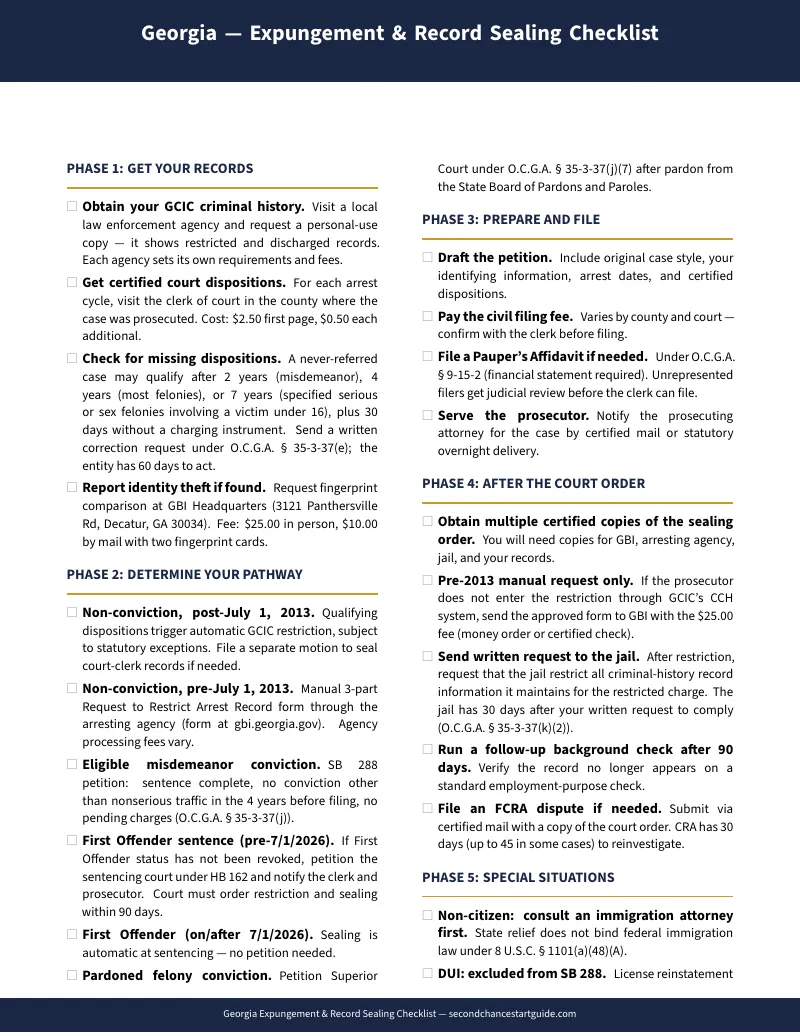
Not ready for the full guide? Download the free Georgia Expungement Eligibility Checklist — a two-page diagnostic covering non-conviction restriction, SB 288 misdemeanor restriction, First Offender sealing, and pardon eligibility. It is enough to determine which pathway applies to your situation.
Your record qualifies for certain forms of relief or it does not. The guide tells you which, maps the steps that apply to each pathway, and shows you how to check whether the relief reaches relevant records.
Frequently Asked Questions
What if the rules change after I buy?
We update the guide when the rules change. Email us any time, even years later, and we'll send you the current edition free.