Your Case Was Dismissed. Your Record Was Not.
You finished everything the court asked of you — the deferred acceptance program, the community service, the months of compliance. The prosecutor dropped the charges, or the judge signed the dismissal. You moved on with your life.
Then a background check pulled it up anyway. The conditional job offer stalls. The rental application comes back denied. A licensing board asks you to explain something you thought was gone ten years ago. And when you search eCourt Kōkua yourself, there it is — a case you assumed was closed, listed as if nothing ever changed.
This is not a glitch. This is how Hawaii's record system works by default. A dismissed case, an acquittal, even a completed deferred plea — none of these automatically disappear from the state's databases. You have to make them disappear, through an administrative process most people do not know exists, filed with an agency most people have never heard of.
The eCourt Kōkua Navigation System
The Hawaii Expungement & Record Sealing Guide is a step-by-step navigation system built around the specific way Hawaii's dual-agency record framework actually operates — not the way most people assume it does. It replaces scattered government forms and outdated legal blogs with a single filing sequence that accounts for the traps Hawaii does not warn you about: the multi-charge sealing block, the legacy certificate backlog, the inter-island records maze, and the private databases that keep reporting records long after the state clears them.
What's Inside
- The Eligibility Decision Matrix — a structured walk-through that sorts your case into the correct pathway: standard non-conviction expungement, deferred acceptance with its one-year (or four-year) waiting period, first-time drug or property exceptions, juvenile sealing, under-21 DUI relief, or gubernatorial pardon. You know exactly where you stand before you spend a dollar on filing fees.
- The Multi-Charge Sealing Trap Diagnostic — under HRS § 831-3.2(f), the court will deny sealing if your case involves multiple charges and one of them is not covered by the expungement certificate, or if a co-defendant in your case has not been expunged. This diagnostic walks you through identifying and resolving this blocker before you file, instead of discovering it months later in a denial order.
- HCJDC Form 159(b) Line-by-Line Guide — the exact fields, the Social Security Number rules, payment formatting (certified check or money order payable to "State of Hawaii"), and the common mistakes that result in losing the $10 non-refundable fee with nothing to show for it.
- The eCourt Kōkua Self-Audit Protocol — step-by-step instructions for searching the court database, interpreting ambiguous docket codes, and identifying cases that appear "active" but are actually eligible for expungement. This is the same check employers and landlords run — except now you are running it first.
- Inter-Island Filing Logistics — complete contact details, mailing addresses, document request procedures, and fee schedules for all four judicial circuits (Oahu, Maui County, Hawaii Island, Kauaʻi) and the county police departments (HPD, MPD, KPD) that operate independently of one another. Filed with the wrong circuit or the wrong agency, your application goes nowhere.
- Post-2025 Automatic Sealing Guide — how the Act 159/Act 3 transmission system is supposed to work, the specific conditions that cause it to fail, what to do with legacy certificates issued before the July 2025 cutoff, and the exact steps to verify that the court actually executed a sealing order on your case.
- The Fair Chance Hiring Toolkit — Hawaii's Ban the Box law (HRS § 378-2.5), the five-year misdemeanor and seven-year felony lookback limits, the "substantially related" standard employers must meet before withdrawing a conditional offer, and the FCRA notice requirements that give you legal leverage if an employer acts on expunged records.
- Federal & Immigration Guardrails — a clear, detailed warning that state expungement does not bind the FBI, USCIS, or DHS. Non-citizens must preserve certified copies of their records before filing. Any failure to disclose an expunged arrest on immigration forms is treated as material misrepresentation.
- Private Background Check Purge Instructions — form letters and step-by-step procedures for forcing commercial screening companies to remove expunged records from their databases, because state relief does not automatically propagate to third-party systems.
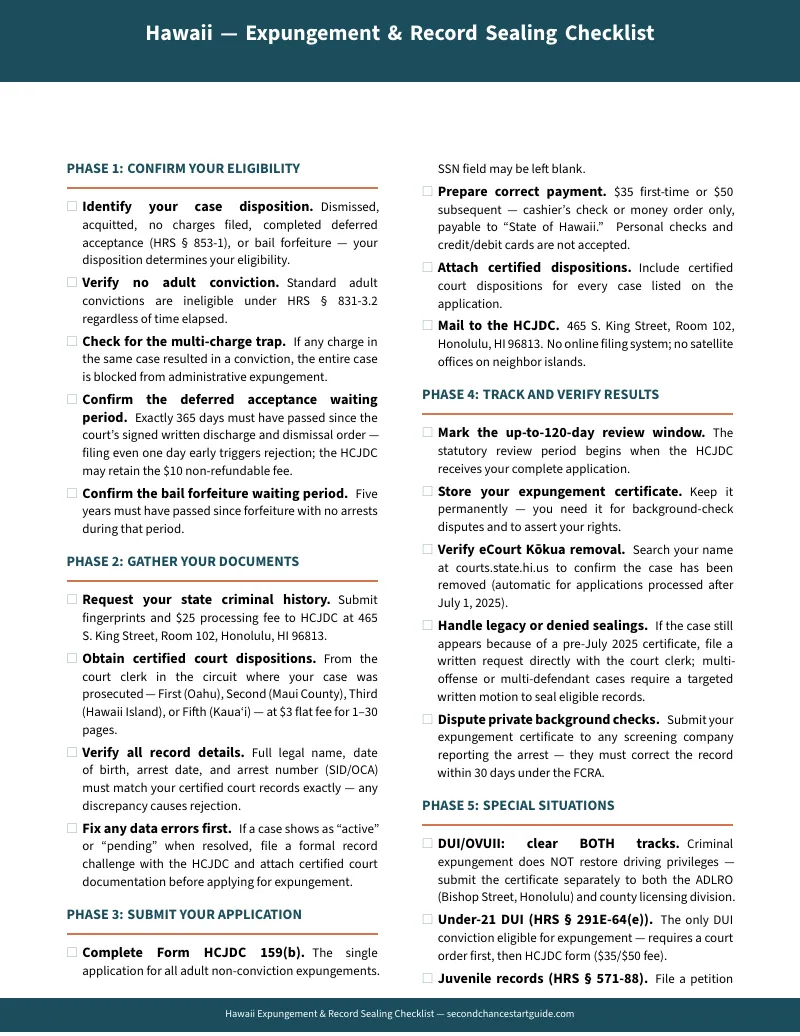
- Printable Planning Worksheets — eligibility self-assessment, HCJDC application filing checklist, post-approval verification tracker, ADLRO timeline calculator, and agency communication log — five separate fillable PDFs you can print and use at each stage of the process.
Who This Is For
- You received a conditional job offer and your background check is pulling up an arrest from years ago that was dismissed or never charged
- You completed a deferred acceptance plea and assumed the arrest was gone — but it is still visible on eCourt Kōkua and showing up in tenant screenings
- You were arrested during a vacation or college stint on a different island and have no idea which court or police department has your records
- You work in hospitality, healthcare, defense contracting, or security — industries where Hawaii's background check requirements are strictest
- You are applying for a professional license and need to confirm whether your expunged record will be visible to the licensing board
- You qualify for the first-time drug, first-time property, or under-21 DUI exception and need the court-order petition process explained step by step
Why Free Government Pages Are Not Enough
The HCJDC website provides blank forms. The eCourt Kōkua portal lets you search your own name. The Hawaii State Judiciary website has a short FAQ. What none of these sources explain is that the HCJDC can issue your expungement certificate and the court can still deny the sealing order — leaving your record fully visible to every employer and landlord who searches eCourt Kōkua. They do not warn you about the multi-charge and co-defendant exclusions under HRS § 831-3.2(f). They do not explain that certificates issued before July 2025 were never forwarded to the courts under the old two-step system. And they do not provide any guidance on clearing your record from the commercial background check databases that most private employers actually use.
This guide consolidates every procedural trap, every waiting period, every court-circuit-specific filing rule, and every post-order follow-up step into one sequence. It is the difference between filing correctly on the first attempt and losing months and fees to avoidable mistakes.
The Guarantee
If the guide does not give you a clear, actionable filing plan for your Hawaii record, email us and we will refund you — no questions, no forms, no waiting period.
Start Clearing Your Record
Download the free eligibility checklist to audit your eCourt Kōkua record and confirm your expungement pathway. If you already know you need the full filing roadmap, get the complete Hawaii Expungement & Record Sealing Guide — every step, every form, every deadline, every island covered. For less than the cost of a single government filing fee, you get the system that makes sure you only pay that fee once.