Your license is suspended. The DOT says fix it — but the courts, the county, and the DOT each control a different piece, and none of them explain the other's rules.
You pulled your record on myMVD and found suspension codes you do not fully understand. The DOT website listed your reinstatement requirements but did not explain that the court-debt hold from Polk County has to be cleared before the DOT will process anything, that your child support suspension runs through a completely different agency, or that the OWI civil penalty you paid last month does not count toward the fines the county attorney is collecting.
Iowa's reinstatement system runs on two tracks that do not share a database. The DOT manages administrative revocations, civil penalties, SR-22 filings, interlock requirements, and credential issuance. The Iowa Judicial Branch and county attorney offices manage unpaid fines, contempt hearings, and County Attorney Payment Plans. CAPP procedures vary by county, and state law provides a fallback if the county where a fine was imposed has no installment program. Miss a step on either track, pay a fee in the wrong order, or enter a payment plan in one county while a hold from another county stays active — and your license stays suspended while you burn through money and one of your five lifetime CAPP agreements.
The Dual-Track Resolution System: a guide built to connect Iowa's court system and DOT
The Iowa Driver's License Reinstatement Guide maps every hold type to the agency that controls it, organizes the resolution sequence across both tracks, and walks you through each step — from initial diagnosis on myMVD and Iowa Courts Online to the moment you hold a valid Class C license. It covers OWI revocations, court-debt suspensions, child support blocks, safety responsibility holds, habitual violator bars, medical holds, and out-of-state flags through the National Driver Register. Each hold type gets its own chapter, its own checklist, and its own clearing sequence — assembled for someone who cannot afford to waste a fee or restart a compliance clock.
Hold diagnosis across both systems
The DOT's myMVD portal shows your reinstatement requirements but does not explain which court issued which hold or which county holds your fines. Iowa Courts Online shows case numbers and balances but has no visibility into DOT administrative holds. The guide walks you through pulling records from both systems, cross-referencing the results, and building a hold-by-hold inventory that tells you exactly who to contact and in what order.
County Attorney Payment Plans — county examples
A CAPP under Iowa Code §§ 321.210A and 321.210B can lift a court-debt suspension while you pay in installments. But there is no statewide standard. Polk County requires cases to be at least 60 days past sentencing and runs a 30-day processing window. Some counties set a minimum delinquent debt threshold. Some require a financial affidavit plus two recent pay stubs. Iowa law requires a financial statement before an agreement and limits each driver to five lifetime agreements, and child support debts and out-of-state citations are excluded. The guide includes selected county program examples and a tracker for recording the rules and contacts in your county.
OWI administrative reinstatement — the full sequence
The DOT can revoke your driving privileges for an OWI even if you are not convicted in court; that administrative process runs independently of the criminal case. Before reinstatement, you must complete the 12-hour Prime for Life course, undergo a substance use disorder evaluation, file an SR-22 unless it is a zero-tolerance revocation, pay the $200 civil penalty, and satisfy any ignition interlock requirements — in a specific order. The guide maps every step, notes which agencies verify which completions, and flags the common failure point where proof of course completion does not appear in the DOT's system.
Temporary Restricted Licenses — both pathways
Iowa offers a standard non-OWI TRL under § 321.215 (restricted to verified trips at specified times and places) and an OWI TRL under Chapter 321J. An OWI TRL is not destination-restricted and usually requires an ignition interlock on every vehicle you operate. For revocations based on offenses on or after January 1, 2025, a medical-waiver TRL can be issued without the IID but is limited to § 321.215(1)(a) purposes. A person whose privilege was revoked under § 321J.21 may also apply for a no-IID TRL if at least 12 years have passed since the underlying § 321J.2 revocation period ended; this exception applies to revocations for offenses that occurred on or after January 1, 2025. Each pathway has its own application form, eligibility rules, and disqualifiers. The guide covers both, including the absolute bar on commercial motor vehicle operation.
Ignition interlock compliance and transition
The IID requirement is straightforward in concept and dense in compliance rules. State-approved vendors, calibration schedules, the 2025 medical waiver exception and its restrictions, the mandatory post-reinstatement interlock period for second or subsequent offenses, and the serious misdemeanor for tampering with, removing without authorization, or circumventing an IID while the requirement is in effect — the guide covers each one and maps the transition from interlock-restricted driving to full Class C privileges.
SR-22 financial responsibility
Your insurer files an SR-22 electronically with the DOT, certifying minimum liability coverage of $20,000/$40,000/$15,000. The filing period runs for two years from the first day of suspension or revocation. If the policy cancels or lapses during that period, the insurer notifies the state and the DOT may suspend your license again. The guide covers how to find affordable SR-22 coverage, non-owner policies for drivers who do not own a vehicle, and the out-of-state residency statement process for people clearing Iowa holds from another state.
Child support holds — resolved separately
A child support hold under Chapter 252J runs through Iowa Child Support Services (CSS), not through the courts or the DOT. It must be cleared separately before your license can be reinstated; a CAPP cannot resolve it. The guide explains the CSS payment agreement process and the withdrawal of the Certificate of Noncompliance that lifts the hold.
Out-of-state holds and the National Driver Register
If you left Iowa with an unresolved hold, or moved to Iowa with one from another state, the NDR's Problem Driver Pointer System flags your record whenever a licensing agency queries it. The guide covers remote clearance of Iowa holds using a customer number on the myMVD portal, the out-of-state residency statement for satisfying financial responsibility requirements without buying a redundant Iowa-specific insurance policy, and how to identify and resolve pointers from other states.
Professional referral decision points
Most reinstatements are administrative paperwork — not legal proceedings. But the guide identifies the specific situations where the complexity or stakes warrant a lawyer: active criminal prosecution, contested OWI charges, warrants in multiple jurisdictions, CDL complications, immigration consequences, and cases involving complex civil judgments or accident liability. Each gets a clear explanation of why that line exists.
Who it is for
- The driver facing a job loss because of a suspended license — you need a valid license to keep the job or start a new one, and you have no idea how many holds are on your record or how long clearance takes
- The driver caught between the court track and the DOT track — you paid fines at the courthouse but the DOT still shows suspended, or you paid the DOT but a court hold from another county is blocking everything
- The OWI driver navigating reinstatement for the first time — the criminal case and administrative revocation run on separate timelines, and nobody explained which steps must be completed in which order
- The driver buried in court debt across multiple counties — fines spread across two or three counties, with local CAPP rules to navigate, and you have already used one or two of your five lifetime agreements
- The person who left Iowa years ago and just found an active hold — you tried to get a license in your new state and were turned away because Iowa shows an unresolved suspension in the national database
Why not just use the free state resources?
The rules exist in public. Assembling them into an actionable sequence that connects both tracks — including selected county CAPP examples — does not.
The Iowa DOT website and myMVD list your reinstatement requirements and accept civil penalty payments online. They do not explain the court track, do not coordinate with county attorney offices, and do not warn you that a court-debt hold from a different county is blocking the reinstatement you just paid for.
Iowa Courts Online shows case numbers and balances. It has no visibility into DOT administrative holds, insurance suspensions, interlock requirements, or child support blocks.
County attorney payment plan pages each explain their own county's rules — but only their own. They do not explain multi-county coordination, excluded debt types, or how the CAPP interacts with the DOT track.
OWI defense firm websites cover the criminal case side — retainer starts at $1,500 or more. They rarely explain the administrative steps a driver must complete on their own after the court case is resolved, or that many drivers can handle the entire reinstatement process without retaining a lawyer.
Interlock vendor websites explain their hardware and leasing terms. They do not cover the full reinstatement sequence, the non-OWI holds that must also be cleared, or the transition steps from interlock to full privileges.
Free resources give you the rules one track at a time, one county at a time, one agency at a time. The guide gives you the complete resolution sequence — both tracks, all relevant counties, the correct clearing order, and the transition steps that connect administrative compliance to a valid license.
A fraction of what a single misstep costs
One wrong step — paying the DOT's reinstatement fee before clearing a court hold that blocks it, entering a County Attorney Payment Plan in one county while a hold from a different county keeps your license suspended, letting an SR-22 policy lapse during the mandatory filing period — and you are back at the starting line with less money and more time added to your suspension. Each misstep burns one of your five lifetime CAPP agreements, wastes a fee that will not be refunded, or restarts a compliance clock that was nearly finished. Driving while suspended in Iowa is a simple misdemeanor with a $250–$1,500 fine under Iowa Code § 321.218. If the suspension is OWI-related, it is a serious misdemeanor with a $1,000 fine under § 321J.21.
The guide costs — once, no subscription, no hourly rate. It covers every hold type, both tracks, selected CAPP examples and a county tracker, the OWI reinstatement sequence, the TRL application process, and the exact order that prevents you from paying for something that cannot go through yet — plus six printable worksheets (driving record diagnostic, agency communication log, CAPP county tracker, OWI compliance checklist, cost calculator, and master reinstatement sequence) and a quick-start checklist you can start working through today.
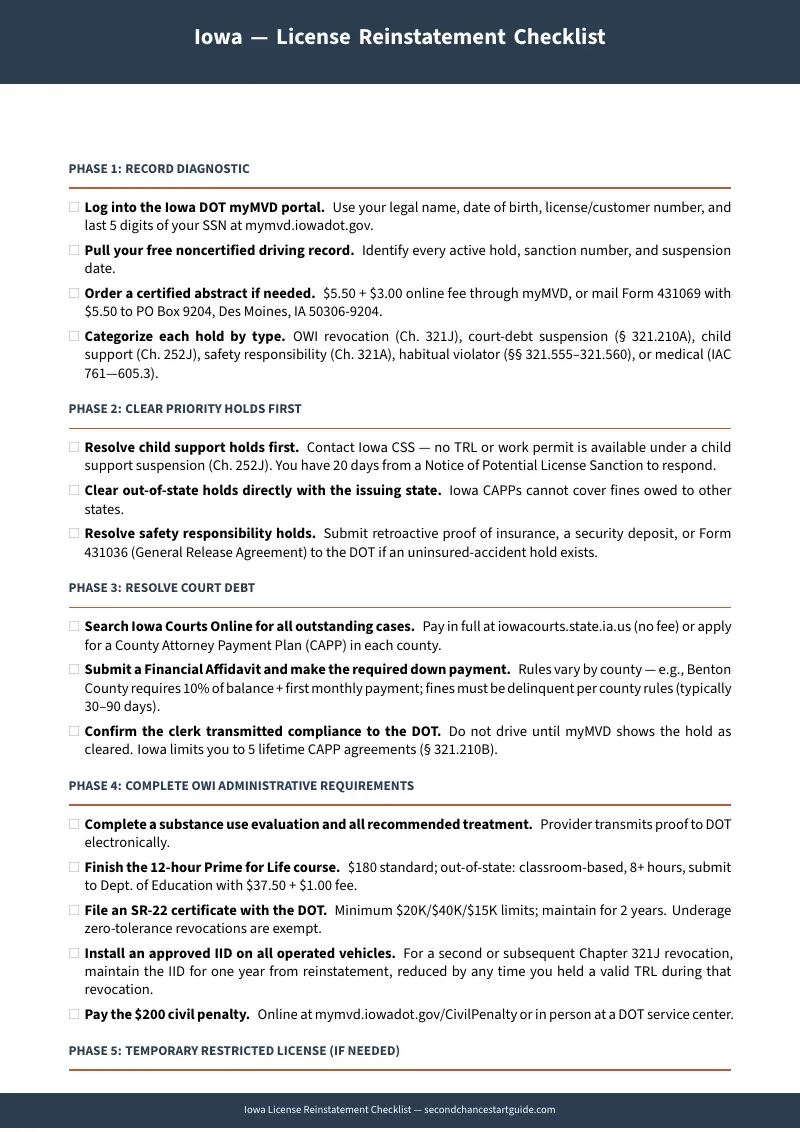
Not ready for the full guide? Download the free Iowa — License Reinstatement Checklist — a printable diagnostic covering hold identification, clearing sequence, and document requirements. It is enough to start organizing your record. The full guide is there when you need the complete framework.
Full refund, no time limit. If the guide does not help, email [email protected] and we will refund you in full — no questions, no deadline.
Frequently Asked Questions
What if the rules change after I buy?
We update the guide when the rules change. Email us any time, even years later, and we'll send you the current edition free.