Your license is suspended. The Secretary of State won't tell you which courts and agencies put the holds there — or what order to clear them in.
You checked your driving record and it says "suspended" or "revoked." You assumed paying the fine would fix it. It didn't. Or you completed treatment and expected your driving privileges to come back automatically. They didn't. Or someone told you the 2021 Clean Slate to Drive reforms cleared everything — but those reforms only removed qualifying FCJ and FAC suspensions for specified violations, and OWI-related actions were completely unaffected.
Michigan's licensing system is not one system. It is at least three — the Secretary of State, local district and circuit courts, and the Friend of the Court — and none of them tell you what the others require. Pay the MDOS reinstatement fee before every court has transmitted its clearance, and your money processes but your status does not change. File an OHAO restoration packet with an SOS-258 evaluation outside its 90-day submission window, and the packet misses the form package's stated deadline. Submit support letters that contradict the details in your substance use evaluation, and the hearing officer may deny your petition — after a final order, another hearing on the same matter is generally barred for one year unless OHAO provides otherwise.
Meanwhile, driving while license suspended under MCL 257.904 is a misdemeanor. A first offense carries up to 93 days in jail and a $500 fine, and a second or subsequent violation can mean up to a year.
The Hold Clearing Sequence — a step-by-step reinstatement map built around the order that actually matters
The Michigan Driver's License Reinstatement Guide is not a summary of what the Secretary of State website already says. It is a process navigator built around one insight that free resources consistently miss: the order you complete the steps determines whether you waste money. Every hold type is mapped to its clearing process, every clearing process is laid out with exact requirements and fees, and the resolution sequence is organized so you never pay for something before the prerequisite step is done.
What's inside the guide
Driving Record Audit and Hold Diagnosis — because "suspended" tells you nothing about why. The guide walks you through ordering a certified complete driving record through MiLogin, classifying every barrier on it — definite suspension, indefinite suspension (FAC or FCJ), revocation, out-of-state NDR hold — and mapping each one to the specific court or agency that controls the release. You build a complete hold inventory and resolution roadmap before spending a dollar.
Court-Debt and Administrative Hold Clearing — because the Secretary of State cannot lift a hold placed by a local court. If your record shows an FAC or FCJ suspension, you must resolve the underlying case with the specific court that issued it — clearing any warrant, paying or negotiating the fine, paying the $45-per-failure court clearance fee under MCL 257.321a, and then paying MDOS the reinstatement fee. The guide explains how to handle multiple holds across different courts and the sequence that prevents premature reinstatement fee payments.
Child Support Hold Resolution — because the driver must obtain a Friend of the Court certificate showing compliance and provide it to the Secretary of State. Under MCL 552.628, a license suspension requires arrears exceeding two months, income withholding that is not applicable or has been unsuccessful, a finding that the obligor can pay but is willfully not paying, and a finding that no other sanction would be effective. The guide explains the payment arrangement negotiation, the statutory criteria, the $45 court clearance fee, and the applicable MDOS reinstatement fee.
First-Offense OWI Suspensions and Restricted Driving — because the rules change dramatically based on your BAC. A standard first OWI (BAC under 0.17) carries a 180-day suspension with a 30-day hard suspension; after that, MDOS may issue a restricted license for a specified portion of the remaining suspension, limited to purposes under MCL 257.319(16) — no BAIID required. A first High BAC (0.17 or higher) carries a one-year suspension with a 45-day hard suspension; MDOS may issue restricted driving for the remainder if an approved BAIID is installed. The guide maps each scenario, explains what "restricted" actually means in practice, and covers the OWVI path for Operating While Visibly Impaired.
The OHAO Restoration Hearing — because if your license was revoked, paying a fee will not get it back. Two qualifying OWI convictions within seven years or three within ten trigger a revocation. A first revocation carries a minimum one-year wait before a license may be issued; a subsequent revocation within seven years of a prior revocation or denial carries a minimum five-year wait. The standard path to restoration is a formal petition to the Office of Hearings and Administrative Oversight, where you must prove by clear and convincing evidence that you have maintained sobriety. The guide walks through the entire evidentiary packet: Form SOS-257, the substance use evaluation on Form SOS-258 (which must be submitted within 90 days of the evaluation), drug screens, three to six notarized support letters unless you plan to present witnesses at the hearing (letters are required for out-of-state administrative review), and interlock documentation — with guidance on coordinating document timing and keeping evidence consistent.
BAIID Compliance — because a reported major violation requires MDOS to reinstate your original revocation or denial. The guide covers choosing an approved provider, understanding the difference between minor violations (missed calibration, startup test accumulations) and major violations (rolling retest failures, tampering, missed retests), the documentation practices that defend against false-positive allegations, and ensuring OHAO receives a hearing request within 14 days of the effective date of MDOS's reinstatement of the original revocation or denial.
Sobriety Court — because there is an alternative path for some repeat offenders. Michigan's specialty sobriety courts can offer restricted driving before OHAO eligibility. The guide explains the program requirements, how sobriety court compares to the standard OHAO process, and who qualifies.
Out-of-State Clearance — because a Michigan hold can follow you to another state through the Problem Driver Pointer System. If your new state's DMV found an active Michigan hold on the national driver register, you need to clear it from wherever you live. The guide covers the administrative review option and the full OHAO hearing option for non-residents; out-of-state administrative review requires support letters and proof of residency.
CDL Disqualifications — because there is no restricted commercial driving privilege. A first qualifying OWI triggers a one-year commercial disqualification (three years if it occurs while operating a commercial motor vehicle carrying placarded hazardous materials), and two qualifying violations arising from two or more separate incidents trigger a lifetime disqualification, with eligibility for reissue after at least ten years and Secretary of State approval. The guide covers the triggers, timelines, and the professional referral decision point.
Costs, Timelines, and Financial Planning — because reinstatement costs vary from under $200 for a simple definite suspension to several thousand for an OHAO appeal with BAIID compliance. The guide provides a complete fee reference, a worked cost example for an OHAO appeal, and a planning framework so you can estimate your total before you start spending.
Plus: Worksheets and Planning Tools — a driving record audit worksheet, court-debt resolution tracker, OHAO evidence packet checklist, support letter prompt sheet, BAIID compliance log, and a reinstatement cost planner.
Who this is for
- Commuters whose job depends on driving — your license was suspended and there is no transit alternative where you live. You need the fastest legal path back to driving, and the guide maps which restricted driving options apply to your specific suspension type.
- Drivers who paid the fine but are still suspended — you cleared the balance with the court, but the Secretary of State still shows "suspended." The guide explains why these are separate systems and what to do about the gap — including secondary holds you may not know about.
- People who thought Clean Slate fixed everything — the 2021 reforms cleared qualifying suspensions, but the underlying fines were not cancelled and OWI-related actions were completely unaffected. The guide explains what was and was not cleared.
- Recovering drivers preparing for an OHAO hearing — you have maintained sobriety and reached your eligible-for-review date. The guide structures the entire evidentiary packet and walks through the consistency requirements that the official forms do not explain.
- Parents facing a child support license hold — you cannot lose the license that gets you to the job that makes the payments. The guide walks through the Friend of the Court negotiation, compliance certificate, and clearance-fee steps.
- Out-of-state drivers blocked by a Michigan hold — you moved away years ago and your new state found a Michigan hold. The guide explains how to clear it remotely through administrative review or a hearing.
Why not just use free resources?
The rules exist in public. The sequence does not.
- The Secretary of State website lists reinstatement fees and links to the OHAO form package. It does not explain how to coordinate clearances across multiple courts, does not warn you that paying a reinstatement fee before every hold is resolved wastes money, and does not cover the support letter consistency requirements that can determine an OHAO outcome.
- MichiganLegalHelp.org provides accurate, State Bar-supported articles — but one topic at a time. There is no tool that maps your combination of holds to a resolution sequence, no document tracker, and no support letter alignment checklist.
- License restoration law firms are built to convert you into a client at fees that commonly run several thousand dollars. They cover the OHAO hearing because that is what they bill for, but rarely explain the court-debt and administrative-hold clearing process that many drivers need to complete first. A driver with a simple definite suspension does not need an attorney — but no firm's website will tell you that.
- Interlock vendor websites push immediate installation while burying the requirement for OHAO to receive a hearing request within 14 days of the effective date of MDOS's reinstatement of the original revocation or denial, or the documentation practices that protect you against false-positive allegations.
The guide costs a fraction of one wrong step in the reinstatement process. One premature reinstatement fee or incomplete OHAO packet costs more in wasted money and waiting time than the entire guide.
Satisfaction guarantee
If the guide does not deliver what it promises, email [email protected] for a full refund, no time limit.
Start clearing your holds today
The guide costs — one payment, instant download, no subscription. It covers every hold type, every clearing process, every fee, every OHAO evidence requirement, and the exact sequence that prevents you from paying for something before the prerequisite step is done.
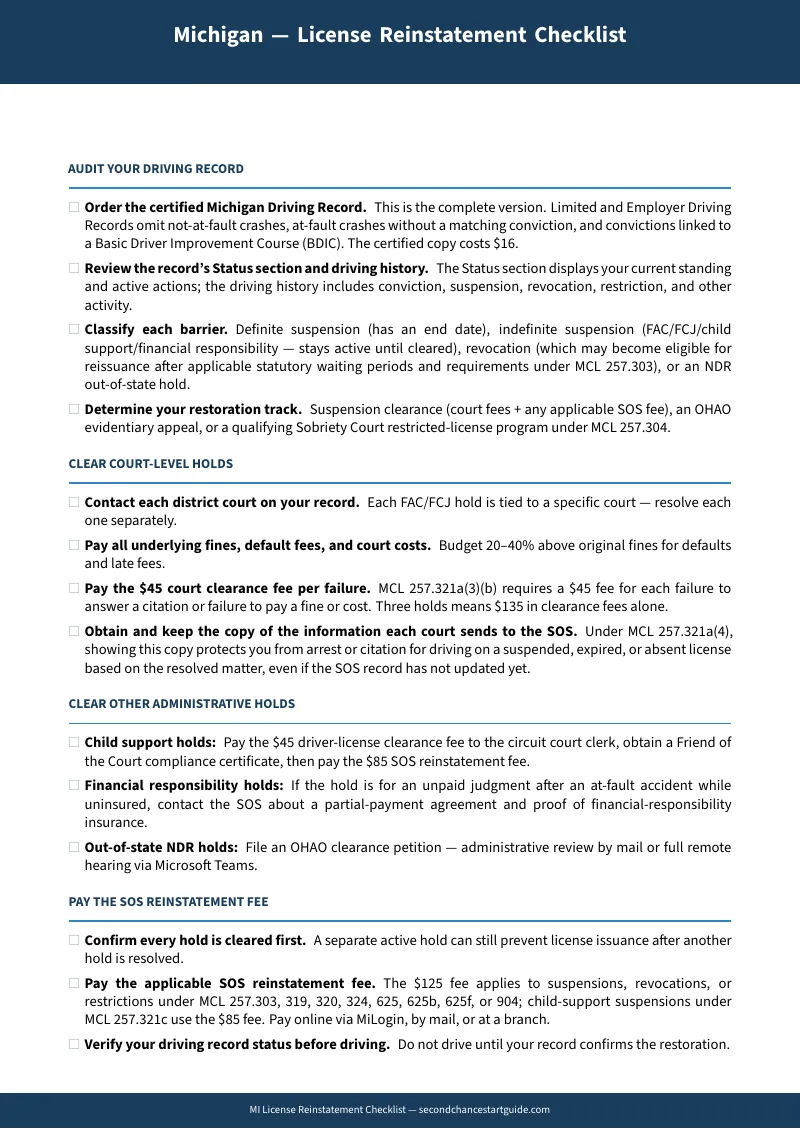
Not ready for the full guide? Download the free Michigan License Reinstatement Checklist — a two-page diagnostic covering hold identification, suspension classification, and the clearing sequence. Enough to start organizing your record tonight.
Frequently Asked Questions
What if the rules change after I buy?
We update the guide when the rules change. Email us any time, even years later, and we'll send you the current edition free.