Missouri's split DOR-and-court system means your license can be held hostage by agencies that never talk to each other. The Hold-by-Hold Resolution Map puts every clearing step in the right order — so you stop paying fees that change nothing.
You already know your license is suspended. What the Department of Revenue's status page does not tell you is why it will stay that way even after you pay the fee it asks for.
Missouri divides authority over your driving privilege between the DOR Driver License Bureau in Jefferson City and a scattered network of municipal courts, circuit courts, and the Family Support Division. Each one can block your license independently of the others. A court in Jackson County can hold you suspended while the DOR shows no outstanding requirements on its end. The Family Support Division can flag a child support arrearage that the DOR cannot override. An out-of-state DMV can report a driver to the National Driver Register, which can prevent Missouri from issuing or renewing a license until the reporting state resolves the issue.
The result: drivers pay $20 or $45 reinstatement fees to the DOR, resolve individual court fines, and file SR-22 insurance certificates — then discover their license is still suspended because an upstream hold they did not know about was blocking every downstream clearance. The money is gone. The status has not changed.
The Missouri Driver's License Reinstatement Guide uses a Hold-by-Hold Resolution Map — a structured clearing sequence that starts with the highest-priority holds (the ones that block everything else) and works down to the final reinstatement fee. Instead of guessing which agency to call or which form to file next, you follow a task list built from the actual hierarchy of Missouri's suspension system.
What's Inside
The Record Audit — Pull Everything Before You Pay Anything
The guide starts with a complete diagnostic: how to retrieve your DOR driving record (Form 4681, $2.82 plus $2.00 office fee), how to search CaseNet for outstanding court holds across municipal and circuit courts, and how to identify out-of-state holds you may not even know about. You build the full picture before you spend a dollar — because a reinstatement fee paid while a court hold remains active changes nothing except your bank balance.
The Clearing Sequence — Holds Resolved in Priority Order
Not all holds are equal. A child support suspension blocks reinstatement until the DOR receives a stay or termination order from the Family Support Division or a court. An out-of-state pointer on the National Driver Register can prevent Missouri from issuing or renewing a license until the reporting state resolves the issue. The issuing court resolves a FACT case and provides proof of compliance; the DOR processes that proof and the reinstatement fee. Lieu of Bail follows a separate court release-order process. The guide maps this hierarchy so you work from the top down instead of clearing whatever seems easiest and discovering it did not matter.
FACT and Lieu of Bail Holds — Clearing the Court Layer
A missed court date turns a minor traffic ticket into a license suspension. The issuing court must resolve the case and provide proof of compliance; the DOR processes that proof and the $20 reinstatement fee before reinstating your driving privilege. The guide walks you through searching CaseNet to find the right court, paying the fine or appearing in court, getting the compliance receipt the DOR requires, and submitting it with the fee to PO Box 3950 in Jefferson City. For Lieu of Bail holds, the path is different: the court issues a release order and the DOR lifts the hold with no reinstatement fee.
Child Support Suspensions — The Hold That Blocks Everything Else
When the Family Support Division flags arrears that meet the threshold (three months of current support or $2,500, whichever is less), the DOR suspends you on FSD's authority. The guide walks you through contacting the FSD at 866-313-9960, understanding when a payment agreement can prevent or stay the suspension, and what it takes to fully terminate it and clear the $20 DOR fee.
DWI Reinstatement and Chemical-Test Refusal
An alcohol-related stop or arrest involving a BAC over the legal limit or a refused chemical test triggers a DOR administrative action separate from criminal court. These actions can require a $45 reinstatement fee, SATOP, and a two-year SR-22; an SR-22 is not required for a first-time zero-tolerance suspension if you are under 21. An ignition interlock may also be required based on your record or conviction. Those administrative requirements can remain even if criminal charges are reduced or dismissed. A chemical-test refusal triggers a one-year revocation — and you have only 30 days from the date the Notice of Revocation is issued to file a Petition for Review. The guide separates the administrative and criminal tracks and maps the reinstatement requirements for each scenario.
SR-22 Insurance — When You Need It, When You Don't
An SR-22 is a certificate your insurer files electronically with the DOR to prove you carry liability coverage. It is required after alcohol-related suspensions (maintained for two years) and after accident-involved insurance-failure suspensions (maintained for three years from the date eligible to reinstate). A single day of lapsed coverage triggers an automatic re-suspension, a new reinstatement fee, and a fresh filing requirement. The guide explains the filing periods, when proof of insurance alone is enough, and how to avoid the re-suspension loop.
Insurance Lapse — The Tiered Penalty System
Driving without insurance carries escalating consequences: a first offense costs $20 to reinstate, a second costs $200, and a third or subsequent costs $400. An accident while uninsured triggers a separate process — the judgment must be settled or a court-approved installment plan entered before the DOR will act. The guide covers common insurance-related suspension types and the specific requirements for each.
SATOP — The Program Requirement That Catches Everyone
Every alcohol- or drug-related reinstatement in Missouri requires completing the Substance Awareness Traffic Offender Program — even if the underlying charges were reduced or dismissed. The screening costs $126, plus a separate $249 supplemental fee due at screening, before assignment to one of four program levels. You must begin within six months of receiving your assignment. The guide walks through scheduling, program levels, costs, and what to do if you cannot afford the fees.
Restricted and Limited Driving Privileges — Legal Driving Before Full Reinstatement
If you are serving a long suspension or denial and need to drive for work, school, or medical care, the guide maps two pathways. The immediate 90-day Restricted Driving Privilege (RDP) may be available if you have no alcohol-related offenses in the past five years and your license is not currently suspended or revoked for another reason — apply within 15 days of receiving the Notice of Suspension and install an approved interlock device. Eligible drivers may also serve a 30-day suspension and then use a 60-day RDP. A Limited Driving Privilege (LDP) covers other eligible suspended or revoked drivers through the DOR (Form 4595) or a circuit court petition. The guide explains the eligibility rules and application process for each.
Professional Referral Decision Points
The guide identifies specific situations that cross the line from administrative paperwork into legal territory: active warrants, CDL disqualification, contested hearings, 5-year or 10-year DWI denials, chemical-test refusals, immigration-adjacent cases, and out-of-state reciprocity disputes. These are not soft suggestions — they are decision points where the stakes or complexity justify professional representation.
Printable Planning Tools
The kit includes 10 fillable worksheets you print and write on: the Hold-by-Hold Tracking Worksheet, Fee Calculator Worksheet, Court Resolution Log, Agency Communication Log, SR-22 and IID Compliance Tracker, Record Audit Worksheet, RDP/LDP Eligibility Worksheet, SATOP Enrollment Tracker, Child Support Hold Worksheet, and Professional Referral Decision Card.
Who It's For
- The driver who just learned their license is suspended — and does not know which courts, agencies, or states placed the holds, or which one to resolve first.
- The parent or worker who cannot stop driving — and needs the fastest legal path back to a valid license, including restricted privilege options they may not know about.
- The driver who paid a fee but is still suspended — because other holds remain active, or because the DOR cannot override a suspension controlled by a court or the Family Support Division.
- The driver facing a DWI administrative action — who needs to understand the 15-day RDP window, the 30-day chemical-refusal petition deadline, and the full SATOP and SR-22 timeline.
- The driver who moved to Missouri from another state — and discovered that an unresolved hold from their former state blocks everything in Missouri until that state clears it.
Why Not Just Use the Free Resources?
The DOR website covers its own administrative actions — points, fees, SR-22 requirements. CaseNet shows court records. Neither one tells you which holds block which clearances, what order to resolve them in, or that paying a reinstatement fee while a court or FSD hold remains active wastes your money.
Traffic attorneys charge several hundred dollars or more for representation. Effective for contested hearings and complex denials — but they do not file your SR-22, call the Family Support Division, or walk you through SATOP enrollment. Those are administrative steps this guide covers directly.
Interlock vendors and SR-22 providers sell the equipment and insurance the DOR requires. They do not understand court procedures, cannot clear FACT holds, and are oriented toward selling their product — not explaining the clearing sequence that determines whether their product even matters yet.
Generic legal sites use multi-state templates with Missouri's name inserted. They routinely conflate the RDP and LDP pathways, miss the SATOP requirement for reduced charges, and funnel you toward attorney referral fees.
Free resources give you the rules one hold at a time. The guide gives you the resolution sequence — record diagnosis, priority hierarchy, clearing steps, fee structure, insurance filings, SATOP enrollment, restricted privilege pathways, and professional referral triggers — assembled for someone who needs to drive again and cannot afford to clear holds in the wrong order.
Satisfaction Guarantee
If the guide does not help you understand your reinstatement path, email [email protected] for a full refund, no time limit.
Get Your License Back
The guide costs — once, no subscription, no hourly billing. It covers common hold types, their clearing entities, and the related fees and forms, plus the resolution sequence that prevents you from paying for something that cannot take effect while another hold remains active.
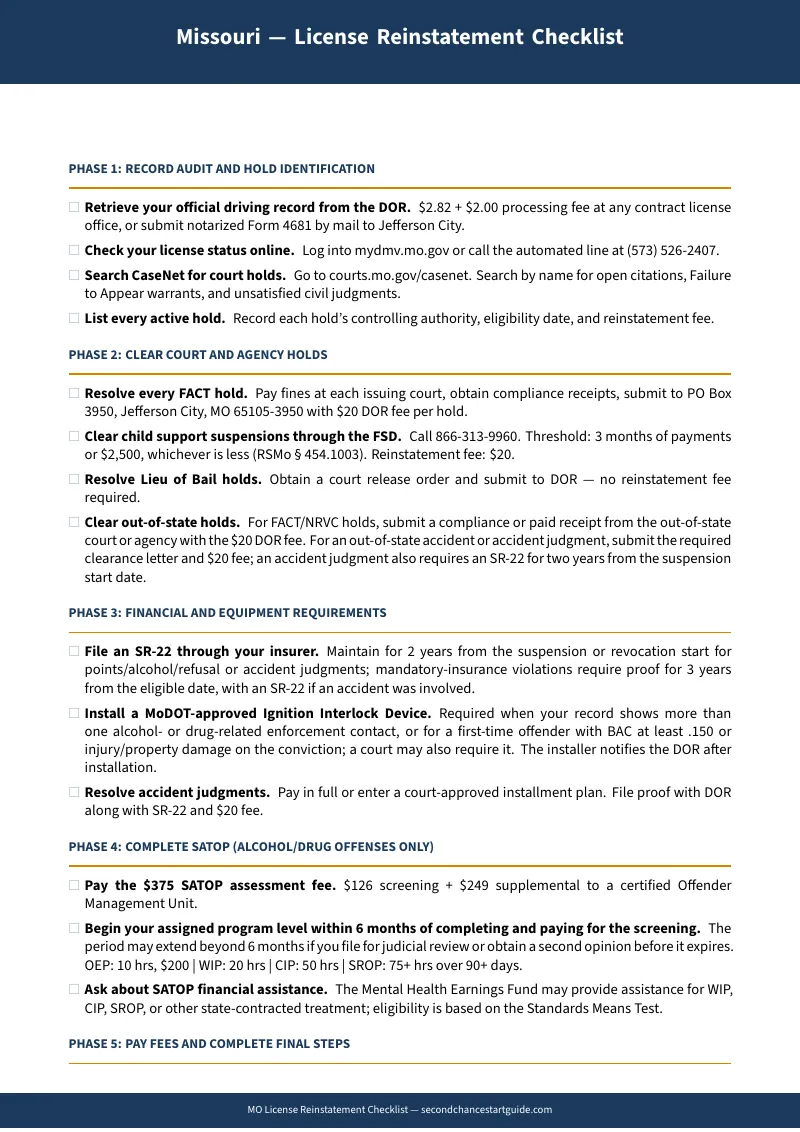
Not ready for the full guide? Download the free Missouri License Reinstatement Checklist — a two-page diagnostic covering hold identification, clearing sequence, form numbers, and fee structure. It is enough to start organizing your record. The full guide is there when you need the complete framework.
Frequently Asked Questions
What if the rules change after I buy?
We update the guide when the rules change. Email us any time, even years later, and we'll send you the current edition free.