The Hold-Clearing Sequence for Nevada Drivers
You know your license is suspended. What you probably do not know is which agencies placed the holds on your record, whether a court warrant needs to be resolved before any DMV fee will accomplish anything, or whether Senate Bill 219 actually cleared your record — or just changed the label on what is blocking you.
The Nevada DMV does not suspend your license alone. Municipal and justice courts, the Division of Social Services, the DMV's own insurance verification program, and out-of-state licensing agencies through the National Driver Register can all place independent holds on a single driving record. Each hold has its own clearing entity, its own fee, and its own process for transmitting clearance back to the DMV system. Pay a reinstatement fee while a court warrant remains active, and your license stays suspended — you just have less money. Clear a court hold but miss the child support compliance notice, and you are still grounded.
The Nevada Driver's License Reinstatement Guide is a hold-clearing sequence. It maps every suspension cause to the specific agency that controls it, organizes the resolution steps in the order that actually moves your status forward, and walks you through the compliance requirements for each cause — from failure-to-appear warrants and child support holds to DUI revocations, insurance lapse penalties, ignition interlock requirements, restricted license applications, and out-of-state blocks on the national Problem Driver Pointer System.
What's Inside
- Hold Diagnosis Worksheet — a standalone printable worksheet for sorting the four hold categories on your ten-year driving record: judicial (bench warrants and failure-to-appear flags), child support (DSS holds under NRS 483.443), DMV administrative (insurance lapses, demerit points, DUI revocations), and interstate (National Driver Register pointers). Work the categories in this order so every payment advances your status instead of hitting a wall upstream.
- Court Resolution Walkthrough — the steps for resolving failure-to-appear holds across Nevada's fragmented court system. It covers the 30-day surrender rule under NRS 199.335 for people admitted to bail or released without bail who have not been recommitted to custody: surrendering no later than 30 days after the required appearance avoids the separate offense. It also explains how to confirm the court transmits clearance to the DMV.
- SB 219 Diagnostic — how to tell whether your suspension was truly wiped by Senate Bill 219's debt-based reinstatement or whether a failure-to-appear hold replaced the financial one. The guide walks through the exact distinction the law makes so you do not assume a clear record and get arrested under NRS 483.560.
- Child Support Hold Resolution Path — the Division of Social Services clearing process under NRS 483.443, including one-time driver-license-suspension payments through iPayOnline or in-person kiosks, the required caseworker follow-up, and how to confirm the compliance notice reaches the DMV.
- Insurance Lapse Fee Calculator — the full tiered fee schedule under NRS 482.557, with worked examples for first through third offenses and lapse durations from 1 day to 181+ days. When an SR-22 filing is required, the guide covers the continuous maintenance rules and what happens if coverage lapses during the required period.
- DUI Reinstatement Sequence — the multi-step clearing path after a DUI conviction: ignition interlock device installation and 90-day calibration intervals, SR-22 filing requirements, DUI school and Victim Impact Panel completion, and the $120 plus $35 victim impact fee at the DMV. For rural drivers more than 100 miles from an IID manufacturer, the guide covers the statutory exception under NRS 484C.460.
- Restricted License Application Guide — Form DMV-21 eligibility rules and documentation requirements for each permitted driving purpose: work (Section A employer verification), school, medical appointments, grocery shopping, and court-ordered child visitation. Includes the daily hour limits, mileage restrictions, and the additional documentation self-employed drivers need.
- Out-of-State Hold Protocol — how to identify an interstate hold from the National Driver Register, contact the originating state, satisfy their requirements, and verify the hold has been cleared before visiting a Nevada DMV branch.
- DMV Visit Checklist — a standalone printable listing the documents and next steps for a DMV visit when one is required, organized by suspension cause: court clearance letters, SR-22 confirmation, IID Certificate of Compliance, identity and residency documents, and the stacked-fee worksheet so you know what you owe before you go.
- Professional Referral Decision Points — specific situations where the complexity or stakes warrant hiring an attorney rather than handling the administrative steps yourself: active criminal prosecution, contested DUI administrative hearings, CDL holds, multi-jurisdictional warrants, and interstate licensing disputes.
Who This Is For
- Drivers with holds from multiple agencies. You have a court warrant from one city, an insurance lapse flag from the DMV, and maybe a child support hold you did not know about. The guide sequences the clearing order across agencies so every payment advances your status instead of bouncing off an upstream hold that must be resolved first.
- Drivers who thought SB 219 cleared their record. The 2021 law ended debt-based suspensions, but your status still shows suspended. The guide explains how failure-to-appear holds replaced the financial ones for many drivers and walks through the resolution path for each.
- Drivers facing a DUI suspension. Your license was revoked, and the reinstatement path involves an ignition interlock device, an SR-22 filing, DUI school, a Victim Impact Panel, and specific fees — in a specific order. The guide maps the full sequence and the compliance windows so a missed calibration or a lapsed SR-22 does not restart the clock.
- Parents and workers who cannot stop driving. Nevada's distances and limited public transit outside the Strip corridor make a car essential for getting to work and getting children to school. You have been driving on a suspended license because there is no realistic alternative, and each trip risks a misdemeanor charge under NRS 483.560. If DMV receives a record of your conviction or punishment, it must extend your suspension by an additional like period. The guide shows the fastest path to a legal credential — including restricted license options you may not know you qualify for.
- Drivers with an out-of-state hold. You moved to Nevada and assumed the old issue stayed behind. If your record shows an active out-of-state suspension, Nevada cannot issue you a license until the state that issued it clears the record — nothing else you do in Nevada resolves that hold.
Why Not Just Use Free Resources?
The rules exist in public. The resolution sequence does not.
The Nevada DMV website lists causes of suspension and fee amounts, but it does not explain the clearing order — why a reinstatement fee paid while a court hold remains active cannot restore your license, or why an SR-22 filed before the underlying insurance lapse penalty is resolved accomplishes nothing.
Municipal and justice courts handle their own jurisdictions and nothing else. The Las Vegas Municipal Court cannot tell you about a hold placed by Sparks Justice Court, and neither court coordinates with the Division of Social Services or an out-of-state licensing agency. You are the only person connecting these entities.
Traffic attorneys charge hundreds for a consultation and thousands for representation — but they will not file your restricted license application, call another state's DMV about an interstate hold, or walk you through the child support compliance process. Those are administrative tasks the guide covers directly.
Lead-generation sites use multi-state templates with the state name swapped in. They routinely miss Nevada-specific details like the NV LIVE insurance verification system, the distinction between registration and license suspensions at Smog Busters kiosks, and SB 219's limits on what it actually cleared.
Free resources give you the rules one hold at a time. This guide gives you the complete clearing sequence — hold diagnosis, priority order, fee structure, restricted license eligibility, insurance filing requirements, and professional referral triggers — for someone who needs to drive again and cannot afford to clear holds in the wrong order.
100% Satisfaction Guarantee
If the guide does not help you map your reinstatement path, email us at any time for a full refund. No forms, no conditions.
Start Clearing Your Holds Today
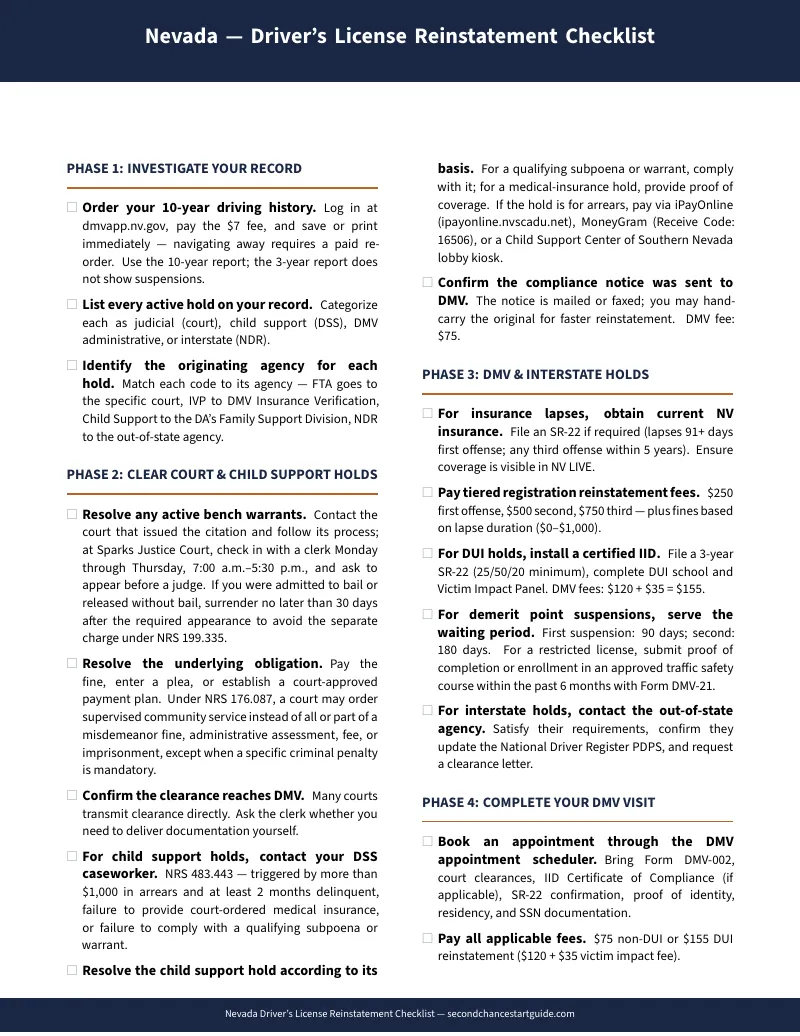
Download the free Nevada License Reinstatement Checklist to identify your holds and plan your clearing sequence. When you are ready for the full resolution roadmap — with the hold diagnosis worksheet, court resolution walkthrough, SB 219 diagnostic, insurance lapse fee calculator, restricted license application guide, professional referral decision points, and 8 standalone printable worksheets — get the complete guide for .
Frequently Asked Questions
What if the rules change after I buy?
We update the guide when the rules change. Email us any time, even years later, and we'll send you the current edition free.