
Your Old Record Is Blocking Your Next Step. New Hampshire's Annulment Process Can Remove It — and a Denial Can Restrict Refiling for Three Years.
You already know the record is there. It showed up on a background check, and now a job offer, a lease, or a licensing application is hanging on what you do next. New Hampshire law provides a path to treat that arrest or conviction as though it never happened — the state calls it annulment, and a granted petition means you can legally answer "no" to criminal history questions on most applications.
But the process is petition-based, offense-specific, and unforgiving. A petition that does not meet the statutory waiting-period requirements must be dismissed without a hearing; the three-year refiling restriction applies after a denial. For standard offense-class waiting periods, the clock starts the day after all terms and conditions of the sentence are complete, not on the conviction date. Miss the fact that one ineligible conviction on your record blocks annulment of every other charge, and you've wasted months and hundreds of dollars on a petition that was never going to succeed.
The Annulment Filing System: Everything the Court Forms Don't Tell You
The New Hampshire courts publish blank petition forms and a one-page checklist. What they don't provide is the step-by-step process that connects the forms to the agencies, the fees, the timelines, and the traps. The New Hampshire Expungement & Record Sealing Guide fills that gap — it is a complete filing system that takes you from "Am I eligible?" through "How do I verify my record is clean?" in one document.
This guide was built from the actual statute (RSA 651:5), the court rules, the State Police annulment procedures, and the Department of Corrections investigation process. It covers every offense classification, every waiting period, and every categorical exclusion — in plain language, without hedging behind "consult a lawyer" on questions the statute answers directly.
What's Inside
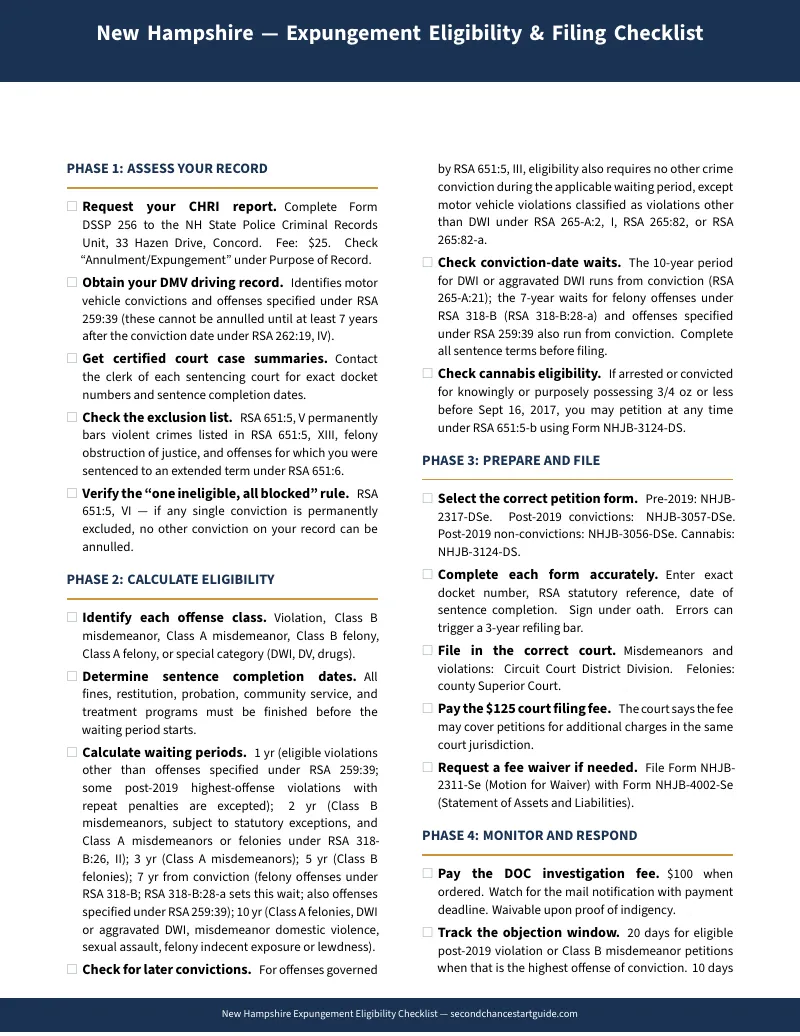
- Eligibility analysis by offense class — the waiting periods for violations (1 year), Class B misdemeanors (2 years), Class A misdemeanors (3 years), Class B felonies (5 years), Class A felonies (10 years), DWI convictions (10 years from conviction date), felony offenses under RSA 318-B:28-a (7 years from conviction, except a Class A misdemeanor or felony under RSA 318-B:26, II, which has a 2-year period under RSA 651:5, III(i)), and domestic violence misdemeanors (10 years), all mapped against the statute so you can verify your own timeline
- Sentence-completion calculator — the step-by-step process to identify the exact date your waiting period began, accounting for probation, suspended sentences, restitution, fines, community service, and court-ordered treatment programs. This is where most self-filed petitions fail.
- The "one ineligible, all blocked" rule explained — how one permanently barred conviction can lock your entire record, the violent crimes defined in RSA 651:5, XIII, felony obstruction of justice defined in RSA 651:5, XIV, and offenses sentenced to an extended term under RSA 651:6, plus what alternatives exist
- Petition form selection — which of the four court forms to use when a petition is needed: NHJB-2317-DSe (pre-2019 offenses), NHJB-3057-DSe (post-2019 convictions), NHJB-3056-DSe (post-2019 non-convictions), or NHJB-3124-DS (historical marijuana charges); plus the automatic annulment rule for qualifying post-2019 non-convictions
- Multi-petition filing strategy — how to use the same-court, same-time filing rule to have the $125 fee cover multiple petitions filed at one location together, and how to coordinate petitions across Circuit Court and Superior Court locations
- Fee breakdown and waiver instructions — every fee in the process ($125 court filing, $100 DOC investigation, $100 State Police removal), which ones apply to your case, and the full fee-waiver process using Form NHJB-2311-Se with the Statement of Assets and Liabilities
- The DOC investigation and hearing — what the Department of Corrections report covers, the prosecutor's objection window, what to expect if the court schedules a hearing, and how the judge applies the "consistent with public welfare" standard
- Non-conviction and dismissed-case relief — the automatic annulment rule for post-2019 non-convictions, the manual petition path for older dismissals, and the no-fee exception for arrest-only records
- Post-approval cleanup — how the State Police process the removal, the notification to federal agencies, how to verify your record is clean, and how to dispute entries with private background-check databases that keep reporting after annulment
- When you need a lawyer — clear boundaries for when a process guide is enough and when professional help is essential, including multi-county records, federal or immigration overlap, and professional licensing disclosures
- 8 standalone worksheets and planning tools — printable PDFs you fill in alongside the guide: an eligibility assessment worksheet, a sentence-completion calculator, a filing checklist and fee tracker, a fee calculator, a forms quick reference, a waiting-period quick reference, an agency communication log, and a post-annulment verification tracker
Who This Is For
This guide is for anyone in New Hampshire whose background check is showing an old arrest or conviction — and who needs a clear, step-by-step map of the annulment process without paying a lawyer. It covers eligible violations, misdemeanors, felonies, DWI convictions, non-conviction arrest records, and historical marijuana charges under RSA 651:5-b.
It is not legal advice. It does not file anything for you. It is a process guide that shows what to file, where to file it, and how to verify the result — written in plain language for people who are navigating this on their own.
Why Not Just Use the Free Court Forms?
The court self-help portal publishes the blank petition forms, a checklist, and a fee schedule. That is a list of ingredients, not a recipe. The forms do not explain how to calculate your sentence-completion date (which determines whether you can file at all), how the "one ineligible, all blocked" rule applies to your specific record, which of the four petition forms matches your situation, what happens during the DOC investigation, how to coordinate petitions across multiple courts, or what to do about the private databases that keep reporting your record months after the court grants the annulment.
A criminal defense attorney handles all of this for you — for a flat fee that typically runs between $1,500 and $3,000 per charge. For people with straightforward, eligible records who want to file on their own, this guide provides the same process knowledge at a fraction of that cost.
Satisfaction Guarantee
If the guide doesn't meet your needs, email [email protected] for a full refund, no time limit. We read every message.
Get Started
Download the free New Hampshire Expungement Eligibility Checklist to see if you qualify — or get the full New Hampshire Expungement & Record Sealing Guide for and start filing with confidence.
Frequently Asked Questions
What if the rules change after I buy?
We update the guide when the rules change. Email us any time, even years later, and we'll send you the current edition free.