Your record is public. Your options are not obvious.
A background check just blocked something that matters — a job offer in the Bakken oil fields, an apartment in Fargo, a nursing license application, a CDL clearance. The charge is years old, maybe even dismissed, but it's sitting on the public court portal for anyone who searches your name.
You look into sealing it. And immediately, you hit the wall: North Dakota's Legal Self-Help Center explicitly says they cannot assist with criminal record matters. No petition forms. No templates. No instructions. The state expects you to draft your own legal pleading — with the same precision as a licensed attorney — and a single formatting error or omitted address can get your petition denied. Worse, a denial can bar you from refiling for up to a year.
Lawyers charge $1,500 to $3,500 to handle this. National document-prep services charge $800 or more and still miss North Dakota's local procedural details — the 45-day prosecutor response window, the CDL exclusion on DUI sealing, the recent HB 1166 changes to nonconviction closure.
The Record Relief Filing System
This guide translates North Dakota's record relief statutes into a step-by-step filing system you can follow on your own. It's built around the five distinct relief tracks available in the state — each with different eligibility rules, waiting periods, and procedures — so you file the right petition in the right court the first time.
No generic templates pulled from another state's laws. No vague instructions to "consult an attorney." Every chapter maps directly to the statute that governs it, with the exact documents you need, the exact offices you file with, and the exact sequence of steps from your BCI record request through the signed court order.
What's Inside
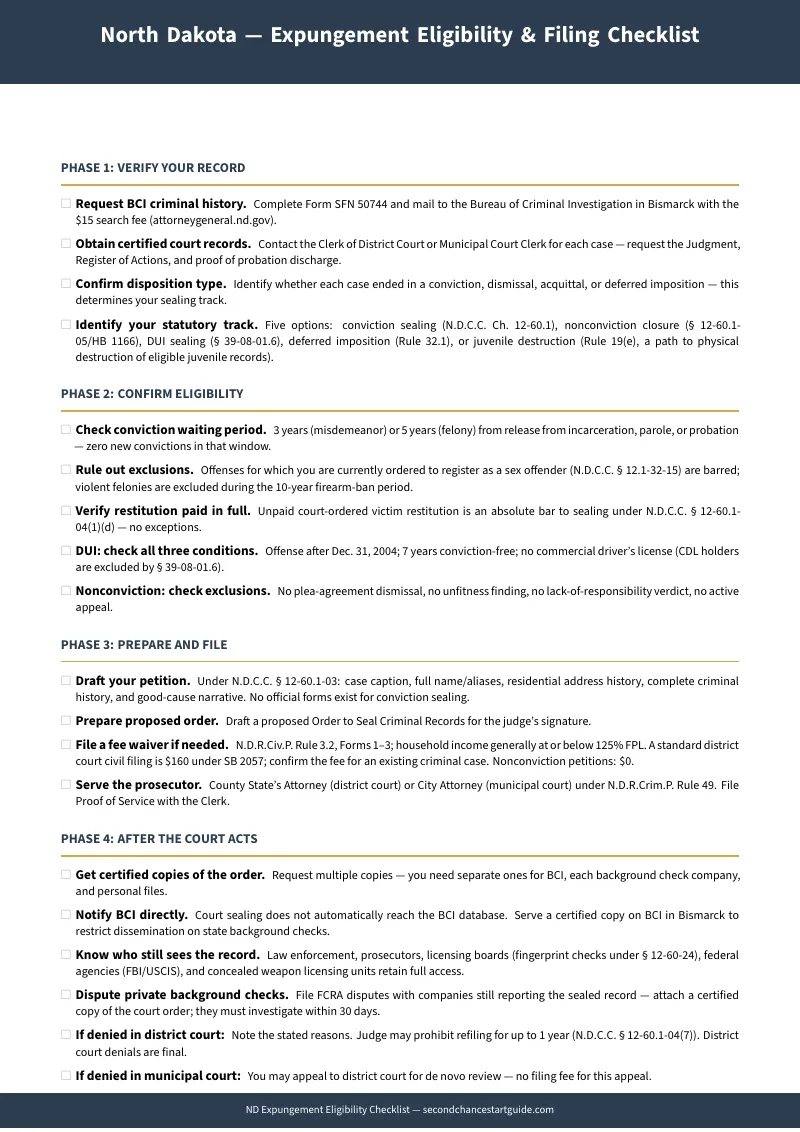
- BCI record audit walkthrough — how to request your official criminal history from the Bureau of Criminal Investigation (Form SFN 50744, $15 fee), cross-reference every entry, and catch discrepancies before they sink your petition
- Conviction sealing petition blueprint — the structural layout for your Petition to Seal Criminal Records and Proposed Order under Chapter 12-60.1, including the case caption, residential address history, full criminal disclosure, and the good-cause narrative that judges actually weigh
- Good-cause narrative framework — three elements (blocked opportunity, changed circumstances, disproportionate impact) that courts evaluate, with worked examples showing the difference between generic language that fails and specific documentation that succeeds
- HB 1166 nonconviction closure — the complete process for closing dismissed and acquitted records, including the August 1, 2025 dividing line, the official fee-free petition form, the four statutory exclusions, and what to do when the automatic closure doesn't happen on schedule
- DUI/APC sealing track — the separate § 39-08-01.6 pathway with its 7-year conviction-free requirement, the CDL exclusion, and eligibility rules that differ from standard conviction sealing
- Deferred imposition automatic sealing — how Rule 32.1 triggers automatic dismissal and sealing 61 days after probation completion for infractions and misdemeanors, with no petition required
- Filing fee and waiver guide — the $160 standard fee, the free nonconviction track, and step-by-step instructions for the fee waiver packet (Forms 1 and 2) if your income falls at or below 125% of the Federal Poverty Level
- Prosecutor service protocol — how to properly serve the State's Attorney or City Attorney under Rule 49, including the proof-of-service documents the court requires before it can act on your petition
- Admin Rule 41 remote access prohibition — the faster, more limited relief option that removes your case from the public internet portal without full sealing, and when it makes sense as a first step
- Post-sealing background check cleanup — how to use the Fair Credit Reporting Act to force private screening companies to purge outdated records, including a sample dispute letter and the certified court order process
- Firearm rights restoration timeline — how the 10-year felony firearm ban interacts with sealing eligibility, and when possession rights are restored
Who This Is For
- You have a misdemeanor or felony conviction in North Dakota and the waiting period has passed (3 years for misdemeanors, 5 years for felonies)
- You have a dismissed or acquitted charge from before August 2025 that's still showing up on background checks
- You completed a deferred sentence and want to confirm your record was automatically sealed
- You have a DUI or Actual Physical Control conviction and want to understand the separate sealing pathway
- A professional licensing board is asking about your criminal history and you need to understand what they can and cannot access after sealing
- A private background check company is still reporting a sealed or dismissed record and you need to dispute it
Why Not Just Google It?
The statutes are public. The problem is that the state provides absolutely no forms, templates, or filing instructions for conviction sealing petitions. The North Dakota Legal Self-Help Center tells you point-blank they cannot help with criminal matters. That means you're drafting legal pleadings from scratch — your petition, your proposed order, your confidential information form, your service documents — using statutory language you have to interpret yourself.
A minor drafting error changes everything. Omit one residential address. Forget to disclose an out-of-state arrest. Fail to include proof of service on the prosecutor. Any of these can result in an immediate denial — and the court can bar you from refiling for a full year. The guide gives you the structural blueprint that the court system doesn't provide.
What This Guide Does Not Do
This is an educational process guide, not legal representation. It does not establish an attorney-client relationship, and it makes no guarantees about the outcome of your petition. Meeting the statutory requirements gets you in the door — the judge's decision remains discretionary. The guide also explains the limitations of sealing clearly: sealed records remain visible to law enforcement, prosecutors, judges, and licensing boards with statutory background check authority. Federal immigration authorities do not recognize state sealing orders and require full disclosure. If your situation involves complex multi-jurisdiction records, pending charges, or immigration consequences, the guide includes referral pathways to Legal Services of North Dakota, the State Bar referral service, and specialized practitioners.
For less than the cost of a single hour of paralegal time, you get the complete filing roadmap — every track, every document, every deadline — in one place.
Includes the full guide (47 pages), the quick-reference eligibility checklist, and 5 standalone planning worksheets — eligibility assessment, criminal history audit, petition filing tracker, agency communication log, and post-sealing enforcement checklist.