Your license is suspended. The BMV website lists requirements. It does not tell you which court to call first or what happens if you pay fees in the wrong order.
You checked your BMV record and reinstatement requirements and found a wall of suspension codes. A 12-point suspension. Warrant blocks from courts you forgot about. A child support hold from a CSEA. An insurance non-compliance flag. Each hold has its own clearing entity, its own paperwork, its own fee — and the BMV will not reinstate your license until every one of them is resolved. Pay the reinstatement fee before clearing a court warrant block, and your money processes but your license stays suspended. Clear three holds but miss a fourth from a municipal court two counties away, and the BMV sends you home.
The Ohio Reinstatement Roadmap inside this guide is what free resources leave out: the exact resolution sequence — which holds to clear first, which courts to contact, which fees to pay in which order — organized so you do not waste money on steps the BMV will reject because a prerequisite was not met.
What's Inside
Hold Diagnosis and Record Audit
A step-by-step walkthrough of logging into the BMV portal with your OHID, downloading your Unofficial Copy of Your Driving Record (Two-Year), and using the separate "Reinstatement Requirements and Fees" service. The two-year record shows driving-record actions from the last two years; the guide shows you how to read it alongside your reinstatement requirements and map each hold to its clearing entity.
The 2025 House Bill 29 Reforms — What Changed and What Did Not
HB 29 retroactively eliminated suspensions for failure to pay court fines or fees and forgave $8.3 million in associated reinstatement fees. That relief did not automatically clear every separate suspension involving OVI, failure to appear, 12-point accumulation, child support, or insurance non-compliance. The guide explains which holds were lifted, which remain, and how to verify your specific situation.
OVI Dual-Track Timeline — because an arrest can start one track before a conviction starts another
An OVI arrest can trigger an immediate Administrative License Suspension (ALS) from the BMV; a later conviction can bring a separate court-ordered suspension, with ALS time credited against it. For a first offense, the ALS hard-time period is 15 days after a positive test or 30 days after a refusal. The guide maps both tracks, including court suspension periods, the three-day Driver Intervention Program option in lieu of jail for a first offense, the $315 reinstatement fee under the schedule effective April 9, 2025, and an ignition-interlock pathway under R.C. 4510.022 for eligible first-time offenders. The court may set conditions on those privileges.
Limited Driving Privileges — the petition most people file in the wrong court
Ohio courts can grant limited driving privileges for work, school, medical care, and treatment under R.C. 4510.021. But you must petition the right court: the sentencing court for court-imposed suspensions, the municipal or county court of your county of residence for BMV-imposed ones. The guide covers which court to file in, the supporting affidavit requirements (exact days, times, routes, addresses), the employer verification letter, and the "Privilege Notebook" system that some courts require.
Child Support Suspension Navigator — because the CSEA, not the court, controls your license
A Class F suspension is imposed by the BMV after a CSEA notice. Under HB 29, the CSEA may not notify the BMV earlier than 30 days after sending you notice; qualifying circumstances can affect whether the license suspension proceeds. For active suspensions, the guide walks through filing for limited driving privileges and the two concurrent motions required for administrative child support orders.
Insurance Non-Compliance — the one-year clock that restarts on a single lapse
HB 29 changed the repeat-violation lookback from five years to one year, eliminated registration blocks and vehicle impoundments, and shortened the mandatory SR-22 filing period from three or five years to one year. But a single policy lapse restarts the one-year compliance clock. The guide covers the 45-day response window after a BMV notice, the SR-22 filing process, reinstatement fees by offense count, and the documentation that prevents a rejected filing from resetting your timeline.
Stacked Suspensions — The Sequential Clearing Workflow
When multiple unrelated holds have piled up over years, the guide provides the resolution sequence that prevents wasted fees: (1) warrant blocks first, (2) CSEA electronic releases, (3) mandatory courses or Driver Intervention Programs, (4) SR-22 bond filing, (5) BMV Fee Installment Plan enrollment. Each step is mapped to its clearing entity with the forms, fees, and submission methods.
The BMV Fee Installment Plan and the Amnesty Program
If you owe at least $150, all mandatory suspension periods have ended, you have met every reinstatement requirement except the fees, and you are not on a court-approved fee plan, you may qualify for the Fee Installment Plan under OAC 4501:1-1-45. Its initial minimum first and monthly payments are $25, subject to change by the registrar. Eligible drivers who document indigence through SNAP, Medicaid, Ohio Works First, VA Pension Benefits, or SSI may seek a full fee waiver through the Amnesty Program. The guide walks through qualification and enrollment for both.
"Check Before You Drive" Verification Protocol
Paying your court fines does not mean you can drive. The BMV database must update to "Valid" status, and that can take 7–10 days if you paid by mail. Driving before the status changes is an offense under R.C. 4510.21 — up to 500 hours of community service and a $1,000 fine for a first offense, escalating to 180 days in jail for a third within three years. The guide explains how to verify your status and why you should carry a printed copy of the "Valid" abstract.
Professional Referral Decision Points
The guide identifies specific situations where the complexity warrants professional legal counsel — active criminal prosecution, OVI charges with contested facts, active warrants in multiple jurisdictions, CDL holders, immigration consequences, and inability to pay court costs — so you know when to handle it yourself and when to hire an attorney.
Who This Is For
- The driver who needs a valid license for a job that starts in two weeks — and has no idea how many holds are on their record or what order to clear them in
- The driver navigating their first OVI — dealing with an immediate ALS and a possible later court-ordered suspension from separate authorities, and trying to figure out when they can petition for driving privileges
- The parent facing a child support suspension — who needs to drive to keep paying the support and does not know the CSEA must wait at least 30 days after notice before notifying the BMV
- The driver with stacked holds from multiple courts and agencies — who paid one fine and expected their license back, but the BMV still shows "Failure to Reinstate" because other holds remain
- The driver who qualifies for fee relief but does not know it — who could use the Fee Installment Plan or the Amnesty Program instead of paying everything at once
Why Not Just Use Free Resources?
Free resources cover individual rules. They do not sequence them.
- The BMV website lists your reinstatement requirements but does not explain which court controls each hold, what order to resolve them in, or that paying a fee before clearing a prerequisite wastes money.
- Ohio Legal Help offers the best free overview available, with an AI-powered action plan. But it lacks local municipal court fee schedules, draft affidavit templates for limited driving privilege petitions, and the step-by-step CSEA motion walkthrough for administrative orders.
- OVI defense firm blogs cover the criminal side thoroughly — because that is what they bill $1,500 to $5,000 for. They intentionally leave out the administrative self-help steps, the Fee Installment Plan, and the Amnesty Program.
- IID vendor sites explain OVI penalties in detail — to sell you a $70–$150/month device lease. They cover nothing outside OVI: no child support, no warrant blocks, no insurance holds.
The guide gives you a coordinated resolution sequence for Ohio's different hold types. It maps each clearing entity, fee, and prerequisite so you can avoid paying for steps that cannot proceed yet.
What You Get
- The Ohio Driver's License Reinstatement Guide — a 51-page PDF covering hold diagnosis, the 2025 HB 29 reforms, OVI dual-track timelines, limited driving privileges, child support holds, insurance non-compliance, stacked suspension sequences, the Fee Installment Plan, the Amnesty Program, and professional referral decision points
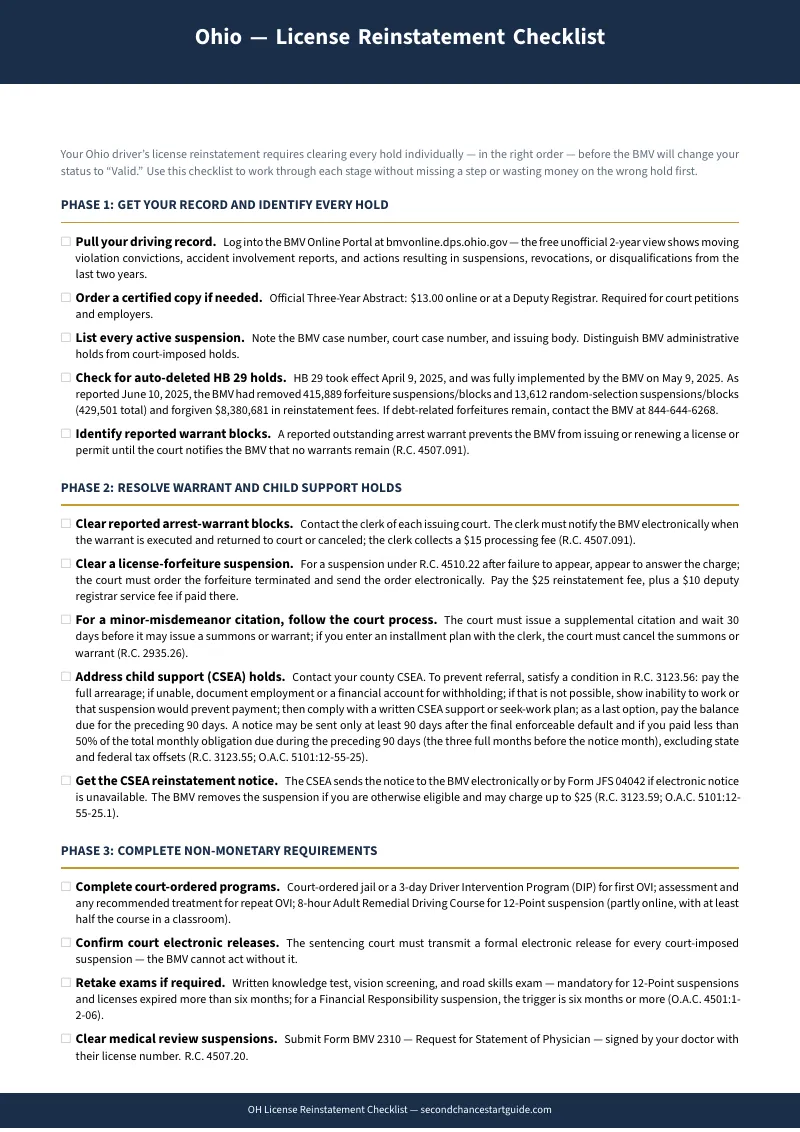
- The Ohio License Reinstatement Checklist — a two-page PDF covering hold diagnosis, clearing sequence, fees, and document requirements
- Six companion worksheets — Suspension Inventory, Reinstatement Fee Calculator (with installment plan and amnesty eligibility checks), Court Filing Checklist, Agency Communication Log, SR-22 Tracking Sheet, and Reinstatement Progress Tracker — all printable PDFs designed to be filled in by hand as you work through each step
Instant PDF download. No subscription. No hourly billing. Use it at your pace.
Not ready for the full guide? Download the free Ohio License Reinstatement Checklist — a two-page diagnostic covering hold identification, clearing sequence, and document requirements. It is enough to start organizing your record. The full guide and its six companion worksheets are there when you need the complete framework.
Full Refund, No Time Limit
If the guide does not help you, email [email protected] for a full refund. No time limit, no questions, no forms.
Frequently Asked Questions
What if the rules change after I buy?
We update the guide when the rules change. Email us any time, even years later, and we'll send you the current edition free.