Your license is suspended. The DMV won't tell you which agencies put the holds there — or what order to clear them in.
You checked your status on DMV2U and it says "Suspended." You assumed paying the court fine would fix it. It didn't — the court handled the judicial side, but the DMV still needs its own electronic clearance and its own reinstatement fee. Or you set up a payment plan with the Department of Revenue and expected the hold to lift automatically. It didn't — OAA needs to transmit the release separately, and the DMV can take several business days to process it. Or the Division of Child Support just sent a suspension notice, and now the license you need to get to the job that makes the payments is about to disappear.
Oregon's license suspension system is not one system. It is at least four — the DMV, the circuit and municipal courts, the Department of Revenue, and the Division of Child Support — and none of them coordinate with each other. File an SR-22 before the court has transmitted a Failure to Appear clearance, and you start paying high-risk insurance premiums on a license the DMV still cannot release. Pay the $85 reinstatement fee before the Department of Revenue has cleared its hold, and the fee cannot replace the DOR release or advance your status. Start an ignition interlock lease before confirming your hardship permit waiting period has passed, and you pay for hardware you cannot yet legally use.
Meanwhile, driving while suspended is generally a Class A traffic violation under ORS 811.175. Certain suspension types make it criminal under ORS 811.182, including Class A misdemeanor cases that carry up to 364 days in jail and a $6,250 fine and Class B felony cases.
The Hold Clearing Sequence — a step-by-step reinstatement map built around the order that actually matters
The Oregon Driver's License Reinstatement Guide is not a summary of what the DMV website already says. It is a process navigator built around one insight that free resources consistently miss: the order you complete the steps determines whether you waste money. Every hold type is mapped to its clearing agency, every clearing agency's requirements are laid out with exact forms, fees, and timelines, and the reinstatement sequence is organized so you never pay for something before the prerequisite step is done.
What's inside the guide
Hold Diagnosis and Driving Record Audit — because "Suspended" on DMV2U tells you nothing about why. The guide walks you through ordering a Certified Court Print, which includes five years of suspension, cancellation, and revocation entries and ten years of major traffic convictions. Use it as a starting point, then confirm any active hold and missing case details with DMV and the responsible agency before mapping the resolution path. You build a suspension inventory before spending a dollar or making a phone call.
Clearing Court-Level Holds — FTA, FTC, and Legacy Debt — because the DMV cannot lift a hold the court put there. Oregon ended new debt-based license suspensions in October 2020 under House Bill 4210, but pre-2020 Failure to Comply suspensions last up to 20 years unless the sentencing court clears them. Failure to Appear suspensions remain fully authorized and last up to 10 years. The guide explains how to identify which courts hold your suspensions, how to contact each court's traffic division, how to check whether the 2022 or 2023 gubernatorial remission orders already forgave your debt, and how to petition for fee relief when they did not.
The Department of Revenue License Reinstatement Program — because you may not need to pay your full court debt to get your license back. For circuit court debts assigned to the Department of Revenue's Other Agency Accounts division, the LRP lets you enroll with a $200 down payment and a monthly payment plan. The hold is lifted while you continue to pay. The guide covers the enrollment requirements, the payment methods that avoid processing delays, the no-grace-period rule that makes a missed payment grounds for removal from the program, and the 48-hour timeline for OAA to notify the DMV after enrollment.
DUII Dual-Track Navigation — because the criminal case and the administrative implied-consent suspension are handled by different agencies, and resolving one does not clear the other. A DUII arrest triggers an administrative suspension that can begin as soon as 30 days after a breath-test failure, plus a separate criminal case with its own mandatory suspension. The guide separates both tracks, explains the 10-day hearing-request deadline for a breath-test failure or test refusal (for a blood-test failure, use the deadline on the DMV notice), lays out the implied-consent suspension lengths and criminal conviction periods, and maps the hardship permit waiting periods, ignition interlock requirements, and OHA treatment completion certificate for each scenario.
Ignition Interlock and the 90-Day Rule — because a negative report during the final 90 days can extend the requirement. Under ORS 813.635, if a negative report occurs during the last 90 consecutive days of the required installation period, IID use continues until the manufacturer submits a certificate showing 90 consecutive days without a negative report, beginning on the date of the most recent negative report. The guide maps the installation process, the monitoring requirements, and what to track so you do not get caught by an unexpected extension.
Child Support Suspension Resolution — because the DMV cannot lift this hold itself, and it disqualifies you from a hardship permit entirely. When the Division of Child Support suspends your license for arrears equal to the greater of three months of support or $2,500, the Child Support Program or the prosecuting District Attorney's office handling the case must notify DMV when the requirements for reinstatement are met. And under ORS 807.240(8)(a), you cannot drive on a hardship permit while this hold is active. The guide walks through the 30-day notice period, the options for entering a payment agreement, and the release process.
Uninsured Accident and SR-22 Timing — because filing an SR-22 before the rest of your record is clean means paying high-risk premiums on a license the DMV cannot yet release. An SR-22 filing after an uninsured accident lasts three years. For accidents on or after January 1, 2026, Senate Bill 840 ended the mandatory one-year DMV suspension but kept the SR-22 requirement. A driving-uninsured conviction on or after January 1, 2026 requires a one-year SR-22 filing. The guide covers the carrier's legal obligation to notify the DMV if the policy lapses and the timing that prevents premature filing from wasting money.
The At-Risk Driver Medical Program — because a medical suspension comes from the DMV's own program, not from a court. The guide explains how the program initiates a suspension, the medical or psychological evaluation requirements, and the reinstatement steps.
Hardship Permits — Who Qualifies and Who Doesn't — because not every suspension type is eligible for restricted driving. Oregon hardship permits allow limited driving for work, medical care, treatment, and specific necessary services, with a 12-hour daily driving limit and strict documentation requirements. The DMV excludes traffic-crime revocations, At-Risk and child-support suspensions, second-or-subsequent DUII suspensions lasting three years, and assault suspensions when you were convicted of certain traffic crimes in the prior 10 years. Some DUII suspensions also have waiting periods. The guide covers the non-refundable $75 application fee, DUII waiting periods, and the employer verification or self-employment documentation you need.
The Driver Improvement Program — because a DMV-triggered suspension for accumulated convictions requires its own process. The guide covers the program requirements, the interview, and the restrictions on a provisional driving privilege.
The Reinstatement Fee and License Process — because "Eligible" on DMV2U does not mean you can drive. The guide explains the $85 reinstatement fee, the online and in-person payment options, and the critical distinction between "Eligible" (you may be able to apply for a driving privilege) and "Valid" (your driving privilege is reinstated). Drivers who assume a court clearance alone restores their license get caught here.
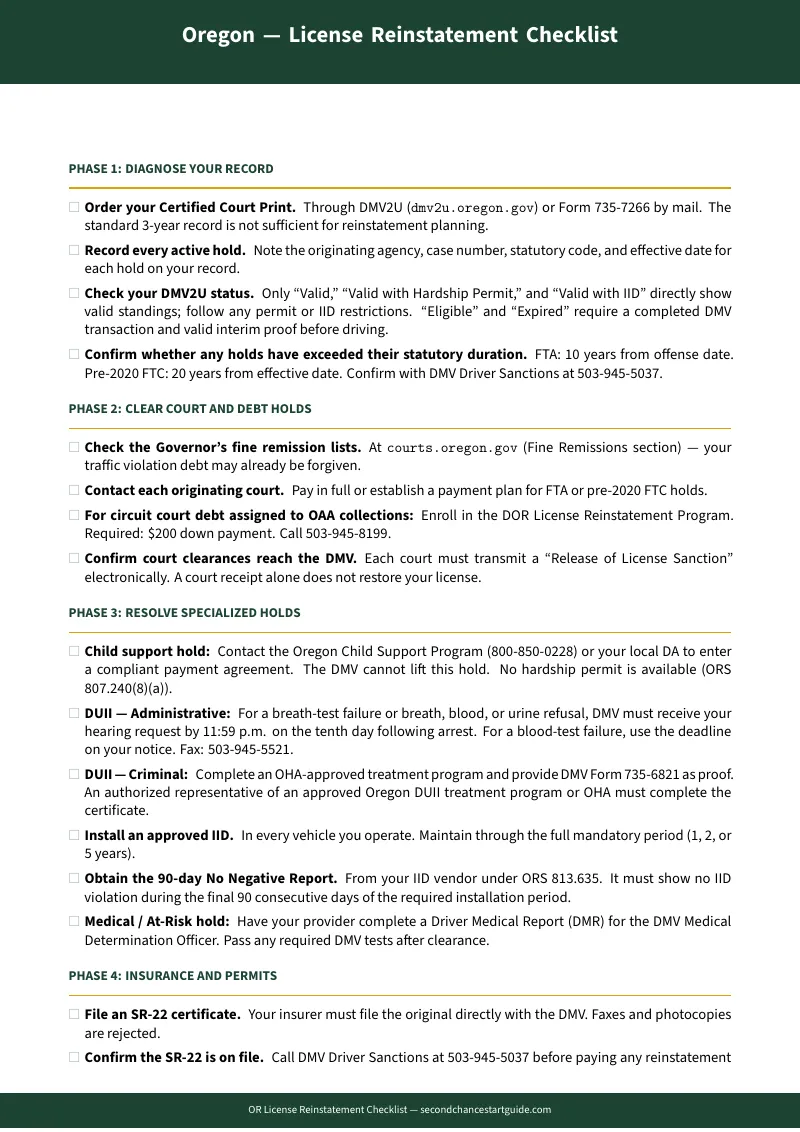
Plus: Worksheets and Planning Tools — Suspension Inventory Worksheet, Reinstatement Sequence Planner, Agency Communication Log, DUII Compliance Tracker, Hardship Permit Application Checklist, Reinstatement Fee Calculator, SR-22 Compliance Log, Court Hold Clearing Worksheet, DOR LRP Enrollment Tracker, and Child Support Hold Tracker. The free checklist covers hold identification and the diagnostic sequence — enough to start organizing your record tonight.
Who this is for
- Drivers with stacked holds from agencies that do not coordinate — one court hold, one DOR collection, one child support suspension, and maybe an old insurance lapse. The DMV will not reinstate until every agency has transmitted its clearance. The guide maps each hold to its clearing path and gives you the sequence that prevents wasted fees.
- Commuters whose job depends on driving — your license is suspended and there is no transit alternative. You need the fastest legal path back to driving, and the guide maps which restricted driving options apply to your specific suspension type.
- Drivers who paid the fine but are still suspended — you cleared the debt through the court or the Department of Revenue, but DMV2U still shows "Suspended." The guide explains why these are separate systems and what to do about the gap.
- DUII offenders navigating two parallel timelines — the administrative implied-consent suspension and the criminal case run on different tracks with different deadlines. The guide separates both and identifies where the ignition interlock and SR-22 requirements apply.
- Parents facing a child support license hold — you cannot afford to lose the license that gets you to work. The guide walks through the Division's 30-day notice process, the payment agreement options, and the release timeline.
- Drivers who may qualify for gubernatorial remission — Governors Brown (2022) and Kotek (2023) forgave certain pre-2020 traffic violation fines. The guide explains how to check the lists and what to do if your name is on one but your status has not changed.
Why not just use free resources?
The rules exist in public. The sequence does not.
- The DMV website lists reinstatement fees and links to forms. It does not explain how to coordinate a court-level FTA clearance with a Department of Revenue payment plan, does not warn you that paying the reinstatement fee before all source-agency holds are cleared wastes money, and does not cover the child support negotiation process.
- Oregon Law Help and the Oregon Law Center provide free court debt relief packets and self-help forms. They are focused on petitioning for fee waivers — they do not provide tactical guidance for DUII administrative requirements, hardship permit applications, or the sequencing of multiple overlapping holds.
- The Department of Revenue website explains the License Reinstatement Program for circuit court debts assigned to its Other Agency Accounts division. It cannot help with municipal or justice court holds, child support suspensions, implied-consent proceedings, or any of the other non-DOR agencies that may be holding your license.
- DUII defense law firm websites are built to convert you into a client. They cover the criminal defense side because that is what they bill for, but rarely explain the separate administrative requirements you must complete with the DMV. And they will not explain the LRP payment plan or the gubernatorial remission orders.
- Ignition interlock vendors push immediate installation while burying monthly lease, calibration, and de-installation fees. They do not explain that a negative report during the final 90 days can extend your interlock requirement beyond its initial period, and they do not warn about waiting periods that must pass before installation matters.
The guide costs a fraction of one wrong step in the reinstatement process. One premature SR-22 filing costs more in wasted premiums than the entire guide.
Satisfaction guarantee
If the guide does not deliver what it promises, email [email protected] for a full refund, no time limit.
Start clearing your holds today
The guide costs — one payment, instant download, no subscription. It covers every hold type, every clearing agency, every fee, and the exact sequence that prevents you from paying for something before the prerequisite step is done.
Not ready for the full guide? Download the free Oregon License Reinstatement Checklist — a two-page diagnostic covering hold identification, suspension code decoding, and the clearing sequence. Enough to start organizing your record tonight.
Frequently Asked Questions
What if the rules change after I buy?
We update the guide when the rules change. Email us any time, even years later, and we'll send you the current edition free.