
Your case is over. Your record is not.
You were arrested. The charges were dropped, dismissed, or resolved through deferred adjudication. You assumed the system would clean up after itself. It didn't. A DPS criminal history or court-index entry can remain. Private background-screening companies may still show information they collected before the case ended. And the next employer, landlord, or licensing board that runs a background check may see "dismissed charge" — which reads to them exactly the way you're afraid it does.
In Texas, a dismissed case does not by itself erase an arrest record. A completed deferred adjudication does not itself seal anything, though some eligible cases receive an automatic nondisclosure order after the required period. Record relief may be available through expunction under Chapter 55A of the Code of Criminal Procedure or nondisclosure under Government Code Chapter 411. Some expunction orders follow a separate petition; others can be entered through the criminal case. Nondisclosure may be automatic or petition-based for qualifying deferred-adjudication cases and specified convictions. Each route has different eligibility rules, timing, and outcomes. An ineligible filing may be denied and delay the process. If a petition omits an agency that holds a record, that record may remain.
The Texas Expungement & Record Sealing Guide is a Dual-Track Clearance System — a complete diagnostic and filing manual that covers both pathways, start to finish, for people who want to handle the process themselves.
What the Dual-Track Clearance System Covers
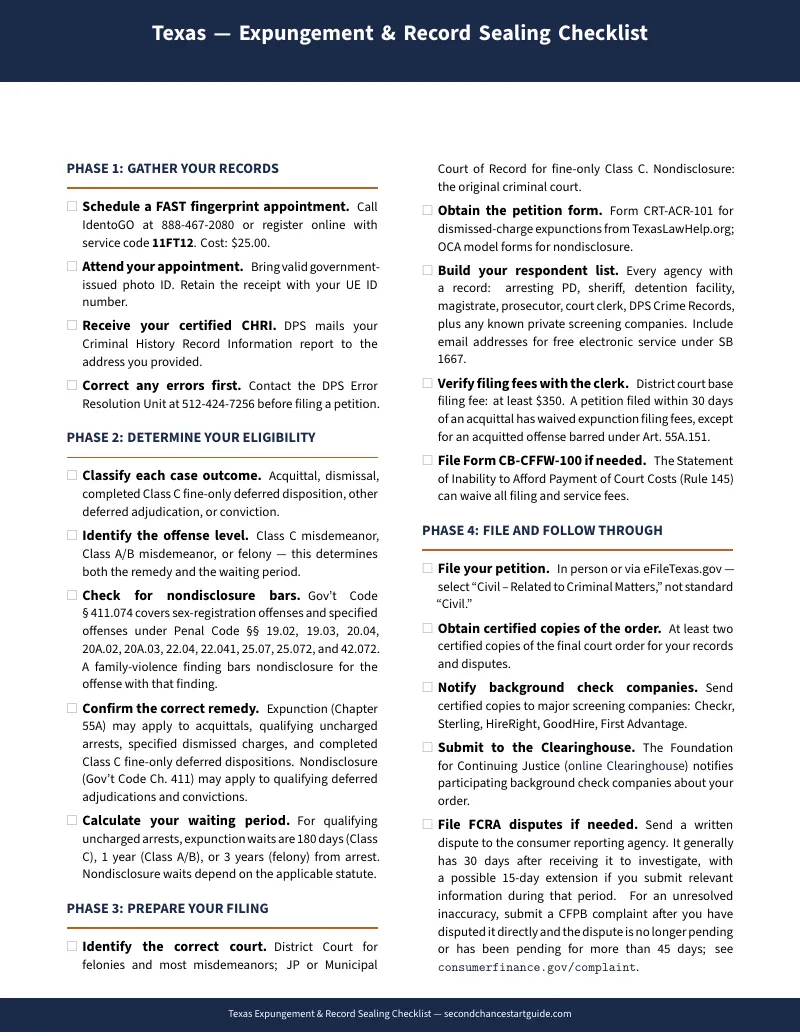
The Eligibility Decision Tree. Texas law offers two main record-relief pathways with strict eligibility boundaries. Expunction under Chapter 55A can apply to acquittals, qualifying dismissals, no-billed arrests, and arrests that were never charged, subject to the rules for each route. Nondisclosure under Chapter 411 can apply to qualifying deferred-adjudication cases and specified convictions, with statutory exclusions. The guide maps your case outcome, offense class, and elapsed time to the applicable route so you can assess eligibility before filing.
Waiting Period Calculator. Timing depends on the route. Under Article 55A.052(a), when its eligibility conditions are met and no indictment or information charging a misdemeanor based on the arrest or a felony arising from the same transaction has been presented, waiting periods from arrest are 180 days for a Class C misdemeanor with no same-transaction felony charge, one year for a Class A or B misdemeanor with no same-transaction felony charge, and three years for a felony or same-transaction felony charge. The attorney representing the state may certify that the records are not needed for any criminal investigation or prosecution, allowing earlier filing. Article 55A.054 applies when prosecution is no longer possible because the limitations period has expired. Under Section 411.0725, a qualifying deferred-adjudication misdemeanor can be petitioned for at discharge and dismissal; specified misdemeanors under Penal Code Chapters 20, 21, 22, 25, 42, 43, or 46 have a two-year wait, and qualifying felonies have a five-year wait. Section 411.072's automatic route has a 180-day minimum from the date the court placed the person on deferred-adjudication community supervision. The guide maps the timelines so you can identify the one that applies.
Chapter 55A Petition Drafting. The expunction petition is the document the court evaluates. It must name every agency that holds a record of the arrest — DPS, the arresting law enforcement agency, the county sheriff, the jail booking facility, and any other entity that processed or stored case information. Miss one, and that agency keeps the record even after the judge signs the order. The guide covers the required elements, the verification statement, the common omissions that leave records intact, and the county-specific filing procedures that trip up pro se filers.
eFileTexas Walkthrough. Electronic filing is available to pro se petitioners, but the portal was built for attorneys. The filing category for expunctions is "Civil – Related to Criminal Matters," not standard civil — and selecting the wrong one may lead to a clerk return for correction. Documents must be text-searchable PDFs. Each case requires its own filing envelope. The guide walks through every screen, from court selection and filing codes to document formatting and the payment step.
Nondisclosure Filing Guide. Nondisclosure under Government Code Chapter 411 has automatic and petition-based routes for qualifying deferred-adjudication cases and specified convictions, including DWI/BWI-specific provisions. The guide explains the eligibility, timing, and filing court for the routes it covers, and what a nondisclosure order does and does not hide from public view.
Post-Order Private Database Updates. This is where most other resources stop — and where the real frustration begins. The court order directs government agencies to process record destruction, return, or sealing. Private companies may still hold separately collected data; for nondisclosure orders, DPS also sends notices to certain private entities under Section 411.075. The guide covers contacting companies likely to hold your record, submitting an order to the Expungement Clearinghouse, disputing inaccurate information under the FCRA, and Chapter 109's prohibition and potential remedies when a business entity covered by the chapter continues publishing criminal record information after it knows of or receives notice that an expunction or nondisclosure order has issued for that information. The Clearinghouse says its notifications reach more than 500 private-sector sources.
Special Circumstances. Immigration applicants face a critical risk: federal law defines "conviction" more broadly than Texas law, and destroying records before securing certified copies can complicate a USCIS application. Professional license applicants need to understand that while Section 411.0755 means they don't have to disclose a nondisclosed proceeding in a licensing application, certain boards listed in Section 411.0765 may still receive the record. LTC applicants need to know the five-year bar and when a sealed order removes it. The guide identifies these edge cases before you file.
Who This Guide Is For
- Job seekers whose background check shows a dismissed charge, a no-billed arrest, or a completed deferred adjudication — and who need it gone before the offer expires
- Renters blocked by an automated tenant screening that flagged an old arrest, even though the case was dismissed
- Professional license applicants in nursing, education, real estate, law, or other regulated fields who need to understand what a nondisclosure order does and does not hide from their licensing board
- Non-citizens preparing a USCIS application who need to protect their documentation before filing a state petition
- Anyone who already got a court order but still appears on private background checks and mugshot sites — the guide's post-order steps explain how to request updates from screening companies and use the applicable legal protections
Why Not Hire an Attorney or Use Free Forms?
An expunction attorney charges between $1,500 and $3,500 for a straightforward, uncontested case. For complex cases — multiple arrests, contested hearings, immigration considerations — professional representation makes sense, and the guide tells you when to hire one. But for cases where eligibility is clear and no one is expected to object, the procedural steps are the same whether you file them or an attorney does. The difference is whether you're paying for the procedure or the lawyer's time.
Free forms on TexasLawHelp cover basic, uncontested scenarios. They do not include county-specific fee breakdowns, eFileTexas filing-code walkthroughs, the full list of agencies to name in the petition, or any process for clearing private background-check databases after the court signs the order. Generic online document services still reference the pre-2025 Chapter 55 framework instead of the current Chapter 55A — a petition built on outdated statutory language risks clerk rejection.
The guide bridges the gap: the same procedural depth an attorney would follow, at a fraction of the cost, with the post-order private-database clearance process that most attorneys don't handle.
What You'll Have When You're Done
- A clear determination of whether your case qualifies for expunction, nondisclosure, or neither — before you spend a dollar on filing fees
- A correctly drafted petition with every required agency named and the verification statement included
- A filed case through eFileTexas or in person, with the right filing category, the right document format, and the fees accounted for
- A signed court order — and post-order steps for requesting updates from private background-screening databases, data brokers, and mugshot websites
Satisfaction Guarantee
If the guide doesn't deliver what it promises, email [email protected] for a full refund, no time limit. Every word in this guide is specific to Texas law. If it doesn't match your situation, you don't pay.
Start Clearing Your Record
The guide costs — one payment, no subscription, no hourly billing. It covers both expunction and nondisclosure, the filing process, and the post-order steps for requesting updates from private databases. Plus five printable planning tools — an eligibility diagnostic worksheet, a filing cost calculator, a respondent agency tracker, a post-order database clearance log, and a timeline planner — and a two-page eligibility checklist you can work through tonight.
Not sure yet? Download the free Texas Expungement Eligibility Checklist — a two-page diagnostic that maps your case outcome to the applicable record-relief pathway. If the checklist shows you're eligible, the full guide is there when you're ready to file.
Frequently Asked Questions
What if the rules change after I buy?
We update the guide when the rules change. Email us any time, even years later, and we'll send you the current edition free.