A Background Check Just Derailed Your Plans. Vermont Law Says You Might Not Have to Live With It.
You already served the sentence. You did the time, paid the fines, stayed out of trouble. But every employer, every landlord, every licensing board that runs a background check sees the same thing — and makes the same assumption. The record follows you like a second sentence, one that nobody told you how to end.
Vermont law provides a path to seal or expunge qualifying records. But the process is dense, procedural, and unforgiving of mistakes. Act 60 — effective July 1, 2025 — overhauled the entire system, restricting true expungement to a narrow set of cases and shifting most relief to the sealing track. Online advice written before the change will steer you wrong. A premature filing triggers a mandatory two-year lockout before you can try again.
The Record Clearance Filing System
This guide is built around a single objective: getting you from "I think I might be eligible" to a court order in your hand, without a lawyer and without the kind of procedural mistake that costs you two years.
It walks through Vermont's post-Act 60 record clearance process in the exact order you need to handle it — which remedy applies to your case (expungement, sealing, or automatic clearance), whether you meet the waiting period, how to obtain and verify your official records, how to complete the petition forms correctly, how to seek a prosecutor's stipulation that avoids a hearing entirely, and what to do after the court grants your order when private background check companies still show the old record.
What's Inside
The complete filing system includes 10 PDFs — the full guide, an action checklist, and 8 standalone worksheets and reference cards you can print and use alongside the actual court forms:
- Act 60 Eligibility Analysis — the guide maps every offense category to the correct remedy under current law, so you know before you file whether you qualify for expungement (decriminalized conduct only), petition-based sealing (standard misdemeanors and non-violent felonies), or automatic sealing (non-convictions and certain motor vehicle violations). Includes a printable Eligibility Decision Tree worksheet.
- Waiting Period Calculator — a fill-in worksheet that walks you through calculating your exact eligibility date based on offense type (3 years for misdemeanors, 7 for felonies, 10 for DUIs, 30 days for ages 18–21), because filing even one day too early triggers an automatic denial and a two-year refiling ban
- Record Request Checklist — a take-to-courthouse reference card covering how to request your official history through the VCIC or county courts, what to bring, fees, and a fill-in tracker for every docket number and disposition date you need for your petition
- Petition Form Walkthrough — a field-by-field reference for completing Form 200-00130 (the petition itself), Form 200-00132 (the prosecutor stipulation), and Form 600-00229 (the fee waiver), plus a multi-county filing tracker
- Prosecutor Stipulation Prep Card — how to approach the State's Attorney's office to request a stipulated agreement that lets a judge approve your petition without a hearing, what factors make stipulation more or less likely, and a preparation worksheet
- Forms & Fees Reference — a single-page card listing every form number, filing fee, and download link for Vermont's record clearance process
- Key Contacts — phone numbers and addresses for the VCIC, Restitution Unit, Vermont Legal Aid, the South Royalton Legal Clinic, VBA Lawyer Referral, and the CFPB
- Post-Sealing Verification Tracker — a post-order worksheet for tracking government database updates and filing FCRA disputes with private background check companies that continue reporting sealed records
- Post-Order Database Enforcement — the guide covers the specific dispute steps under the Fair Credit Reporting Act to force private screening companies to update their databases, plus the Act 60 penalty provisions
- Special Situations Coverage — immigration consequences (why non-citizens should obtain certified copies before sealing), professional licensing board access to sealed records, the restitution trap (sealing does not erase court-ordered debt), and Ban the Box protections for job applicants
Who This Is For
This guide is designed for people who are handling the petition process themselves — whether that is because Vermont Legal Aid's income caps (125% of the federal poverty level) put free representation out of reach, because a private attorney's $400–$4,000 fee does not make sense for a straightforward, uncontested case, or because you want to understand the full process before deciding whether to hire help.
It is not legal advice and cannot replace an attorney for contested cases, cases with complex multi-county histories, or cases involving immigration consequences. What it does is give you the procedural knowledge to file correctly, avoid the mistakes that trigger denials and delays, and enforce your rights after the court acts.
Why Not Just Use the Free Court Forms?
The Vermont Judiciary publishes the petition forms online. What it does not publish is the instruction manual. The forms themselves do not tell you whether your offense qualifies under Act 60's new categories, whether your waiting period has actually elapsed, how to calculate your eligibility date when probation was extended or revoked, how to approach the prosecutor for a stipulation, or what to do when a private background check company ignores your court order six months later.
Filing the wrong petition type, miscalculating a waiting period, or submitting before all restitution is cleared does not just result in a denial — it triggers a mandatory two-year ban on refiling under 13 V.S.A. § 7605. The forms are free. The mistakes are expensive.
100% Satisfaction Guarantee
If the guide does not give you a clear, actionable path through Vermont's record clearance process, email us for a full refund. No conditions, no time limit.
Start With the Free Checklist or Get the Full Guide
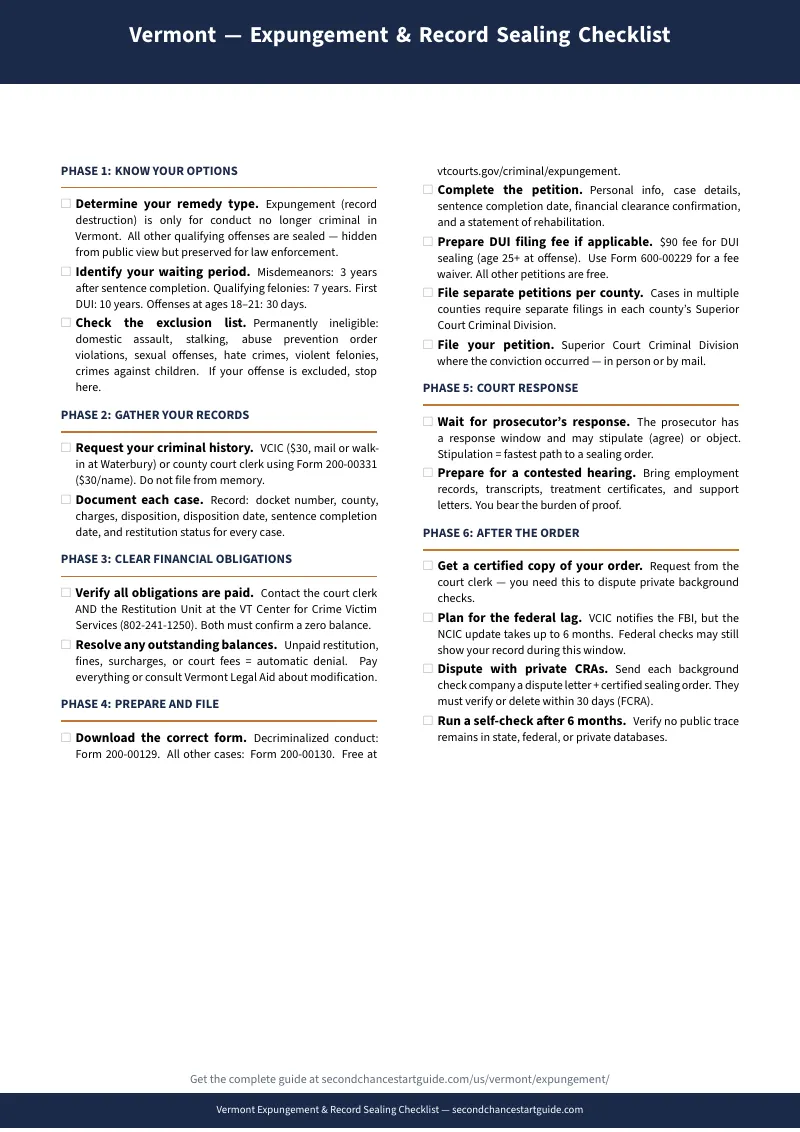
The free Vermont Expungement Eligibility Checklist gives you a quick overview of the eligibility requirements and filing steps — enough to understand whether record clearance might apply to your situation. When you are ready for the complete filing system — eligibility analysis, form-by-form instructions, prosecutor strategy, and post-order enforcement — the full guide picks up where the checklist leaves off.