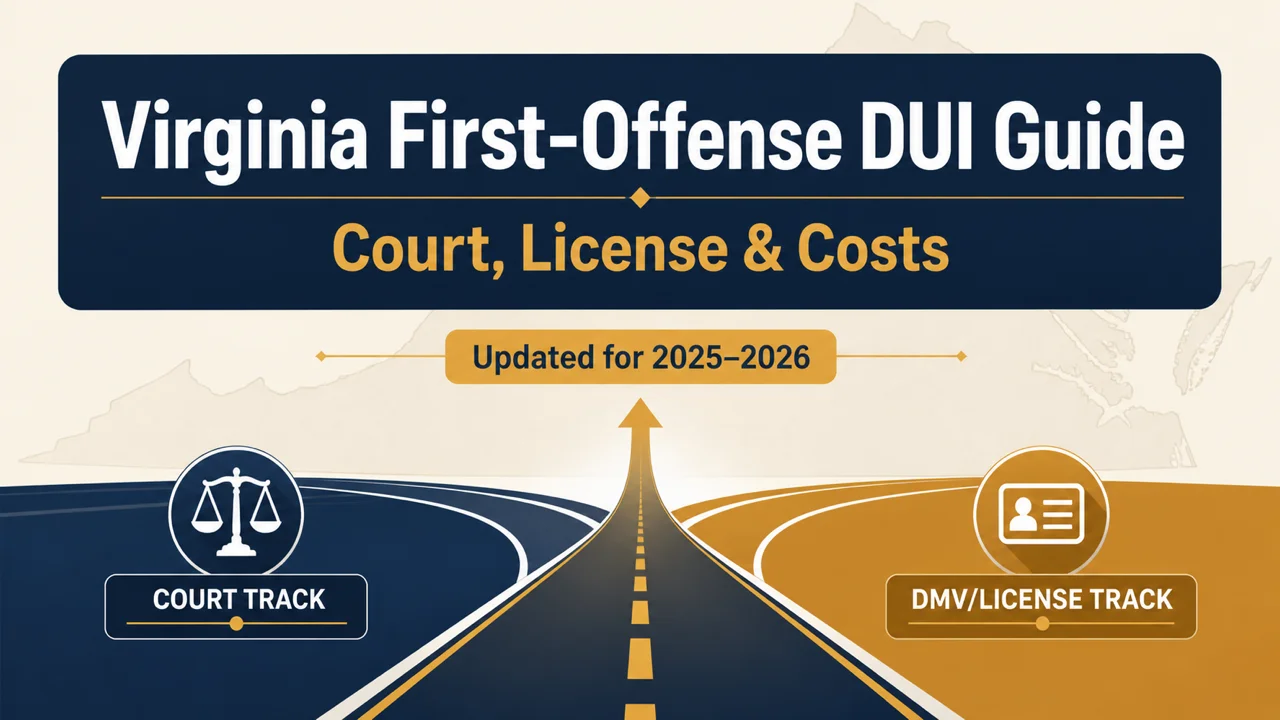
Two separate systems are running your case right now. The court controls one. The DMV controls the other. Neither one explains the other.
A first-offense DUI in Virginia splits into two parallel tracks that operate on independent timelines with different decision-makers and different deadlines. The General District Court handles the criminal case — arraignment, trial, fines, potential jail time, and the mandatory 12-month license revocation that follows a conviction. The Department of Motor Vehicles controls your driving privileges through an entirely separate administrative process — the immediate 7-day hard suspension, restricted license eligibility, FR-44 insurance requirements, and the reinstatement sequence. Finishing every court requirement does not automatically restore your license. You have to satisfy the DMV's administrative conditions separately, in the correct order, and they don't coordinate with the court clerk.
Online resources cover individual pieces of this process, scattered across agency websites written in regulatory language that assumes you already understand how the tracks interact. Defense attorney blogs explain the criminal case clearly — then pivot to a retainer pitch. Interlock company websites push you toward a lease agreement without explaining the VASAP enrollment sequence that determines whether your compliance time actually counts. The Virginia DMV site handles reinstatement steps but says nothing about court-ordered conditions or sentencing timelines.
The Dual-Track Compliance Navigator
This guide maps the criminal court process and the DMV licensing process onto a single chronological timeline. It shows you what to do in each system, when to do it, and — critically — where one system's deadlines affect the other. It's built specifically for Virginia: the 7-day administrative suspension under Virginia Code § 46.2-391.2, the Motion for Review (Form DC-202), both restricted license options under § 18.2-270.1(C), the VASAP enrollment sequence, the FR-44 doubled insurance mandate, the mandatory ignition interlock protocols, the Clean Slate Act exclusion for DUI convictions, and the full reinstatement process.
It doesn't replace a lawyer. It covers the administrative and logistical steps you have to execute yourself regardless of whether you have one — and flags the specific situations where professional legal help is non-negotiable.
What's Inside
- Dual-track timeline — every General District Court hearing and DMV administrative deadline mapped in sequence, from the moment of arrest through full license reinstatement, so you never miss a filing window or confuse which agency controls the next step
- 7-day survival plan — exactly what you can and cannot do during the hard administrative suspension, how to challenge the ALS through Form DC-202, and how to retrieve your physical license from the court clerk on day eight
- Restricted license walkthrough — both options under Virginia Code § 18.2-270.1(C) explained in plain language: the route-restricted license (6 months of interlock, travel limited to approved locations on Form DC-263) versus the unrestricted restricted license (12 months of interlock, any-purpose driving), with eligibility requirements for each
- VASAP compliance sequence — the 15-day post-conviction enrollment deadline, the $400 fee structure ($300 enrollment plus $100 intervention), the intake evaluation, case manager monitoring, and how violation reports flow from VASAP back to the sentencing court
- FR-44 insurance mandate — Virginia's doubled liability requirements explained with 2025–2026 limits ($100,000/$200,000/$50,000), how your insurer files the certificate electronically with the DMV, the consequences of any coverage lapse, and how to secure non-owner FR-44 policies if you don't own a vehicle
- Criminal court walkthrough — what happens at arraignment, how bench trials work in GDC (judge-only, no jury), the 10-day de novo appeal window to Circuit Court, and how pre-conviction VASAP enrollment demonstrates proactive compliance to the sentencing judge
- Line-by-line cost breakdown — every mandatory expense itemized: the $250–$2,500 fine range, court costs, VASAP fees ($400), interlock installation (up to $65 standard), monthly calibration (~$95/month), removal (~$50), the DMV reinstatement fee ($220), and the multi-year FR-44 insurance premium impact
- Elevated BAC and refusal consequences — the mandatory jail thresholds (5 days for BAC 0.15–0.19, 10 days for BAC ≥ 0.20), child passenger penalties, and the separate one-year suspension with no restricted license eligibility for chemical test refusal
- Clean Slate Act reality check — confirmed verification that DUI convictions are permanently excluded from both automated and petition-based record sealing under the Virginia Clean Slate Act effective July 1, 2026
- Special situations — CDL holders facing commercial disqualification, out-of-state license holders under the Interstate Driver License Compact, immigration consequences for non-citizens, and cases involving accidents with injury
- Five printable worksheets — fill-in tools that keep the two tracks organized: the DUI Compliance Timeline Tracker, Document Collection Checklist, Cost Tracking Worksheet, Court Preparation Checklist, and Agency Communication Log
Who This Guide Is For
This guide is for anyone in Virginia facing a first-offense DUI who needs to understand both the criminal court process and the administrative licensing process — all the deadlines, forms, fees, and decision points — before making choices that affect their driving privileges and their record. It's especially useful if you're handling the administrative side without an attorney, but it's equally valuable alongside legal representation because it covers the DMV compliance steps that defense lawyers typically don't walk you through.
It is not for people facing a second or subsequent offense (different mandatory penalties apply), CDL holders facing federal commercial disqualification (consult an attorney immediately), or anyone whose case involves an accident with serious injury, contested breathalyzer calibration evidence, or controlled substance impairment.
Why Not Just Use Free Resources?
The Virginia DMV website at dmv.virginia.gov has reinstatement requirements and fee schedules, but it's written in regulatory language that assumes you already understand the relationship between your court case and your license status. The General District Court system manages dockets and bond conditions but says nothing about DMV restoration steps. Defense attorney websites explain the criminal defense strategy clearly — then stop before the licensing logistics, because that's not what they're selling. Interlock provider sites present simplified summaries of state rules designed to move you toward a lease agreement, often skipping the VASAP enrollment step that determines whether your interlock compliance time actually counts toward your restricted license.
Virginia is one of only two states requiring FR-44 insurance instead of the standard SR-22 — national DUI advice doesn't even mention this requirement. Generic "hardship license" advice from other states is misleading because Virginia mandates ignition interlock installation as a condition of every restricted driving privilege.
This guide takes the accurate, current information scattered across those sources and organizes it into a single process you can follow from start to finish — with the deadlines, forms, fees, and decision points for both tracks in the order you'll actually encounter them.
Download the Free Checklist First
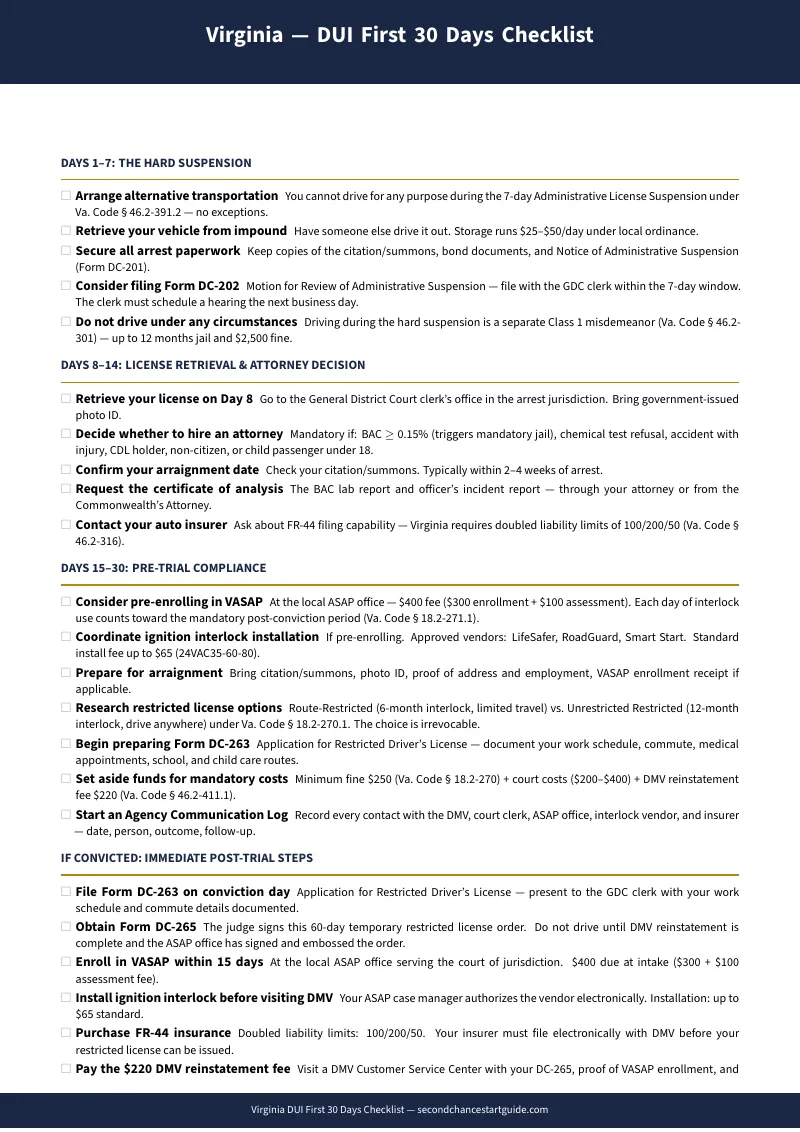
Not sure you need the full guide? Start with the free Virginia — DUI First 30 Days Checklist — a deadline-first action list covering the critical first month after arrest, from the 7-day hard suspension through license retrieval, VASAP pre-enrollment, and preparing for your first court appearance. The full guide shows you how to handle each step, with the context, costs, and decision frameworks behind every action.