You have seven days to request a DOL hearing.
If you were arrested for DUI in Washington, two separate legal machines just switched on. The Department of Licensing is moving to suspend your driving privileges on a civil track — and the criminal court system is building a case on a completely separate timeline. The DOL does not wait for the court, and the court does not care what DOL decides. Miss a deadline on either track and you lose options you cannot get back.
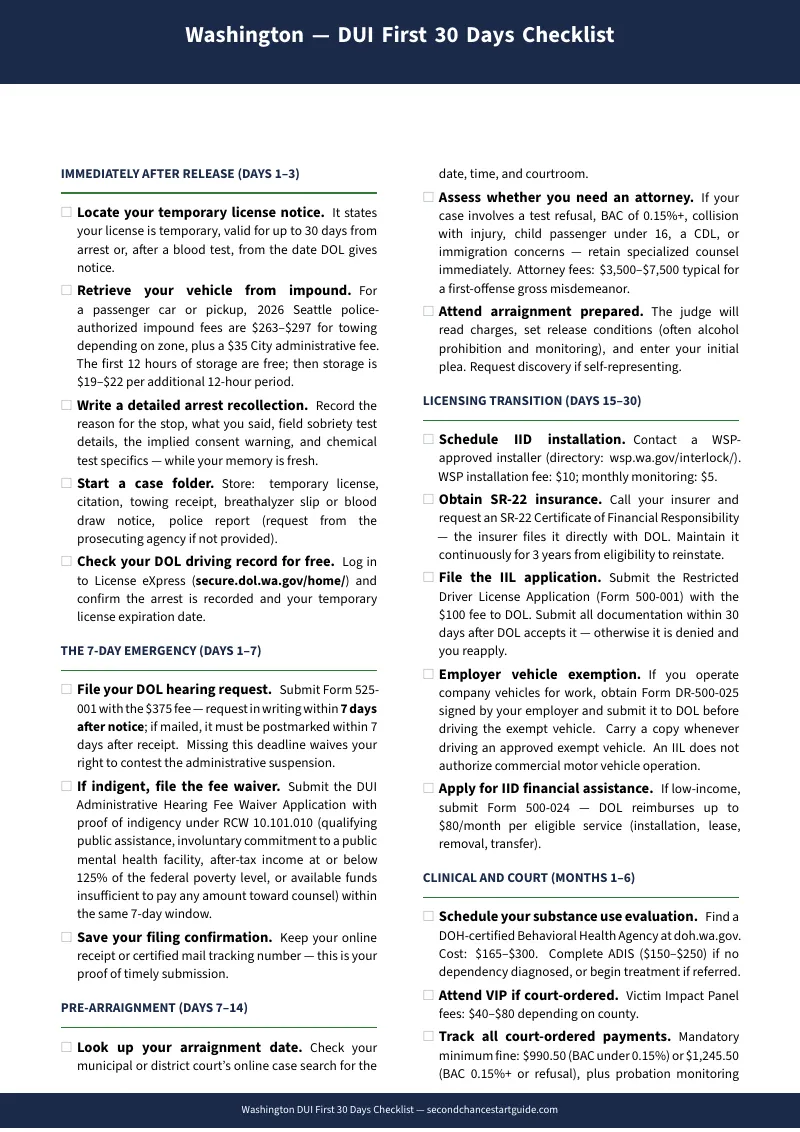
The most dangerous moment is not your first court appearance. It is the 7-day window to request a DOL administrative hearing. An online request is due within seven days after notice is given; a mailed request must be postmarked within seven days after you receive the notice. The $375 fee must accompany the request unless DOL waives it for an indigent person. DOL action takes effect 30 days after arrest, or after DOL notice following a blood test, or when sustained at a hearing, whichever occurs first. A late request may still be considered if you establish good cause under WAC 308-101-080.
Meanwhile, government websites scatter the rules across DOL's Administrative Law Office, the courts, and the state patrol — each covering only their own piece. Defense attorney sites explain just enough to get you into a consultation. And national legal publishers miss Washington-specific details entirely, including the 2026 felony lookback expansion and the current sentencing grid minimums.
The Dual-Track Navigation System
The Washington First-Offense DUI Guide is built around the structural reality that makes Washington DUIs uniquely complicated: you are navigating two independent legal proceedings at the same time, with different agencies, different deadlines, different standards of proof, and different outcomes. This guide maps both tracks in the order you encounter them — so you know exactly what to do, when to do it, and what it costs at every stage.
This is process navigation, not legal advice. The guide does not tell you whether to plead guilty or contest the charge. It tells you every administrative step, every deadline, every fee, and every decision point — so your time with an attorney is spent on legal strategy, not logistics.
What's Inside
- The 7-day DOL hearing deadline, step by step — exactly how to submit your hearing request through License eXpress or by mail, including the fee waiver application process for drivers who qualify for financial assistance. A late request may still be considered if you establish good cause under WAC 308-101-080.
- Administrative hearing preparation — what issues the hearing covers (lawful arrest, implied consent warnings, test administration, applicable thresholds), how to request the police report, and what to expect from the administrative law judge.
- The criminal court timeline, from arraignment through sentencing — when your first appearance is due, what pretrial release conditions to expect, the mandatory sentencing grid minimums ($990.50 for BAC under 0.15%, $1,245.50 for 0.15%+ or refusal), and how deferred prosecution and plea reductions work.
- Ignition Interlock License walkthrough — the three-step application (device installation, SR-22 filing, $100 fee), the employer exemption protocol using Form DR-500-025, and the CDL exclusion that commercial drivers need to know immediately.
- A realistic, itemized cost breakdown — the $375 hearing request fee (which DOL may waive for an indigent person), the $170 alcohol-related reissue fee, and other costs to track, including towing and impound (Seattle's authorized rate schedule), interlock device costs, clinical evaluation and program fees, and SR-22 insurance premiums.
- Chemical dependency evaluation and treatment — what the mandatory evaluation involves, how to find a certified Substance Use Disorder Professional, and the difference between Alcohol and Drug Information School and outpatient treatment programs.
- License reinstatement, end to end — the complete checklist from verifying your suspension end date through paying the $170 alcohol-related reissue fee, maintaining SR-22 for three years, submitting treatment compliance, and meeting the 180-day removal requirements for deferred-prosecution and postconviction restrictions.
- Record relief and the 10-year pathway — Washington does not permanently bar DUI vacation. The guide explains the statutory waiting period, the no-violation requirement, how qualifying DUI-related reduced convictions follow the same 10-year rule, and how 2024 legislation changed the general misdemeanor vacation timeline.
- Six printable worksheets and reference sheets — a document collection tracker, agency communication log, cost tracker with typical Washington amounts, month-by-month IID compliance calendar, reinstatement checklist with date fields, and a key resources and contacts reference card. Print the ones you need and keep them with your case folder.
Who This Is For
- Drivers who need to protect their commute — your livelihood depends on driving, and you need the fastest path to an Ignition Interlock License before the temporary permit expires.
- People preparing for a public defender — your attorney's time is limited. The guide handles every administrative step and deadline so your defender can focus on the legal merits of your case.
- Anyone supplementing private legal counsel — even with a defense attorney, you are responsible for the DOL hearing request, interlock installation, SR-22 filing, evaluation scheduling, and reinstatement paperwork. The guide prevents unforced administrative errors during those steps.
- Out-of-state drivers arrested in Washington — the guide covers how Washington's administrative actions interact with your home state's licensing authority and the special IIL rules for out-of-state license holders.
Why Not the Free Government Websites
Washington DOL explains what the suspension rules are. The DOL Administrative Law Office explains what a hearing involves. The courts explain what happens at arraignment. The state patrol lists approved interlock vendors. What none of them do is put the two tracks in chronological order and show you how the pieces fit together — which deadline triggers which consequence, which agency filing must happen before which court date, and what happens if you get the sequence wrong.
Defense attorney websites provide valuable legal context, but their information funnels toward a consultation. The specific administrative self-help steps — how to file a fee waiver, how to coordinate SR-22 timing with your interlock installation, how to request police reports and other discovery for your defense — are not the kind of content that generates billable hours.
Satisfaction Guarantee
Full refund, no time limit. If the guide does not give you what you need, email [email protected] and we will refund the full amount.
Start With the Free Checklist or Get the Full Guide
The free Washington — DUI First 30 Days Checklist covers the first month: 24 deadline-first actions, contacts, and immediate steps across both tracks. It is enough to stabilize your situation and avoid the worst unforced errors.
The full Washington First-Offense DUI Guide adds the complete chapter-by-chapter walkthrough — from the administrative hearing through sentencing alternatives, interlock compliance, clinical programs, full cost breakdown, and license reinstatement — plus six printable worksheets and reference sheets. For less than the cost of a single hour of attorney time, you get the entire administrative roadmap.
Frequently Asked Questions
Is this legal advice?
No. This is process navigation — a structured guide to the administrative and court steps, deadlines, and fees involved in a Washington first-offense DUI. It does not analyze the merits of your case, recommend a plea, or contest any charge. Where the process raises decisions that benefit from professional legal judgment, the guide tells you so explicitly.
I'm hiring an attorney. Do I still need this?
Yes, unless your attorney is handling every administrative filing for you. Even with private counsel, you are typically responsible for requesting the DOL hearing, installing the interlock device, filing SR-22 insurance, scheduling the chemical dependency evaluation, and completing reinstatement paperwork. Your attorney's time is best spent analyzing the legal validity of the stop and preparing your defense — not walking you through the logistics of scheduling a victim impact panel.
What if my situation is more complicated?
The guide flags specific scenarios where professional legal counsel is strongly recommended: a BAC of 0.15% or higher, a test refusal, a collision involving injuries, a Commercial Driver's License, any prior DUI history within the 15-year lookback, non-citizen immigration concerns, or a passenger under 16 at the time of arrest. For these situations, the guide still covers the administrative process you need to handle alongside your attorney.
How is this different from the free checklist?
The free checklist covers the first 30 days — the immediate deadlines and actions to stabilize your situation. The full guide covers the entire process from arrest through license reinstatement: detailed hearing preparation, the criminal sentencing grid and alternatives, interlock compliance, clinical program navigation, an itemized cost breakdown, record relief pathways, and professional escalation points. The checklist tells you what to do this week. The guide tells you what to expect for the next year.
Can a DUI conviction be cleared from my record?
Washington allows a petition to vacate an eligible gross misdemeanor DUI conviction after 10 years from arrest, but the court decides in its discretion. No subsequent alcohol or drug violation may have occurred during that period. The applicant must also complete all sentence terms, including financial obligations; have no pending criminal charges or new crime conviction in the prior three years; and not be currently restrained by a domestic-violence protection order, no-contact order, antiharassment order, or a civil restraining order that restrains one party from contacting the other. A finding that the applicant violated one of these orders within the prior five years is also a bar. A reckless-driving or negligent-driving-in-the-first-degree conviction follows the same 10-year rule only if it resulted from a charge originally filed as DUI or physical control. The guide explains the full pathway and statutory requirements.
Frequently Asked Questions
What if the rules change after I buy?
We update the guide when the rules change. Email us any time, even years later, and we'll send you the current edition free.