
Your Louisiana Record Is Blocking You — and the Filing Process Is Designed to Trip You Up
You already know the background check is the problem. The job offer that went quiet after the screening came back. The apartment application denied before you could explain. The nursing board that flagged your record during your clinical rotation. What you may not know is that Louisiana has some of the highest expungement filing fees in the country — and if you make a single paperwork error, those fees are gone and your petition is denied with no refund.
Louisiana's record-clearing statutes are actually broad. Dismissed charges, completed misdemeanor sentences, felonies after a ten-year clean period, first-offense marijuana convictions after 90 days — the law covers more situations than most people expect. But the process of actually filing is where things fall apart. You need a certified background check from the State Police. You need court minutes from the parish clerk. You need four separate money orders made out to four different agencies. You need to draft the correct uniform court form — and if your form was printed before August 2024, the clerk will reject it on the spot because Act 580 made every prior version obsolete. You need to serve every party within statutory deadlines, then wait 60 days for any agency to file an objection.
No single official source explains this full sequence. The State Police website lists their $250 fee but says nothing about the other $300 you owe elsewhere. Parish clerks can process your filing but cannot tell you whether you are eligible or help you draft the motion. Attorney websites describe just enough of the process to convince you that you need to pay them $1,500 to $2,500 to fill out the same state-issued uniform forms.
The Louisiana Record-Clearing Filing System
This guide is a complete filing system built for people handling the Louisiana expungement process themselves. It follows the exact sequence you will execute — from determining your eligibility under the current 2024 statutes through distributing certified copies of the signed order to ensure private background check companies actually remove your record.
Instead of leaving you to piece together fragments from the State Police, parish clerks, legal aid waitlists, and attorney blogs, it consolidates every step, form, fee, and deadline into a single reference that follows your case from records request to database clearance — including the parish-level variations and hidden costs that no official self-help page covers.
What's Inside
- The eligibility decision tree — maps your specific case type (dismissed charges under Article 976, misdemeanor convictions under Article 977, felony convictions under Article 978) to the exact statutory pathway, waiting periods, and filing requirements, including the 2024 Act 580 changes that now permit multiple felony expungements in a single ten-year period
- The 893/894 set-aside sequence — the two-step process most people miss: if your conviction was deferred under Article 893 or 894, you must first file a Motion to Set Aside and get an Order of Dismissal before you can file for expungement. Skipping this step wastes your entire filing fee.
- The multi-agency money order map — exactly how to purchase and route the four required payments ($250 to State Police, $200 to Parish Clerk, $50 to DA, $50 to Sheriff), including which agencies accept which payment forms and parish-specific rules that can get your filing rejected
- Fee waiver instructions — how to complete the In Forma Pauperis affidavit under Article 983(L) if you receive SNAP, SSI, or Medicaid, or fall under 125% of the federal poverty guidelines, plus how to obtain a DA Certificate of Fee Waiver for eligible dismissed cases
- Uniform court form walkthrough — line-by-line preparation instructions for EXP 5 (Motion for Expungement), EXP 7 (Affidavit of Response), and EXP 8 (Order of Expungement), with the critical details that cause rejections: using your booking date rather than your offense date, listing the original booking charge even if the DA amended it, and filing on the current post-August 2024 forms
- The 60-day objection window — what happens after filing, who can object (DA, Sheriff, State Police), what triggers a contradictory hearing, and how to prepare if one is scheduled
- Post-order enforcement plan — how to verify the State Police processed your order, request the Certificate of Compliance, and proactively notify private background check databases so your record is removed in weeks instead of the months or years it can take if you do nothing
- Special pathways — the accelerated 90-day marijuana track under Act 342, the First Offender Pardon for immediate felony filing, human trafficking victim exemptions, and DWI-specific requirements including the OMV Repository letter
- Professional licensing and immigration — which licensing boards can view expunged records under Article 973, how to navigate pre-application eligibility determinations under La. R.S. 37:33–36, and why state-level expungement has no effect on federal immigration proceedings
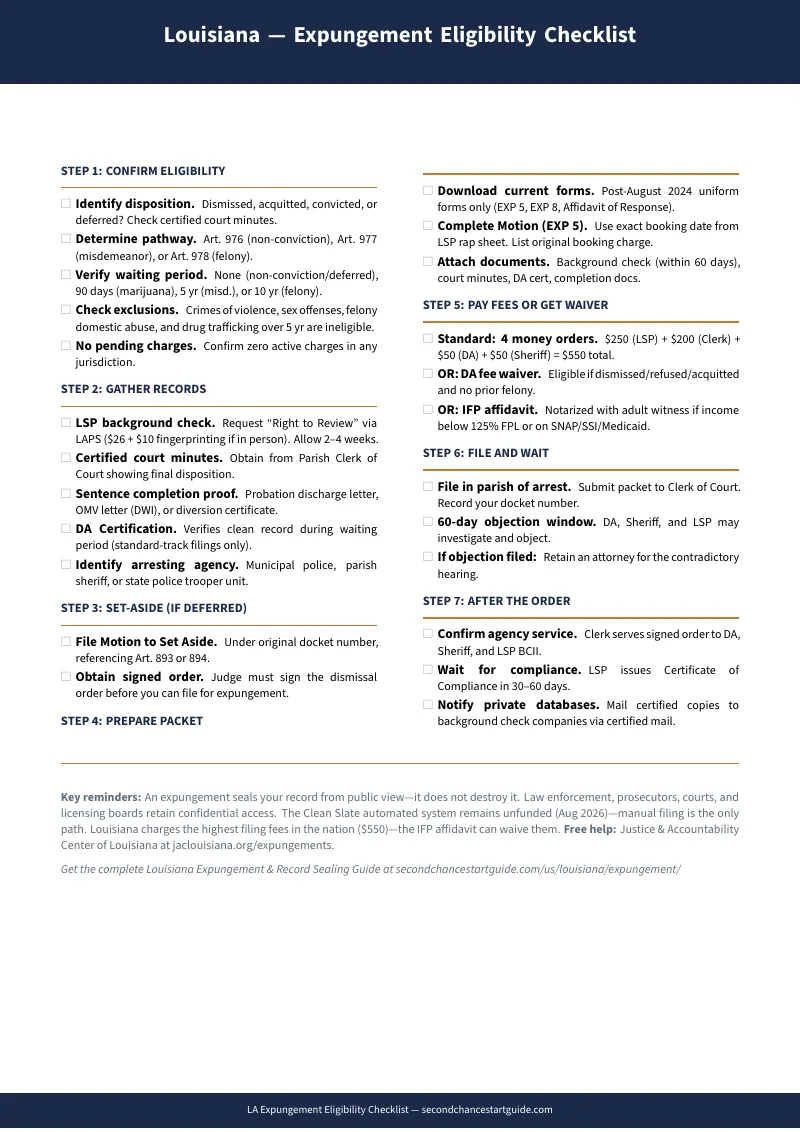
- 20-item filing checklist — included free as a standalone PDF, covering eligibility verification through post-order database enforcement in a printable, track-as-you-go format
Who This Is For
- Anyone in Louisiana whose job offer, apartment application, or professional license is being held up by a background check — whether the case was dismissed, completed, or resolved through probation years ago
- Self-represented filers who want to handle the petition process without paying an attorney $1,500 to $2,500 to fill out the same state-issued uniform forms
- People who completed pretrial diversion but discovered the arrest still shows on their record — and need to understand the separate expungement filing required
- Out-of-state residents with a Louisiana arrest record from a past visit, business trip, or former residency who need to navigate the parish court filing remotely
- Family members helping a loved one navigate the process after sentence completion
Why the Free Resources Fall Short
The Louisiana State Police expungement page lists the forms and their own fee. It does not explain how to determine eligibility, does not mention the other $300 in fees owed to three other agencies, and does not walk you through the filing sequence. Parish clerk websites vary wildly — some provide detailed local instructions, others just list hours and fees. Legal aid organizations like the Justice and Accountability Center do excellent work, but their waitlists are months long and their income thresholds leave most people without assistance.
National document-assembly services charge $199 to $600 and use generic templates that miss Louisiana's multi-agency fee structure, the mandatory 60-day objection window, and parish-level filing variations. They cannot tell you about the 893/894 set-aside requirement, the Act 580 form obsolescence, or the difference between filing in Orleans Criminal District Court (which accepts credit cards in Room 104) and a rural parish clerk that strictly requires postal money orders.
This guide fills the gap between free forms that assume you already understand the process and the attorney retainer that most people cannot justify for what is — in the vast majority of uncontested cases — a manageable self-representation filing.
Satisfaction Guarantee
If this guide does not give you a clear, actionable path to filing your expungement petition, email us and we will refund your purchase — no forms to fill out, no hoops.
Start Clearing Your Record
Download the free 20-item checklist to verify your eligibility and map out your filing steps. When you are ready for the full process — form-by-form preparation instructions, multi-agency fee routing, hearing preparation, and the post-order enforcement plan — get the full guide.