
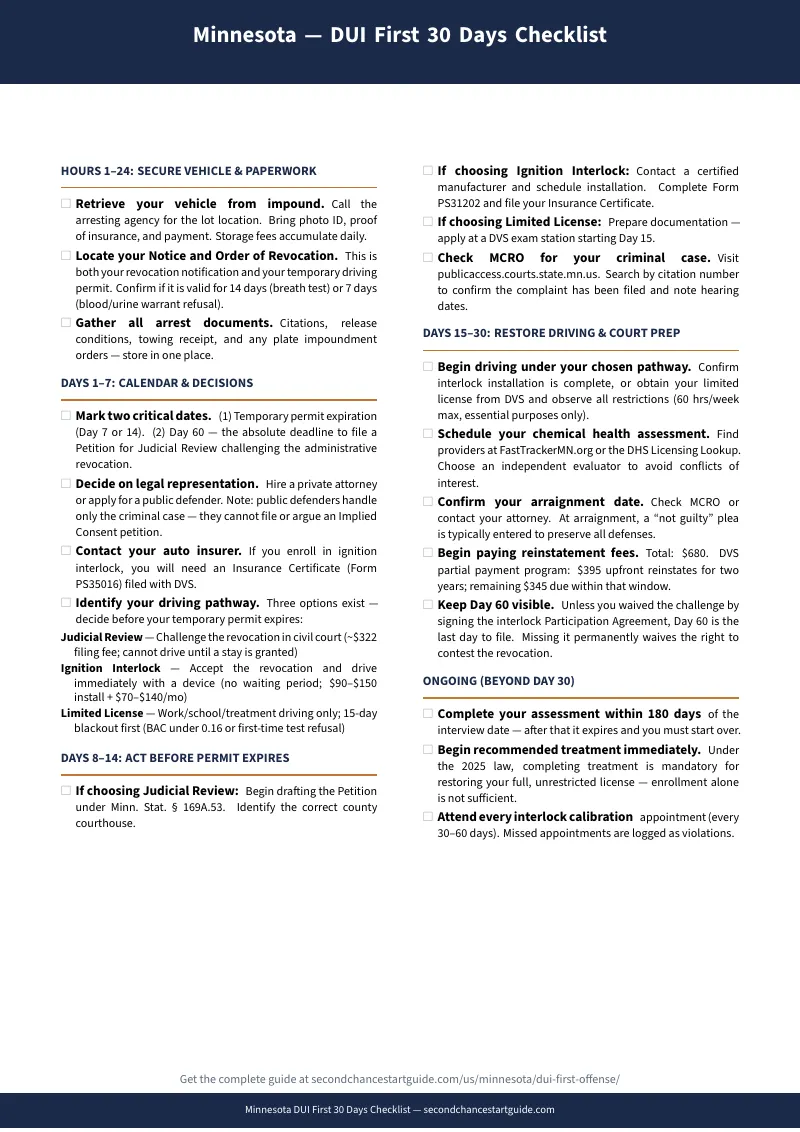
Two clocks started when the officer handed you that Notice. Neither one waits for the other.
A first-offense DWI in Minnesota launches two completely independent legal processes: a civil administrative revocation through the Department of Public Safety that controls whether you can drive, and a criminal prosecution in district court that determines whether you are convicted. Most people don't realize these are separate proceedings with separate deadlines, separate decision-makers, and separate outcomes. Getting the criminal charges dismissed does nothing to undo the administrative revocation. And if you let the 60-day window to challenge that revocation close without acting, it stays on your record permanently — functioning as an enhanceable prior for 20 years under the 2025 HF 2130 reforms.
Free government resources exist, but they're scattered across DVS, the Minnesota Judicial Branch, and the Office of Traffic Safety — none of them explain how the two tracks interact in practice. Attorney blogs explain pieces of the process clearly, then stop at "call us for a free consultation" before telling you what to actually do. Many of them still quote a 30-day judicial review deadline that hasn't been correct in years. National interlock company sites push immediate hardware enrollment while downplaying the limited-license option that costs significantly less for standard first offenders.
The Dual-Track Navigator
This guide maps both legal tracks — administrative and criminal — onto a single day-by-day timeline so you can see exactly what is happening on each clock, when decisions come due, and what to do about them. It is built specifically for Minnesota's system: the 14-day temporary permit, the 60-day judicial review filing window, the choice between a limited license and ignition interlock, the mandatory chemical health assessment, the criminal court sequence from arraignment through sentencing, and the complete reinstatement process — all updated for the HF 2130 reforms that took effect August 1, 2025.
It doesn't replace a lawyer. It makes sure you understand every step whether you hire one or not — and it shows you exactly which situations require professional legal help and which ones you can handle yourself.
What's Inside
- Day-by-day action timeline — from the moment of arrest through full license reinstatement, with every DVS and court deadline mapped to specific calendar days so nothing catches you off guard
- Judicial review filing guide — exactly how to draft and file the Implied Consent petition under Minn. Stat. § 169A.53, including the $322 filing fee, proof of service on the Commissioner of Public Safety, and the correct 60-day deadline that many attorney websites get wrong
- Limited license vs. ignition interlock decision framework — a side-by-side comparison of costs, restrictions, eligibility, and waiting periods so you pick the path that fits your situation, not the one an interlock manufacturer is selling you
- Criminal court walkthrough — what happens at arraignment, how pretrial release conditions work, the omnibus hearing process, and how standard first-offense cases typically resolve
- Chemical health assessment preparation — what the evaluator asks, how the recommendations become binding probation conditions, and how to schedule the assessment so it doesn't delay sentencing or reinstatement
- Complete cost breakdown — every fee itemized: the $680 DVS reinstatement fee, $322 civil filing fee, $75–$250 chemical use assessment, $70–$140/month interlock lease, Form PS35016 insurance certificate, and court fines — with a blank Cost Worksheet to track what you actually pay
- Special situations — CDL holders (one-year federal disqualification), out-of-state licenses (interstate reporting), under-21 zero-tolerance laws, and aggravated first offenses (BAC ≥ 0.16 or test refusal) — with clear guidance on when to stop self-navigating and retain counsel
- HF 2130 reform impact analysis — how the doubled 20-year lookback, extended temporary permit, and installment-payment reinstatement provisions change your specific situation
- 10 printable worksheets — Dual-Track Deadline Calendar, Judicial Review Filing Tracker, Limited License vs Interlock Decision Worksheet, Cost Worksheet, Criminal Court Appearance Log, Chemical Health Assessment Tracker, Ignition Interlock Setup Tracker, Reinstatement Sequence Tracker, Insurance Certificate Tracker, and Limited License Hours Log
Who This Guide Is For
This guide is for anyone in Minnesota who has been arrested for a first-offense DWI and needs to understand the full process — both legal tracks, all the deadlines, and the realistic costs — before making decisions. It is especially useful if you are navigating the administrative track without an attorney, but it is equally valuable alongside legal representation because it covers the logistical and procedural steps that lawyers rarely walk you through in detail.
It is not for people facing a second or subsequent offense (the 20-year lookback changes penalties dramatically), CDL holders facing federal commercial disqualification (consult an attorney immediately), or anyone whose case involves injury, death, or contested facts that require individualized legal strategy.
Why Not Just Use Free Resources?
The DVS website has the forms but buries them in regulatory language across dozens of disconnected pages. Attorney blogs explain the administrative-criminal distinction clearly — then stop at "schedule a free consultation" before telling you what to actually file, where to file it, and what it costs. Many of them still cite a 30-day judicial review deadline that is flatly wrong under current statute — the correct window is 60 days under § 169A.53, subdivision 2(a). National interlock companies list Minnesota's requirements but push immediate enrollment while glossing over the limited-license option, which involves no hardware costs and is available to standard first offenders after a 15-day waiting period.
This guide takes every piece of accurate, current information scattered across those sources and organizes it into a single sequential process — with the deadlines, forms, fees, and decision points in the order you will encounter them.
Download the Free Checklist First
Not sure you need the full guide? Start with the free Minnesota — DUI First 30 Days Checklist — a deadline-first action list covering the critical first month after arrest. It shows you what to do and when. The full guide shows you how, with the context, costs, and decision frameworks behind each step.