Your Nebraska Record Is Blocking You — But Clearing It Means Navigating a System That Doesn't Want to Make It Easy
You already know the background check is the problem. The conditional job offer that went quiet. The apartment application that came back denied. The licensing board that wants "documentation of rehabilitation" you have no idea how to produce. What you may not know is that Nebraska handles record relief differently from almost every other state — and that difference catches people off guard at the worst possible moment.
Nebraska does not expunge adult criminal convictions. Not after five years, not after twenty, not ever. The primary remedy is a judicial set-aside — a court order that nullifies the conviction and restores your civil rights, but leaves the record fully visible on background checks with a notation that it was set aside. For non-conviction records (dismissed charges, acquittals, completed diversions), you can petition for full sealing. And for felony convictions with sentences over one year, the only path runs through the Board of Pardons.
Three different remedies, three different eligibility rules, three different procedures — and no single official source that walks you through all of them in plain language. The court's self-help pages give you the forms but no strategy. Legal aid has income caps that leave most people without help. Private attorneys charge $1,500 to $4,000 for a set-aside petition that you are legally allowed to file yourself.
The Nebraska Record Relief Navigator
This guide is a complete filing system for every record-relief path available in Nebraska — built specifically for people handling the process themselves. It covers the judicial set-aside, non-conviction sealing, and the pardon pathway in the order you will actually encounter them, with the procedural details that official resources leave out.
Instead of leaving you to piece together fragments from court websites, attorney blogs, and outdated legal aid pamphlets, the Navigator consolidates everything into a single reference that follows your case from records request to signed court order — including the differences between county and district court procedures that trip up even experienced self-represented filers.
What's Inside
- The Remedy Finder — a decision framework that maps your specific record type (conviction, dismissal, acquittal, diversion, pardon) to the exact statutory remedy available, so you never waste filing fees pursuing the wrong path
- Records acquisition walkthrough — how to get your Nebraska State Patrol RAP sheet and run a JUSTICE court database search, including the critical difference between a public record (which hides sealed cases) and the complete criminal history you actually need for your petition
- Set-aside petition builder — step-by-step instructions for completing Form CC 6:11 and the proposed Order CC 6:11.2, filing in the original sentencing court, calculating your filing fee ($87 county / $144 district), and serving the prosecuting attorney — with the county-vs-district scheduling differences that no form explains
- Hearing preparation guide — what the judge is looking for when you testify under oath, what evidence of rehabilitation actually moves the needle, and the one argument (re-trying your innocence) that will get your petition denied on the spot
- Non-conviction sealing instructions — the automatic-vs-manual sealing rules, the December 31, 2016 cutoff date, and how to file Form CC 6:12 for older dismissed cases that were not automatically sealed
- Board of Pardons roadmap — eligibility windows (10 years for felonies, 3 years for misdemeanors), the application package requirements, reference letter guidance, and what to expect at the Capitol hearing
- Post-order action plan — what to do after the judge signs, how long digital records take to update, how to get a certified copy for employers, and exactly what employers and landlords will see on background checks after each type of relief
- Fee waiver instructions — when and how to file the In Forma Pauperis affidavit (Form DC 6:7.1), including what it covers and what third-party costs you will still owe
- Complete forms directory and statute reference — every official form, its source, and the statute it implements, so you never file an outdated template that gets rejected at the clerk's window
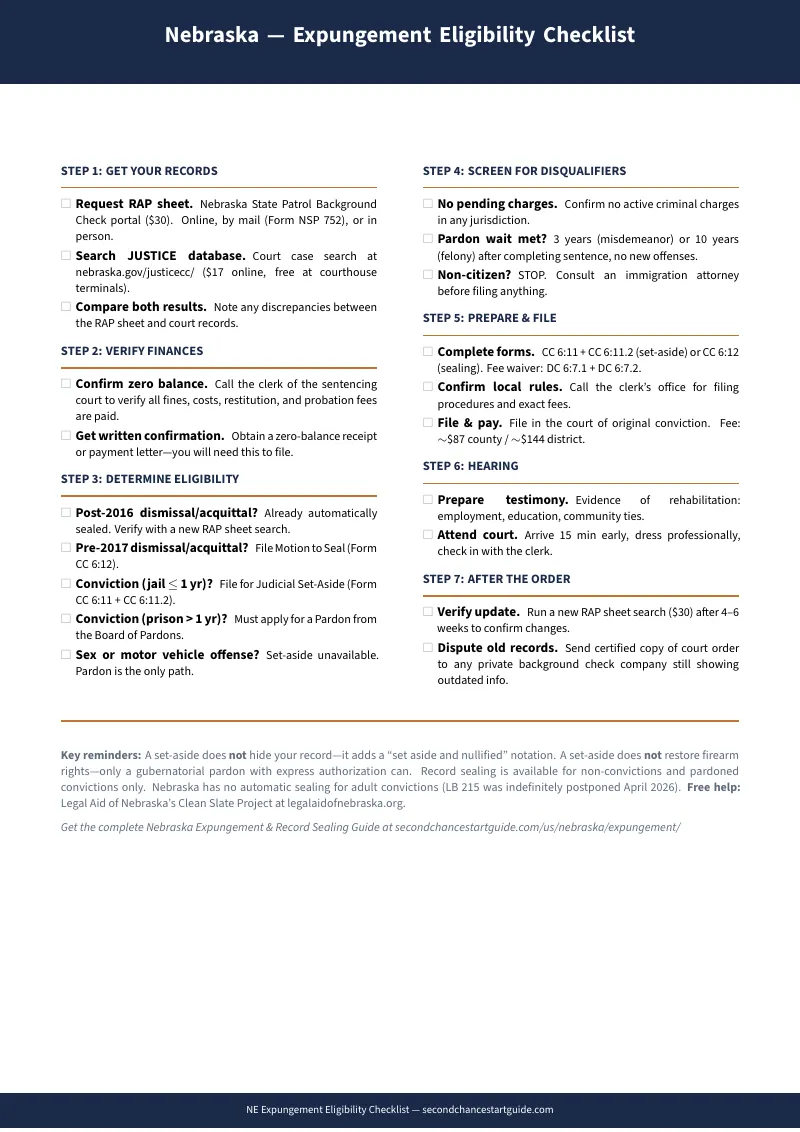
- 20-item filing checklist — included free as a standalone PDF lead magnet, covering eligibility verification through final record update in a printable, track-as-you-go format
Who This Is For
- Anyone in Nebraska whose job offer, apartment application, or professional license is being held up by a background check
- People who completed their sentence years ago and want to understand exactly what relief is available — and what is not
- Self-represented filers who want to handle the petition process without paying $1,500+ for an attorney
- Anyone who has already looked at the court's self-help page and left more confused about the difference between a set-aside, sealing, and a pardon
- Family members helping a loved one navigate the process
Why the Free Resources Are Not Enough
Nebraska's court self-help pages give you the forms and a brief description of each remedy. What they do not give you is the context that determines whether your filing succeeds or fails: which remedy applies to your specific situation, how to prepare testimony that demonstrates rehabilitation rather than re-argues innocence, the difference between county court scheduling (automatic) and district court scheduling (you contact the bailiff), or what to do when the clerk rejects your paperwork for a procedural deficiency the forms never mentioned.
Legal Aid of Nebraska runs an excellent Clean Slate program — but it has strict income eligibility limits. The University of Nebraska College of Law's Clean Slate Project offers clinic-based help, but availability is limited by semester schedules and student capacity. National document-assembly services charge $199 to $600 and routinely miss Nebraska's unique set-aside requirements and local court rules.
This guide fills the gap between the free forms that assume you already understand the process and the $1,500+ attorney retainer that most people cannot justify for what is, procedurally, a manageable self-representation case.
Satisfaction Guarantee
If this guide does not give you a clear, actionable path to filing your record-relief petition, email us and we will refund your purchase — no forms to fill out, no hoops.
Start Clearing Your Record
Download the free 20-item checklist to verify your eligibility and map out your filing steps. When you are ready for the full process — forms guidance, hearing preparation, post-order instructions, and the complete statute reference — get the full Nebraska Expungement & Record Sealing Guide.