Two separate government systems activated the moment you were arrested. Neither one is waiting for the other.
A first-offense DUI in Nevada triggers a civil administrative license revocation at the DMV and a criminal misdemeanor prosecution in justice or municipal court — running on independent timelines, with different standards of proof and different decision-makers. Winning the criminal case does not lift the DMV revocation. Losing the DMV hearing does not settle the criminal charge. If you manage only one track and neglect the other, you can end up acquitted in court and still unable to drive for 185 days.
Free government pages scatter the forms and statutes across dozens of .gov domains in regulatory language. Attorney blogs walk you through the dual-track distinction clearly — then stop at "schedule a free consultation" before explaining what you can actually do yourself. Interlock vendors quote attractive daily lease rates and bury the installation fees, monthly calibration charges, and lockout penalties. And none of these sources address the new SB 309 threshold that lowered the mandatory clinical evaluation trigger to 0.16% BAC, which changes the sentencing requirements for a substantial number of first offenders.
The Dual-Track Process Map
This guide maps both legal tracks — the DMV administrative revocation and the criminal court case — onto a single day-by-day timeline. It covers Nevada's specific system: the temporary permit rules, the hearing request process, the Restriction Y ignition interlock license, the SR-22 filing, mandatory DUI school and the Victim Impact Panel, the SB 309 clinical evaluation and treatment requirements, and the complete reinstatement sequence from first day to unrestricted license.
It does not replace a lawyer. It makes sure you understand every step whether you hire one or not — and it identifies exactly which situations you can navigate yourself and which require professional legal help.
What's Inside
- Day-by-day dual-track timeline — from the moment of arrest through full license reinstatement, with every DMV and court deadline mapped so you never confuse which track a deadline belongs to
- DMV hearing walkthrough — how to submit your hearing request, what the Office of Administrative Hearings process looks like, what the ALJ evaluates, and what happens if you win or lose
- Criminal court guide — arraignment through sentencing, including what a "not guilty" plea preserves, how plea negotiations typically unfold for first offenders, and the community service alternative to jail
- Breath vs. blood test pathways — the separate timelines and trigger points for breath tests, blood draws, and refusals, so you know exactly when your administrative clock starts
- Ignition interlock and Restriction Y — the full installation process, certified vendor selection, compliance rules that prevent costly extensions, the 0.02% lockout threshold, monthly costs, and the rural hardship exception under NRS 484C.460
- SR-22 and insurance impact — what the three-year SR-22 filing actually requires, how to avoid a lapse that triggers vehicle registration penalties, and realistic insurance cost projections
- SB 309 compliance — the lowered 0.16% BAC threshold for mandatory clinical evaluation, the $100 cap on evaluation fees, and the court-ordered treatment requirements that took effect October 2025
- Complete cost breakdown with worked examples — every fee itemized across both tracks: court fines, DUI school, Victim Impact Panel, clinical evaluation, DMV reinstatement and victim compensation fees, interlock lease, and SR-22 insurance, with two scenario walkthroughs so you can estimate your total
- Reinstatement sequence — the exact order of steps, documents, and agency visits needed to go from a revoked license to a fully unrestricted one
- Edge cases — CDL holders, out-of-state licenses, the under-21 zero-tolerance standard, accident cases, and test refusals with their separate penalty structure
- 6 printable planning worksheets — case timeline tracker, DMV hearing preparation checklist, agency communication log, cost tracker, compliance completion checklist, and key contacts reference card, all as separate standalone PDFs you can print and fill in
Who This Guide Is For
This guide is for anyone in Nevada who has been arrested for a first-offense DUI and needs to understand both legal tracks — all the deadlines, compliance requirements, and realistic costs — before making decisions. It is useful whether you are navigating this without an attorney or alongside legal representation, because it covers the administrative and logistical steps that lawyers rarely walk you through.
It is not for people facing a second or subsequent offense (enhanced penalties and mandatory confinement apply), CDL holders facing a federal commercial disqualification (consult an attorney), or anyone whose case involves a fatality, serious injury, or contested forensic evidence requiring expert analysis.
Why Not Just Use Free Resources?
The Nevada DMV website has the forms and statutes, but the information is spread across multiple pages written in regulatory language that assumes you already know the process. Attorney blogs explain the dual-track system clearly — then pivot to $2,500–$5,000 retainer pitches before explaining what you can handle yourself. National interlock companies advertise competitive daily rates while hiding mandatory calibration fees, lockout charges, and installation costs that add up over a 185-day minimum.
The scattered nature of this information creates real risk. Drivers who don't understand the separate administrative track let the temporary permit expire without requesting a hearing. Drivers who underwent blood testing assume they're safe because they kept their plastic license — then get blindsided by a mailed Order of Revocation weeks later. Drivers who win their criminal case assume the license issue is resolved — and discover the DMV revocation stands. Each of these misunderstandings costs driving privileges, and each one is avoidable with a clear map of both tracks.
Download the Free Checklist First
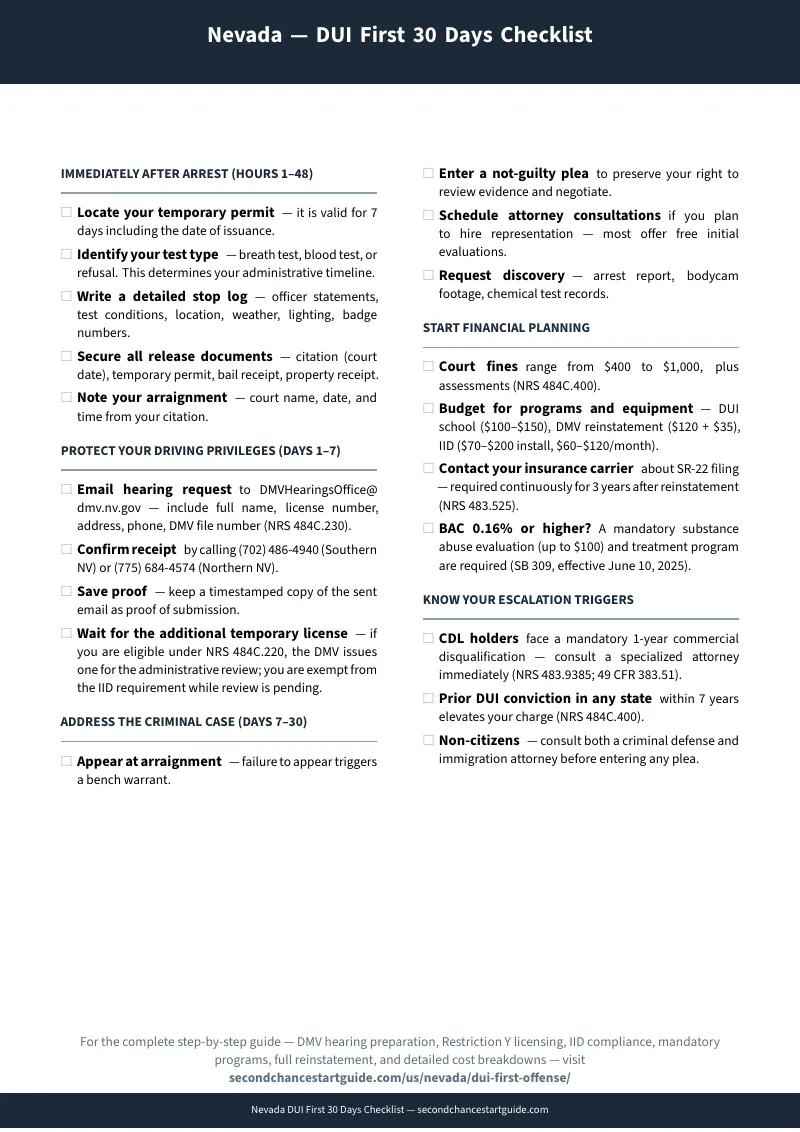
Not sure you need the full guide? Start with the free Nevada — DUI First 30 Days Checklist — a deadline-first action list covering the critical first month after arrest. It tells you what to do and when. The full guide tells you how, with the legal context, decision frameworks, cost projections, and planning tools behind every step.
Get the Full Nevada DUI Guide →
Frequently Asked Questions
What if the rules change after I buy?
We update the guide when the rules change. Email us any time, even years later, and we'll send you the current edition free.