Your old record is costing you offers you've already earned
You passed the interview. You found the apartment. You started the license application. Then a background check pulled up something from years ago — and now you're watching the opportunity disappear while you try to figure out whether Ohio even lets you do anything about it.
Ohio does. Senate Bill 288 and subsequent amendments expanded who qualifies for sealing and expungement. But the rules are specific: which offenses count, how to calculate waiting periods from final discharge, which county form packet to use, how to serve the prosecutor, what to say at the hearing. Miss one step and your petition is denied — or worse, you file for something you were never eligible for and lose the non-refundable $50 fee.
The Ohio Record-Relief Filing System
This is not a stack of blank forms. It's the full filing process — from "Am I eligible?" through "My background check is clean" — in one guide. Every step references the specific Ohio statute, and every county procedure names the actual court, the actual fee, and the actual service rule.
The Ohio Record-Relief Filing System brings together filing procedures for Franklin, Cuyahoga, Hamilton, and Montgomery counties, the updated SB 288 eligibility matrix, and the post-order background-check cleanup process in a single document that follows the order you'll actually do things. Free court websites give you blank forms. Attorneys charge $1,000 to $2,000 for work you can handle yourself if someone shows you how. This guide sits in between — structured enough to file confidently, affordable enough that it doesn't defeat the purpose of doing it pro se.
What's Inside
- The SB 288 Eligibility Matrix — not a vague "check if you qualify" paragraph, but the full decision tree: offense level, number of convictions, waiting period from final discharge, and permanent exclusions. You'll know in fifteen minutes whether your record qualifies and when you can file.
- Waiting-Period Calculator — helps identify your date of final discharge based on the sanctions imposed and how the court ended them, then counts forward to your earliest filing date. The guide explains the same-indictment counting rules so you know exactly how multiple charges from one arrest affect your eligibility.
- County Filing Walkthroughs — step-by-step procedures for Franklin, Cuyahoga, Hamilton, and Montgomery counties. Which form packet to use, where to file it, how to pay the fee, and whether you serve the prosecutor or the clerk does it for you.
- Fee Waiver Instructions — the $50 conviction filing fee and optional local fee can both be waived with a poverty affidavit. The guide walks through completing the affidavit for courts that accept it, so cost doesn't stop an eligible filing.
- Hearing Preparation — the judge must weigh your rehabilitation against the state's interest in keeping the record public. The guide explains the statutory balancing test, the common questions judges ask, and how to present evidence of rehabilitation: employment records, counseling completion, education, community involvement.
- Non-Conviction Relief — dismissed charges, not-guilty findings, and grand jury no bills each have their own rules. The guide covers local fee rules, the statute-of-limitations condition for dismissals without prejudice, and the two-year wait for no bills, or longer when R.C. 2953.61 applies.
- Background Check Cleanup — a signed court order binds the state, but private screening companies (HireRight, Sterling, Checkr) maintain their own databases and will keep reporting sealed records until you formally dispute them under the FCRA. The guide includes the dispute process and the reinvestigation timeline.
- Professional Licensing Limits — some boards retain statutory access to sealed records through BCI. The guide explains which boards can still see your record and when a Certificate of Qualification for Employment or other alternative remedy makes more sense than sealing alone.
- Alternative Remedies — CQE, Certificate of Achievement and Employability, Governor's pardon, and the separate process for firearm-rights relief under R.C. 2923.14. If sealing isn't the right path, you'll know what is.
Who This Is For
- You received a conditional job offer and your background check flagged an old case — you need to know whether you can seal it and how fast
- Your rental application was denied because of a historical charge, and you need the record restricted before your current lease expires
- A licensing board asked about your criminal history and you want to understand what sealing does and doesn't hide from regulators
- You were told years ago that you had "too many" charges — the law has since expanded, and you want to check eligibility under the current rules
- Your case was dismissed but the arrest still shows up on background checks, and you want to file a non-conviction application under your local court's fee rules
Why Not Just Use the Free Court Forms?
Ohio's Supreme Court publishes blank forms. County clerks hand out filing packets. But a blank form does not tell you:
- Whether your waiting period has actually passed — most people miscalculate because they count from sentencing instead of from the date of final discharge
- Which county packet to use when you have cases in both municipal and common pleas courts
- Whether the clerk will serve the prosecutor for you or you must deliver copies yourself
- How to argue rehabilitation at the hearing, where the judge applies a statutory balancing test that tips on the evidence you bring
- How to clear your record from private background-check databases after the court issues the sealing order — the step most people skip entirely, and the reason sealed records keep showing up on employer screens
The forms are the easy part. The process around them is where people lose time, money, and opportunities.
Satisfaction Guarantee
If the guide doesn't deliver what you expected, email [email protected] for a full refund, no time limit. We read every message.
Start Clearing Your Record
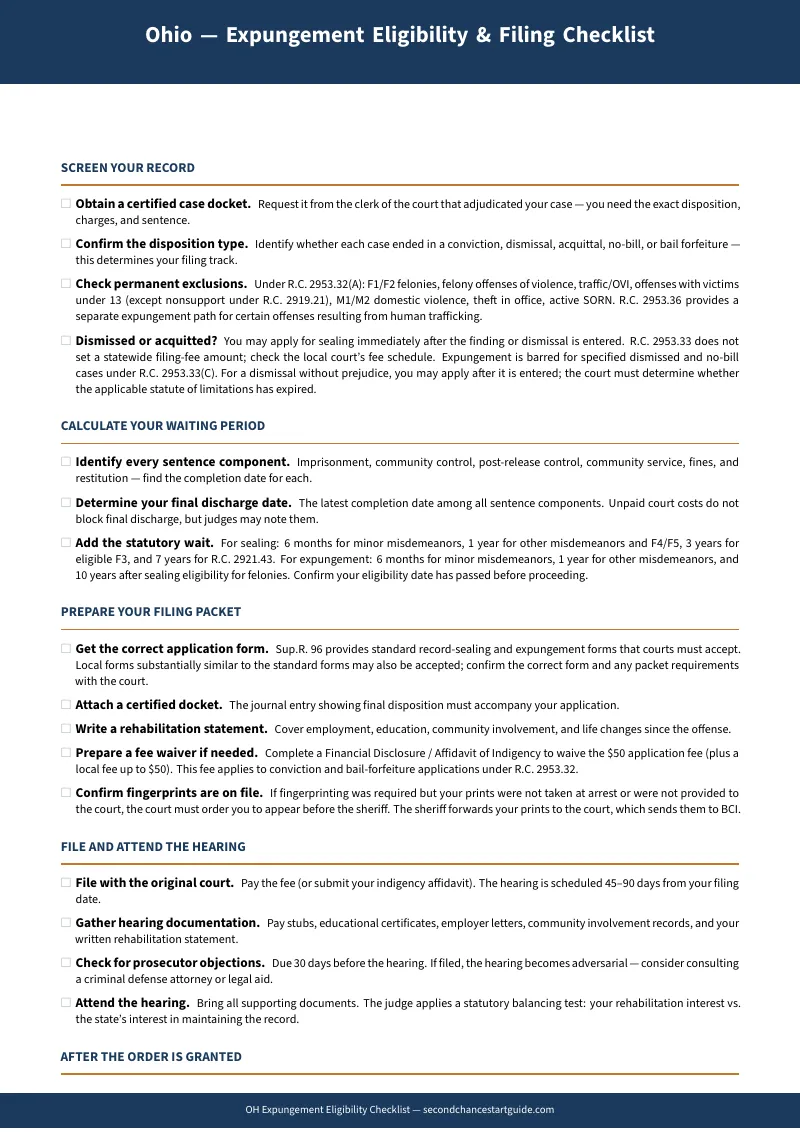
Download the free Ohio Expungement Eligibility Checklist to confirm your eligibility in ten minutes. Ready for the full filing system? Get the Ohio Expungement & Record Sealing Guide for — the complete process from eligibility through background-check cleanup.
Frequently Asked Questions
What if the rules change after I buy?
We update the guide when the rules change. Email us any time, even years later, and we'll send you the current edition free.