
You have ten days to protect your license. The clock started at the arrest.
A first-offense DUII in Oregon launches two legal tracks simultaneously — a civil administrative license suspension managed by the DMV and a criminal Class A misdemeanor prosecution in circuit court. These are separate proceedings with separate decision-makers, separate evidence standards, and separate deadlines. Completing the court's diversion program and getting the criminal charge dismissed does not lift the DMV suspension. Missing the 10-day window to request a DMV hearing forfeits your right to challenge the suspension entirely — and the automatic suspension starts on Day 30.
Free government resources scatter this information across dozens of DMV and OJD pages written in regulatory language. Attorney blogs explain the dual-track distinction clearly — then stop at "call for a free consultation" before telling you what to actually do. National interlock company sites quote low daily lease rates while burying the installation fees, calibration charges, and $75 lockout penalties in the fine print. None of them mention the SNAP-based interlock fee waiver that could save you over $1,000.
The Dual-Track Process Map
This guide maps both legal tracks — the DMV administrative suspension and the criminal court case — onto a single day-by-day timeline so you can see exactly what's happening, when, and what to do about it. It's built specifically for Oregon's DUII system: the 10-day implied consent hearing deadline, the 30-day temporary permit, the diversion program under ORS 813.200, the hardship permit application process, the ignition interlock requirements, and the full license reinstatement sequence.
It doesn't replace a lawyer. It makes sure you understand every step whether you hire one or not — and it shows you exactly which situations require professional help and which ones you can navigate yourself.
What's Inside
- Day-by-day action timeline — from the moment of arrest through full license reinstatement, with every DMV and court deadline mapped to specific calendar days so nothing blindsides you
- 10-day DMV hearing guide — exactly how to submit your implied consent hearing request through the DMV2U portal, by fax, or by mail, with a worked deadline calculation example so you count the days correctly
- Criminal court walkthrough — what happens at arraignment, how the diversion petition works, what conditions apply during the 12-month abeyance, and how cases typically resolve for first-time offenders
- Diversion eligibility checklist — the statutory disqualifiers under ORS 813.215 spelled out plainly, including CDL status, prior diversions within 15 years, injury accidents, and pending charges in any jurisdiction
- Hardship permit and IID walkthrough — the complete application process, SR-22 filing, approved interlock vendors, compliance rules that prevent costly extensions, and the SNAP fee waiver program that covers all installation, leasing, calibration, and removal costs for eligible drivers
- Complete cost breakdown — every fee itemized: $490 diversion filing, $150 alcohol evaluation, treatment costs, Victim Impact Panel, hardship permit application, reinstatement, towing and impound, interlock monthly lease, and SR-22 insurance — with two worked examples showing diversion-track and conviction-track totals
- Test refusal consequences — the separate penalty structure for breath, blood, and urine test refusals, including consecutive suspensions and extended hardship wait periods that most free resources get wrong
- Special situations — CDL holders, out-of-state licenses, collision cases, and the under-21 zero-tolerance standard, with clear guidance on when to stop self-navigating and get professional legal help
- 7 printable planning tools — a first-30-days timeline tracker, diversion compliance log, cost tracker worksheet, agency communication log, hardship permit application planner, diversion eligibility screening, and a key contacts reference card — all designed to print and fill in as you move through the process
Who This Guide Is For
This guide is for anyone in Oregon who has been arrested for a first-offense DUII and needs to understand the full process — both legal tracks, all the deadlines, and the realistic costs — before making decisions. It's especially useful if you're navigating this without an attorney, but it's equally valuable alongside legal representation because it covers the administrative and logistical steps that lawyers rarely walk you through.
It is not for people facing a second or subsequent offense (different mandatory minimums and enhanced penalties apply), CDL holders facing a federal commercial disqualification (consult an attorney), or anyone whose case involves a fatal accident or contested facts requiring expert legal analysis.
Why Not Just Use Free Resources?
The Oregon DMV website has the forms and the statutes, but the information is scattered across dozens of pages in regulatory language that assumes you already know the process. Attorney blogs explain the dual-track system clearly — then pivot to $2,500–$5,000 retainer pitches before explaining what you can do yourself. National interlock companies like Intoxalock advertise low daily lease rates while hiding mandatory calibration fees, lockout charges, and installation costs that add up to more than $1,000 over a 12-month period.
None of these sources mention Oregon's Indigent Ignition Interlock Device Program under OAR 257-100-0075. If you receive SNAP benefits, you qualify for a full waiver of all interlock costs — installation, monthly lease, calibration, and removal — through approved vendors like LifeSafer. Drivers who don't know about this program often fall out of compliance when they can't afford the lease payments, triggering lockouts, extension penalties, and a $75 reset fee. This guide covers the waiver application process step by step.
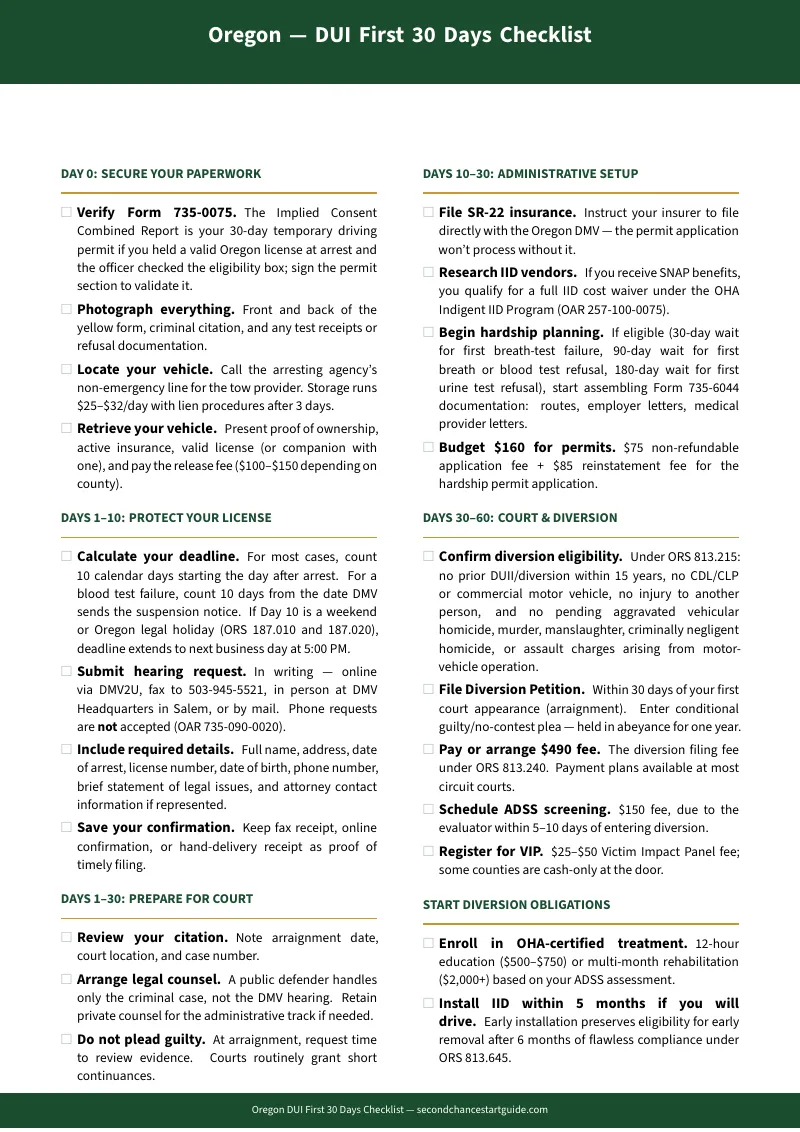
Download the Free Checklist First
Not sure you need the full guide? Start with the free Oregon — DUI First 30 Days Checklist — a deadline-first action list covering the critical first month after arrest. It shows you what to do and when. The full guide shows you how, with the context, costs, and decision frameworks behind each step.