Your record is not the problem. The process is.
You already know something on your background check is holding you back. The job offer stalls. The apartment application gets "lost." The licensing board sends a letter asking for more information. What you don't know is exactly which path to take — because Pennsylvania doesn't have one record-clearing process. It has three.
Expungement removes eligible criminal history record information, subject to statutory exceptions. Clean Slate seals eligible records automatically — sometimes. Petition-based limited access restricts dissemination by court order. Each path has different eligibility rules, waiting periods, forms, and outcomes. File the wrong one and you've spent non-refundable court fees on a remedy you never qualified for.
The Pennsylvania Expungement & Record Sealing Guide is a Record-Relief Filing Map — a single document that lays out every path, tells you which one fits your situation, and walks you through the paperwork from your first background check request to the moment you verify that commercial databases have updated.
What the Filing Map covers
- Three-path eligibility decision tree — classify every charge on your record (non-conviction, summary, misdemeanor, qualifying felony) and match it to expungement, automatic sealing, or petition-based limited access under current law, including Clean Slate 3.0 changes that shortened waiting periods and expanded felony eligibility
- Official PSP record request — ordering the current Pennsylvania State Police criminal history report required for petitions unless the attorney for the Commonwealth waives it, using Form SP 4-170 and the correct payment method; without a waiver, the judge may not rule until the report is filed
- Petition assembly — completing the AOPC templates (Rule 490, 790, or 791) so the OTN, statutory citation, and disposition on your petition match your docket exactly, then preparing the number of copies your county requires
- County filing and DA service — where to file, which fees to bring (they vary by county), and how to properly serve the District Attorney's office so the response window starts running (60 days under Rule 790; 30 days under Rules 490 and 791)
- Clean Slate audit — checking whether your eligible cases were actually sealed by the automated system, and what to do when the PSP computer misses a qualifying record
- Act 53 licensing shield — applying the five-year rule for directly related offenses and using the preliminary determination process so a licensing board evaluates your record under current protections
- FCRA dispute process — disputing inaccurate, incomplete, or unverifiable information in commercial background-check files under the Fair Credit Reporting Act
- Mixed-case docket strategy — handling the common situation where some charges on a single docket were dismissed while others resulted in convictions, requiring two separate filings under two different rules
- Attorney trigger list — the specific situations where the complexity or the stakes make professional help worth the cost, including contested hearings, immigration exposure, and multi-state records
Who this is for
You earn too much for free legal aid and too little to pay a private firm over a thousand dollars per docket. You can fill out forms and mail paperwork. You need someone to tell you which form, which court, which fee, and which order — without the legal jargon or the upsell to a retainer.
If you are facing a pending criminal charge, need a defense strategy, or have a case involving immigration consequences, this guide is not a substitute for an attorney. It says so clearly, and it tells you exactly when to pick up the phone.
Why not just use the free court forms?
The forms are free. The instructions are not. The AOPC templates are blank fields with legal citations — they don't tell you that your certified check needs to be payable to the "Commonwealth of Pennsylvania," not the county, or that a petition carries a $132 statutory fee in addition to any other authorized fees; Allegheny County lists $232 for a petition for expungement. They don't explain that conviction-based limited access requires payment of all court-ordered restitution and the authorized fee, or that a mixed-case docket requires two separate petitions filed under two different rules.
Free legal aid clinics — Community Legal Services, LASP, Philadelphia Lawyers for Social Equity — do excellent work, but they are income-restricted and geographically limited. If you live outside their service area or earn above 200% of the federal poverty level, they cannot represent you.
The guide fills the gap between free-but-unguided court forms and $1,200 attorney fees. It costs less than a single filing fee in most counties.
Satisfaction guarantee
If the guide does not help, email [email protected] for a full refund, no time limit. We read every message.
Start with the free checklist or get the full guide
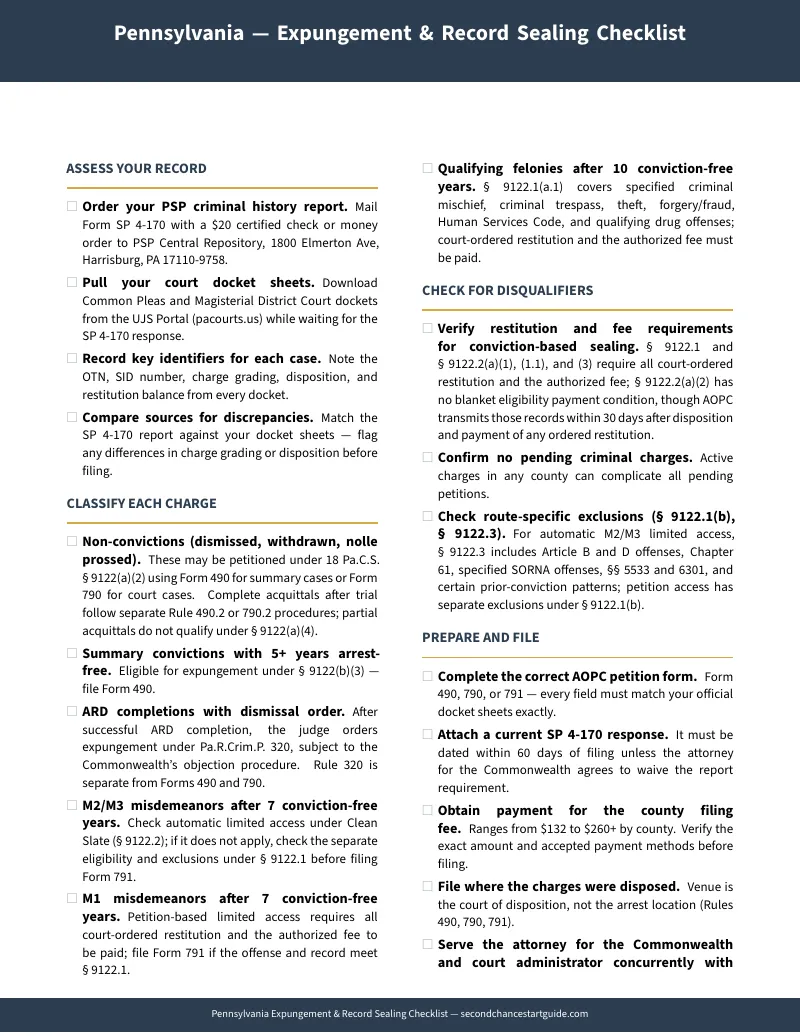
The free checklist gives you a one-page eligibility and filing overview — enough to understand which path applies to your situation. The full guide gives you the complete filing map: every step, every form, every fee, every verification procedure, from your first PSP request to your last FCRA dispute letter.
Download the free checklist to see where you stand, or get the full Pennsylvania Expungement & Record Sealing Guide and start clearing your record today.
Frequently Asked Questions
How long does the whole process take?
It depends on which path applies. Non-conviction expungements and completed ARD cases can be filed immediately — from filing day, the petition typically takes several months to process through the court and all state agencies. Automatic Clean Slate sealing depends on when the PSP system runs its next sweep for your case. Petition-based sealing has statutory waiting periods — seven years for qualifying misdemeanors, ten for qualifying felonies — and then the petition process itself. The guide maps realistic timelines for each path.
What if the District Attorney objects to my petition?
The DA has a response window after you file: 60 days under Rule 790 and 30 days under Rules 490 and 791. If they consent, the petition goes to a judge. If they object, the judge may grant or deny the petition or schedule a hearing; an objection does not automatically require a hearing. The guide covers what to expect in both scenarios and identifies this as one of the situations where hiring an attorney is worth considering.
Does sealing help with professional licensing?
Under § 9124(b)(2), licensing boards may not use convictions subject to limited access under §§ 9122.1 and 9122.2 when considering a license application. For other reportable convictions, Act 53 requires a conviction-specific review. After five years, an offense on the applicable schedule is no longer considered directly related, though the board may still assess risk under 49 Pa. Code § 43b.404. The preliminary determination application lets you check whether a conviction appears on the board's directly related schedule before investing in training.
What about federal background checks and immigration?
State-level record relief does not bind federal agencies. Military enlistment, federal security clearances, and immigration proceedings operate under their own disclosure rules. The guide explains these boundaries and identifies immigration exposure as a mandatory attorney-consultation situation.
I have cases in multiple counties. Do I need to file in each one?
Yes. Each petition must be filed in the judicial district where the charges were disposed. Filing fees, payment methods, and local procedures vary between counties. The guide covers the county-level differences you need to know.
Frequently Asked Questions
What if the rules change after I buy?
We update the guide when the rules change. Email us any time, even years later, and we'll send you the current edition free.