Your Record Ended Years Ago. The Databases Haven't Caught Up.
You finished probation, paid the fines, stayed out of trouble. The case closed. But the background check company that the HR department or the property manager uses does not know that. It sees an open conviction on a court docket it scraped three years ago — or a WSP WATCH report that still lists a charge the court already vacated. A conditional job offer goes sideways. A rental application comes back denied. A nursing program says "disqualified pending review." The case is over in the eyes of the law. It is not over in the eyes of the databases that actually control access to employment, housing, and licensing in Washington.
Washington does not have a general Clean Slate law. For Blake-eligible cases, some participating courts use the AOC's Blake Administrative Vacate Unit to identify and process eligible cases without requiring individuals to file their own motions. In other cases, if you want a conviction vacated, a court file sealed, or an arrest deleted from WSP databases, you make the applicable motion or request yourself — in the right court, with the right form, meeting the right waiting period, and then follow up to make sure the databases actually updated.
The Three-Track System: One Guide That Covers All of Washington's Record Relief Pathways
Washington does not call it "expungement." It splits record relief into three separate legal processes — vacating a conviction, sealing a court file, and deleting non-conviction arrest data — each governed by different statutes, different courts, and different agencies. Most people searching for record clearing do not realize that vacating a conviction (which reverses the guilty plea and lets you legally deny the conviction) is a completely separate process from sealing a court file under GR 15 (which restricts public access to the physical and digital file but does not change the conviction's legal status). And neither of those touches the WSP arrest database, which requires its own administrative request.
The Washington Expungement & Record Sealing Guide is a Three-Track Filing System that maps every entry on your Washington record to the specific pathway, statute, court, and form that clears it — then walks you through every step from pulling your WATCH report to verifying state-record updates and disputing inaccurate or unverifiable commercial screening reports.
What's Inside
- Vacating Convictions — Felony and Misdemeanor Filing Sequences — the complete motion-to-vacate process under RCW 9.94A.640 (felonies) and RCW 9.96.060 (misdemeanors), including the New Hope Act eligibility rules, waiting period calculations from sentencing or release dates, the specific exclusions (DUI, sex offenses, most violent felonies, and the statutory exceptions for certain Assault 2, Robbery 2, and Assault 3 convictions), how to identify which court has jurisdiction, and the step-by-step filing and service-of-process instructions.
- Court Record Sealing Under GR 15 — the separate judicial process for restricting public access to a court file, including the five-part Ishikawa analysis courts apply when considering whether to seal a criminal record, the constitutional standard that prevents courts from sealing a file simply because a conviction was vacated, and an honest assessment of when sealing is realistically achievable.
- WSP Non-Conviction Arrest Deletion — the administrative process under RCW 10.97.060 for removing non-conviction arrest records from WSP databases, including waiting periods and circumstances in which the agency may refuse deletion: deferred prosecution or similar diversion, a prior felony or gross misdemeanor conviction, or an arrest or charge for another crime during the intervening period. The guide also explains the distinction between clearing the WSP database and clearing the court docket.
- Blake-Impact Vacatur and Refund Guide — the court process for vacating an eligible simple drug-possession conviction invalidated by State v. Blake, including ex-parte practices some counties have used. Some participating courts also process eligible cases through AOC's Blake Administrative Vacate Unit without individual motions. Apply for paid court LFO refunds through the Blake Refund Bureau; DOC separately reviews and refunds eligible Cost of Supervision fees. The guide covers child-support garnishment rules that can apply to refunds.
- Legal Financial Obligation Strategy — how outstanding court fines and costs interact with your eligibility, the Certificate of Discharge requirement for felonies under RCW 9.94A.637, and the indigency petition process under RCW 10.01.160(4) for getting non-restitution costs remitted or waived.
- Fair Chance Act Employment Protections — the expanded Washington Fair Chance Act protections, which apply to employers with 15 or more employees beginning July 1, 2026, and employers with fewer than 15 employees beginning January 1, 2027. Before a covered employer takes tangible adverse action based solely on an adult conviction, it must have a legitimate business reason, identify the record, and give at least two business days to respond.
- Background Check Dispute Letter — a ready-to-send letter for commercial screening companies under the federal FCRA and Washington's RCW 19.182, plus the Background Check Dispute Log for documenting transmittal, tracking the 30-day reinvestigation deadline (15-day extension if you send more information), and escalating when a company fails to correct outdated records.
- Deferred Sentence and Diversion Decoder — the critical distinction between a deferred sentence (which remains a conviction under State v. Haggard and must be separately vacated) and a true pretrial diversion like a Stipulated Order of Continuance (which produces no conviction record but leaves the court docket visible). Knowing which one you have determines whether you need a vacate motion, a sealing petition, or neither.
- Printable worksheets — Case Inventory Worksheet, Eligibility Self-Assessment, Filing Timeline Tracker, LFO Balance and Waiver Worksheet, Hearing Preparation Checklist, and Agency Communication Log, each a 1–2 page form you print and write on.
Who This Guide Was Built For
You got a conditional job offer, and the employer just flagged something on your background check. If a covered employer is considering tangible adverse action based solely on an adult conviction, it must have a legitimate business reason, identify the record, and give you at least two business days to respond. You need to know immediately whether your conviction can be vacated, whether it already was and the screening company is reporting stale data, or whether you need to file a dispute. The guide walks you through the verification and response sequence for that compressed timeline.
Your rental application was denied and the rejection letter mentions a criminal history. Automated tenant screening algorithms pull from commercial databases that often display dismissed cases, vacated convictions, and decade-old docket entries as though they are current and active. You need to identify what the screening company reported, determine which database it came from, and either demonstrate that the record was already cleared or start the process to clear it. The guide covers both paths.
You have a professional licensing review and an old conviction on your record. Healthcare, education, and financial services boards in Washington run their own background checks that bypass Fair Chance Act protections. You need to know whether your conviction can be vacated before the review, whether the board can still access a vacated record, and what disclosure obligations remain. The guide maps the boundary between vacated records and licensing board mandates.
You have multiple entries on your record and you do not know which pathway applies to each one. Some are convictions, some are dismissed. One might be a Blake-eligible drug possession. Another might be a deferred sentence that you thought was dismissed but is legally still a conviction. The Three-Track Filing System maps each entry to the correct pathway — vacate motion, WSP deletion request, or sealing petition — so you are not guessing which process to start.
Why Not Just Use Free Resources?
The statutes are public. The court forms are downloadable. What does not exist in any free resource is a single document that maps every entry on your Washington record to the correct pathway, tells you in what order to pursue them, and then walks you through the post-order process for making sure the clearance actually reaches the databases that employers, landlords, and licensing boards check.
Washington LawHelp and the Northwest Justice Project provide accurate legal analysis and free self-help packets — but the resources are fragmented across dozens of pages, they do not cover the commercial background check dispute process, and CLEAR callers may need to try multiple times and wait on hold for up to 30 minutes. If you need legal help during the Fair Chance Act's minimum two-business-day response period before a covered employer takes tangible adverse action based solely on an adult conviction, that timing can be tight.
The Washington State Patrol processes background checks and provides a form for non-conviction record deletion — but WSP says that process does not affect local court records and directs case-specific court questions to the court of jurisdiction. It handles one piece; you coordinate the rest.
Private defense attorneys charge $1,000 to $1,500 for a straightforward vacate motion. Their websites are designed to capture phone consultations, not to walk you through the steps you can handle yourself. For an uncontested misdemeanor vacate motion where you meet all eligibility requirements, you are paying for access, not complexity.
The guide costs — once. It covers all three pathways, the forms, the filing sequences, the post-order verification process, the printable worksheets, and the Background Check Dispute Letter for disputing inaccurate or unverifiable screening reports after a court order.
Trust Signals
Current as of 2026. This guide reflects the Fair Chance Act expansion phasing in from July 1, 2026 for employers with 15 or more employees and January 1, 2027 for smaller employers, the current New Hope Act eligibility framework, and the ongoing Blake refund process — not the pre-2019 rules or the outdated "expungement" terminology that dominates most online resources.
Process navigation, not legal advice. This guide maps the administrative steps, forms, and dispute procedures you can handle independently. It identifies the specific situations — contested hearings, GR 15 sealing petitions, firearm rights restoration, federal records, immigration consequences — where professional counsel is genuinely necessary, and it lists the major legal aid referral resources in Washington.
Instant download. No subscription. No recurring charges. One purchase — the 45-page guide, the two-page eligibility checklist, and eight printable tools (worksheets, logs, and the Background Check Dispute Letter) — with lifetime access to the version you purchase. Full refund, no time limit, if it is not what you need.
The Cost of Getting It Wrong
File in the wrong court and you start over — a motion to vacate must be filed in the exact court that entered the original sentence. Assume a deferred sentence was dismissed when it is legally still a conviction, and the screening company reports it accurately while you told the employer it did not exist — now the problem is your credibility, not your record. Skip the WSP verification step after a vacate order and your WATCH report still shows the conviction months later. There is no FCRA deadline for you to file a dispute, but once you do, the screening company generally has 30 days to reinvestigate, with a possible 15-day extension if you provide relevant information.
Private attorneys charge $1,000 to $1,500 for a single vacate motion. National record-clearing services charge $1,150 to $1,450. One wrong assumption — about which court, which form, which waiting period, or which process even applies to your situation — costs months and can cost an offer.
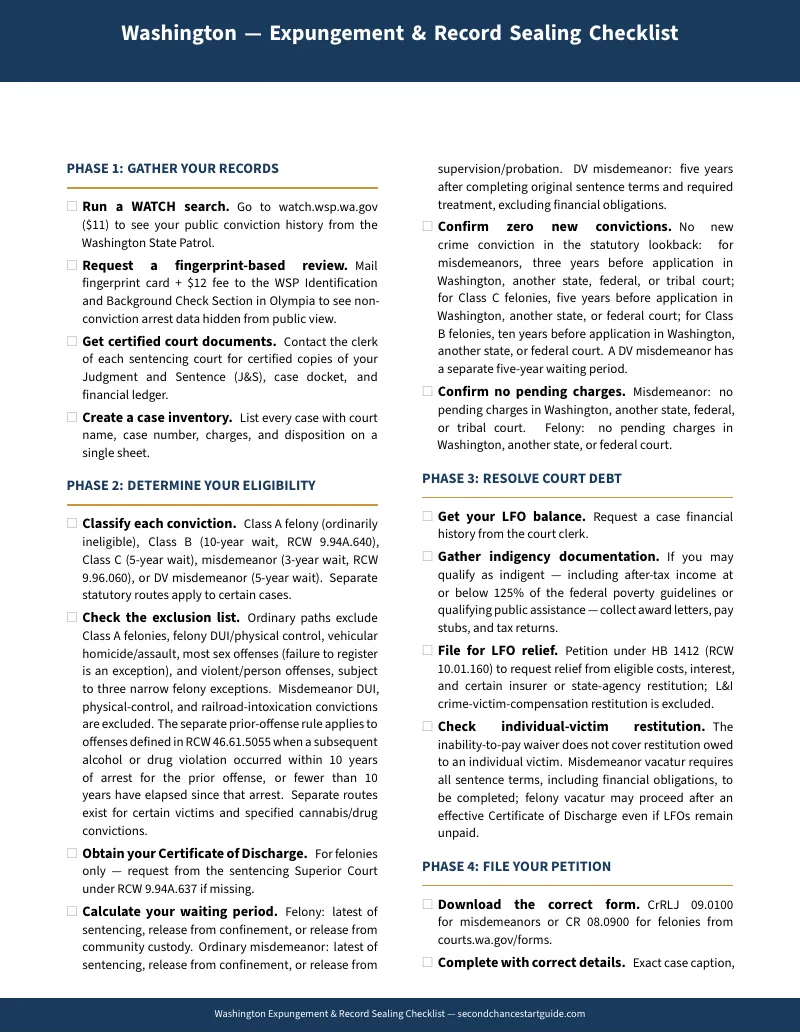
Not ready for the full guide? Download the free Washington — Expungement Eligibility Checklist — a diagnostic covering the statutory eligibility criteria for vacating, sealing, and WSP deletion. It tells you which pathway applies to your situation and whether you meet the basic requirements.
Your record is either eligible for relief or it is not. The guide tells you which, maps the filing sequence, and walks you through the filing, verification, and dispute steps.
Frequently Asked Questions
What if the rules change after I buy?
We update the guide when the rules change. Email us any time, even years later, and we'll send you the current edition free.