Two separate tracks started when you were arrested. The one most people ignore has the tightest deadline.
A first-offense OUI in Maine launches two completely independent legal proceedings: a civil administrative license suspension through the Bureau of Motor Vehicles, and a criminal prosecution in district court. These are not phases of the same case — they have different decision-makers, different evidence standards, and different outcomes. An acquittal in criminal court does not undo your BMV suspension. A successful BMV hearing does not stop the prosecutor from pursuing conviction. Most people focus entirely on the court date written on their summons and miss the administrative deadline that controls whether they can drive for the next five months.
The BMV mails a Notice of Suspension to your last address on file. From the effective date printed on that notice, you have exactly 10 days to request a hearing in writing. If you submitted to the chemical test, filing that request automatically stays your suspension — you keep driving until the hearing is decided. Miss it by one day and the suspension takes effect with no appeal. If you refused the test, you can still request a hearing, but no stay is available and you cannot drive while it is pending. This 10-day window is the single most consequential deadline in the entire process, and it arrives by mail while most people are still trying to understand the difference between the green bail sheet and the court summons.
The Dual-Track Blueprint
This guide maps both legal tracks — administrative and criminal — onto a single day-by-day timeline so you can see exactly what is happening on each clock, when decisions come due, and what to do about them. It is built specifically for Maine's system: the 10-day BMV hearing window, the stay mechanics for chemical test cases, the three distinct license restoration pathways (ignition interlock, work-restricted, and standard restricted), the DEEP program requirements, the criminal court sequence from arraignment through the dispositional conference, and the complete reinstatement process through SR-22 filing.
It does not replace a lawyer. It makes sure you understand every step whether you hire one or not — and it shows you exactly which situations require professional legal help and which ones you can handle yourself.
What's Inside
- Day-by-day action timeline — from the moment of arrest through full license reinstatement, with every BMV and court deadline mapped to specific calendar days so nothing catches you off guard
- BMV hearing request guide — exactly how to draft the written hearing request under 29-A M.R.S.A. § 2483, what information to include, where to submit it, and how the automatic stay works for test-takers — plus what to prepare for the hearing itself, whose scope is limited strictly to probable cause and BAC levels
- Ignition interlock vs. work-restricted license decision framework — a side-by-side comparison that includes the hidden trap most people discover too late: time spent on a work-restricted license during the administrative suspension does not count toward any subsequent court-imposed suspension, potentially doubling your total suspension period. The interlock counts concurrently against both.
- Criminal court walkthrough — what happens at arraignment, how to request the prosecution's discovery package, the mandatory dispositional conference, and how standard first-offense cases can be negotiated to a Driving to Endanger reduction
- DEEP program preparation — the 20-hour Adult Risk Reduction course structure, what triggers a clinical evaluation referral, how to prepare for the session that requires a "significant other," and how to avoid delays that push back your reinstatement date
- Complete cost breakdown — every fee itemized: the $500 mandatory fine plus surcharges, the $300 DEEP course, the $50 BMV reinstatement fee, ignition interlock installation and monthly costs, and typical insurance premium increases — with a blank Cost Worksheet to track what you actually pay. Maine does not require an SR-22 for a standard first-offense OUI
- Special situations — chemical test refusal consequences (275-day suspension, mandatory jail, consecutive sentencing), CDL holders (one-year federal disqualification), out-of-state licenses, passengers under 21, high BAC aggravators, and immigration considerations — with clear guidance on when to stop self-navigating and retain counsel
- 10 printable worksheets — Dual-Track Deadline Calendar, BMV Hearing Request Tracker, Interlock vs Work-Restricted Worksheet, Criminal Court Appearance Log, DEEP Enrollment Worksheet, Cost Worksheet, Ignition Interlock Setup Tracker, Work-Restricted Hours Log, Reinstatement Sequence Tracker, and Attorney Referral Worksheet
Who This Guide Is For
This guide is for anyone in Maine who has been arrested for a first-offense OUI and needs to understand the full process — both legal tracks, all the deadlines, and the realistic costs — before making decisions. It is especially useful if you are navigating the administrative track without an attorney, but it is equally valuable alongside legal representation because it covers the logistical and procedural steps that lawyers rarely walk you through in detail.
It is not for people facing a second or subsequent offense within the 10-year lookback window, CDL holders facing federal commercial disqualification (consult an attorney immediately), or anyone whose case involves an accident with injury, property damage, or contested facts that require individualized legal strategy. If you refused the chemical test, the guide covers the administrative consequences thoroughly, but strongly recommends retaining counsel for both the criminal and administrative proceedings.
Why Not Just Use Free Resources?
The Maine BMV website has the rules but scatters them across disconnected pages in dry statutory language — you can read about OUI suspensions without ever seeing the work-restricted license concurrent-sentencing trap that could double your time off the road. Attorney blogs explain the dual-track system clearly, then stop at "contact us for a free consultation" before telling you what to actually file, where to file it, and what it costs. Many of them don't mention the 10-day hearing deadline at all — they assume you'll hire counsel before it expires. National interlock companies list Maine's requirements but push immediate hardware enrollment while glossing over the eligibility requirements and cost structure of the alternatives.
This guide takes every piece of accurate, current information scattered across those sources and organizes it into a single sequential process — with the deadlines, forms, fees, and decision points in the order you will encounter them.
Download the Free Checklist First
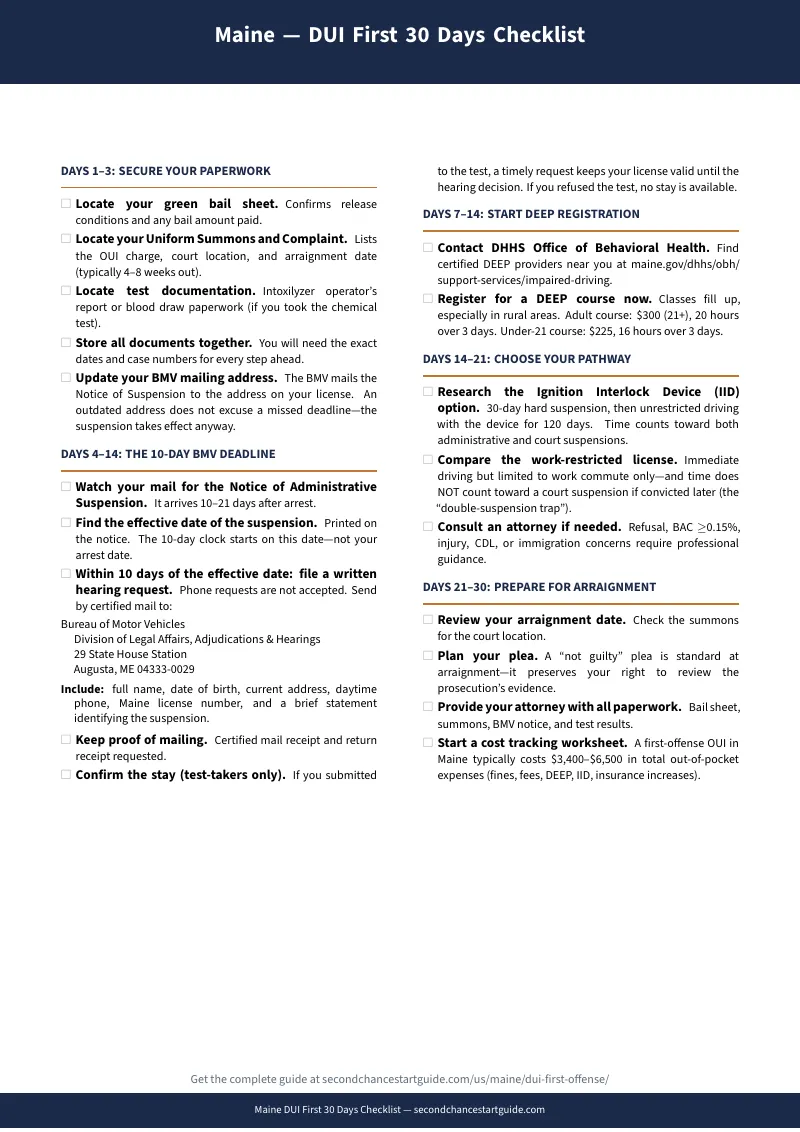
Not sure you need the full guide? Start with the free Maine — DUI First 30 Days Checklist — a deadline-first action list covering the critical first month after arrest, including the 10-day BMV hearing window. It shows you what to do and when. The full guide shows you how, with the context, costs, and decision frameworks behind each step.