Your License Is Suspended. The State Isn't Going to Walk You Through Getting It Back.
You already know what a suspended license costs you — the rides you have to beg for, the job you can't get to, the constant low-grade dread every time you pass a patrol car. What you might not know is that getting your license back in Idaho isn't one problem. It's a stack of them, and the state treats each one as a separate transaction with its own agency, its own forms, its own fees, and its own deadlines.
Pay them out of order and you can void a restricted permit you just applied for. Miss a seven-day appeal window and a suspension that could have been challenged becomes permanent. Assume your court case closing means you can drive again — and get arrested for Driving Without Privileges, which adds another 180-day suspension to the pile.
The Idaho Transportation Department's website will tell you what fees exist. It won't tell you which of your specific holds to clear first, how to coordinate a child support repayment plan with an SR-22 filing, or what to do when an out-of-state block shows up on your record that you didn't know about.
The Hold-by-Hold Reinstatement System
The Idaho Driver's License Reinstatement Guide is a diagnosis-and-resolution system built around one principle: identify every hold on your record, then clear them in the exact sequence that doesn't trigger new problems.
It starts with pulling your official driver license record from ITD and classifying every active suspension — administrative, criminal, financial, medical, or interstate. Then it walks you through resolving each one with the specific forms, fees, payment channels, and verification steps for that hold type. No guessing which agency to call. No discovering a hidden block after you've already paid reinstatement fees somewhere else.
What's Inside
- DUI dual-track walkthrough — the civil ALS suspension and the criminal conviction suspension run independently, with different fees, different timelines, and different forms. The guide maps both tracks so you don't clear one and forget the other.
- Restricted driving permit instructions — which suspension types qualify for an RDP, whether to apply through ITD or your county magistrate court, and the exact forms (ITD 3227 + employer verification ITD 3208) you need to file.
- HB 791 court-debt timeline — Idaho is reinstating license suspensions for unpaid moving infractions starting January 2027. The guide covers the new law's triggers, the implementation timeline, and the steps to resolve delinquent court debt before it hits your record.
- Child support hold resolution — how to negotiate a repayment agreement with Idaho Health and Welfare, what triggers the 180-day stay, and the fee schedule for clearing the ITD block.
- SR-22 filing coordination — how to direct your insurer to file proof of financial responsibility through Idaho's Insurance Verification System, and the three-year maintenance requirement that most drivers don't learn about until a lapse reactivates their suspension.
- Out-of-state and NDR clearance — when an Idaho hold blocks your license in another state (or vice versa), the guide explains how the Driver License Compact works and how to obtain an official ITD clearance letter.
- Fee schedule and forms registry — every reinstatement fee by hold type ($25 points, $75 insurance, $100 child support, $245 ALS, $285 DUI conviction), every required ITD form number, and the payment channels that accept each one.
- Clean Slate Act intersection — shielding a misdemeanor conviction doesn't restore your license. The guide explains what record shielding does and doesn't do for active driving holds.
- Six printable worksheets and trackers — a hold inventory worksheet, fee calculation worksheet, ALS hearing deadline tracker, SR-22 compliance log, court debt resolution tracker, and agency communication log. Print them, fill them in as you work through each step, and bring them to your ITD appointment.
Who It's For
- You were arrested for DUI and you're trying to figure out whether the court case or the ITD suspension is the one you need to deal with first (it's both — they're separate tracks)
- You owe unpaid traffic fines and you're not sure whether the new law means your license is about to be suspended again
- Child Support Services sent a suspension notice and you need to understand your options before the hold goes through
- You moved to Idaho or moved away from Idaho and a hold you didn't know about is blocking your license in your current state
- You need to drive to work or treatment and you want to know whether a restricted permit is available for your suspension type
- Your suspension ended but your ITD status still shows "suspended" and you need to complete the administrative steps the state doesn't volunteer
Why Not Just Use the ITD Website?
The ITD website is good at one thing: processing individual transactions. You can pay a specific fee, check your status, or download a specific form. What it doesn't do is tell you which transactions to complete in which order when you have multiple holds stacked on your record.
It won't warn you that paying your court-debt reinstatement fee before obtaining a court clearance receipt means the ITD can't match the payment. It won't explain that an SR-22 filed before your insurer registers your policy in the Insurance Verification System gets rejected silently. It won't mention that your restricted driving permit application needs an employer verification form that the main RDP page doesn't link to.
The guide isn't a replacement for the ITD website — you'll still use the portal to pay fees and check your status. It's the sequencing layer that sits between you and the state's fragmented system, making sure each step lands in the right order.
Satisfaction Guarantee
If the guide doesn't help you understand your reinstatement path, email us and we'll refund your purchase. No forms to fill out, no hold music, no hoops.
Get Started
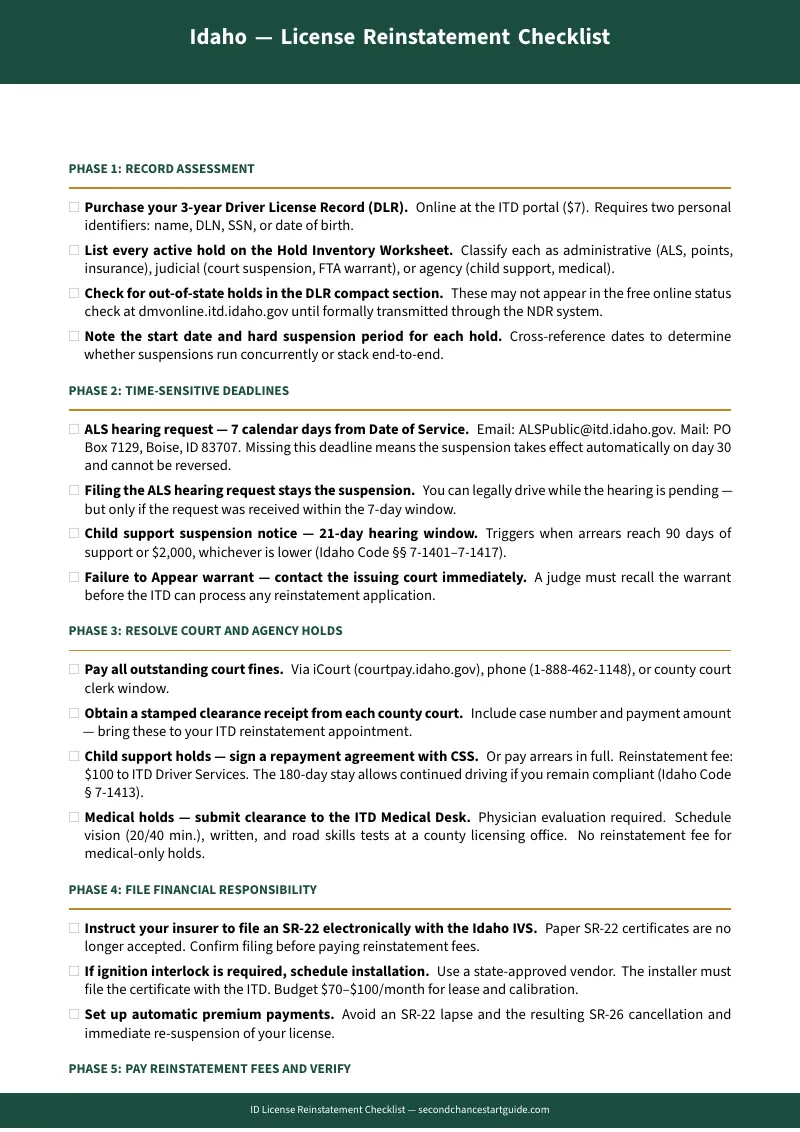
Download the free checklist to see the full task list at a glance. When you're ready for the chapter-by-chapter walkthroughs, the form-by-form instructions, and the sequencing logic that keeps one clearance from canceling another — the full guide is waiting for .